

| FCC Maximum SAR Limit (US) | 1.6 W/kg averaged over 1 gram of tissue (Federal Communications Commission) |
| Typical 5G Sub-6 GHz Speeds | 100-400 Mbps (varies by carrier and location) (General industry estimates) |
| Common IP Rating for Flagship Phones | IP68 (dust-tight; water-resistant up to ~1.5 m for 30 min) (IEC 60529 Standard) |
| Mainstream Display Refresh Rates | 60 Hz (standard), 90 Hz, 120 Hz (high-refresh) (General industry standard) |
| eSIM Adoption | Supported by all major US carriers as of 2023 (Carrier published specifications) |
Why Phone Specs Feel Like a Foreign Language
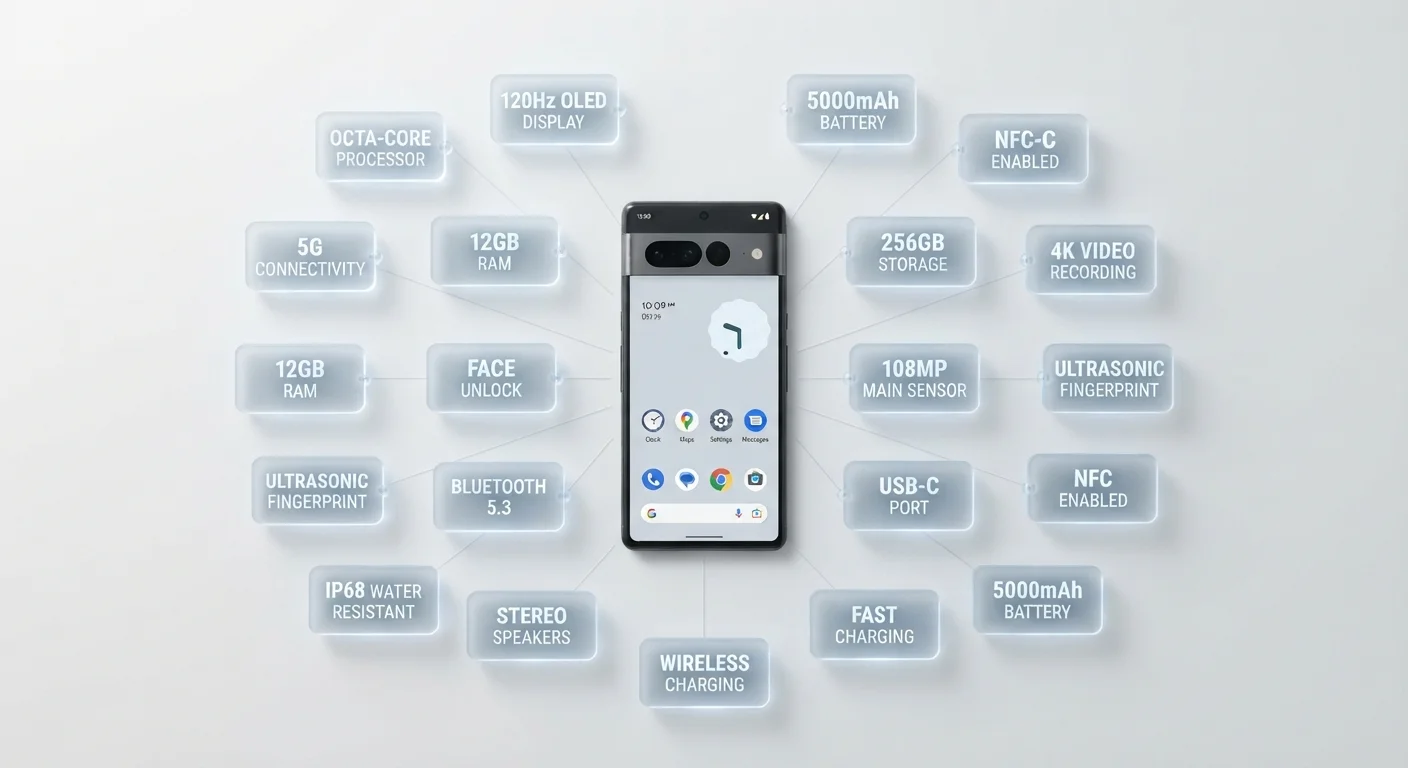
Shopping for or researching a cell phone means navigating a wall of acronyms - 5G, eSIM, IP68, SoC, OLED, mmWave. Manufacturers and carriers use this terminology as shorthand, but without context, the terms tell you very little about whether a device will actually suit your needs.
This reference explains the most commonly encountered phone terms in plain English. Whether you are comparing your first smartphone or helping a family member understand an upgrade, these definitions give you a foundation for making sense of spec sheets and marketing language. If you are just starting out, our no-jargon smartphone starting point is a helpful companion to this glossary.
| FCC Maximum SAR Limit (US) | 1.6 W/kg averaged over 1 gram of tissue (Federal Communications Commission) |
| Typical 5G Sub-6 GHz Speeds | 100-400 Mbps (varies by carrier and location) (General industry estimates) |
| Common IP Rating for Flagship Phones | IP68 (dust-tight; water-resistant up to ~1.5 m for 30 min) (IEC 60529 Standard) |
| Mainstream Display Refresh Rates | 60 Hz (standard), 90 Hz, 120 Hz (high-refresh) (General industry standard) |
| eSIM Adoption | Supported by all major US carriers as of 2023 (Carrier published specifications) |
Connectivity Terms: Networks, SIMs, and Bands
Connectivity specs describe how your phone communicates with cellular networks and other devices. These are among the most misunderstood - and most marketed - terms in the industry.
5G Bands: Why Your Phone's Coverage May Vary
Not all 5G is the same. A phone advertised as "5G capable" may support only sub-6 GHz bands, only mmWave, or both - and coverage depends entirely on which bands your carrier has deployed in your area. Checking a phone's supported band list against your carrier's network map gives you a clearer picture than the 5G label alone. For a deeper look at what 5G technology actually means in practice, see What 5G Actually Is - and What It Isn't.
eSIM vs. physical SIM: A physical SIM is a small removable card you insert into a tray. An eSIM is soldered into the phone and activated digitally. Many current phones support both simultaneously, letting you maintain two separate phone numbers or plans on one device - useful for separating work and personal lines, or using a local data plan while traveling.
Carrier locking is worth checking before you buy or transfer a device. A locked phone will not work with another carrier's SIM until the original carrier unlocks it, typically after a set period or upon request. An unlocked phone works with any carrier that supports its hardware bands.
For a related look at how scammers can exploit SMS and phone calls, see our article on phishing, smishing, and vishing.
Display and Performance Terms
Display and processor specs directly affect how a phone feels to use every day - and they are frequently cited with little explanation.
OLED vs. LCD: OLED (Organic Light-Emitting Diode) screens produce their own light at the pixel level, enabling true blacks and high contrast. LCD (Liquid Crystal Display) screens use a backlight. For a detailed breakdown of how these technologies differ, our screen technology explainer covers the topic thoroughly in the context of consumer displays.
Refresh rate affects perceived smoothness: a 120 Hz display redraws the image twice as often as a 60 Hz display. The practical benefit is most noticeable when scrolling through text or playing games. Higher refresh rates can also consume more battery, though many phones manage this by adjusting the rate dynamically based on what is on screen.
SoC (System on a Chip) is the engine inside your phone. It determines processing speed, how well the camera processes images, battery efficiency, and whether a phone can handle demanding tasks. Understanding which generation of SoC a phone uses is often more informative than individual spec numbers in isolation.
5G
The fifth generation of cellular wireless technology, designed to deliver faster data speeds, lower latency, and greater network capacity than 4G LTE. Coverage and real-world speeds vary significantly by carrier and location.
eSIM
An embedded SIM card built directly into a device's hardware rather than a removable physical card. It lets you activate or switch carriers digitally without handling a physical SIM tray.
Refresh Rate
How many times per second a display redraws its image, measured in hertz (Hz). A 120 Hz screen redraws 120 times per second, making scrolling and animations appear noticeably smoother than a 60 Hz display.
SAR Rating
Specific Absorption Rate - a measurement of how much radiofrequency energy a device can expose human tissue to, expressed in watts per kilogram (W/kg). The FCC sets a maximum SAR limit for phones sold in the United States.
LTE
Long-Term Evolution - the standard often marketed as 4G. It remains the baseline mobile data network across most of the United States, reliable for streaming, browsing, and calls where 5G is not yet available.
RAM
Random Access Memory - the short-term working memory inside a phone. More RAM allows the device to keep more apps active simultaneously without slowing down or reloading them.
IP Rating
Ingress Protection rating - a standardized code indicating how well a device resists dust and water. For example, IP68 means the phone is rated for dust-tight sealing and submersion in water up to a specified depth and time.
Carrier Locking
A software restriction that limits a phone to working only on the carrier that sold it. Unlocked phones work with any compatible carrier's SIM, giving you flexibility to switch providers.
Codec (Audio)
A compression format that determines how audio data is transmitted over a Bluetooth connection. Common codecs include SBC, AAC, aptX, and LDAC - higher-quality codecs can improve wireless audio fidelity when both the phone and headphones support them.
millimeter Wave (mmWave)
A high-frequency 5G band capable of extremely fast speeds but with limited range and poor building penetration. It is primarily available in dense urban areas near dedicated infrastructure.
Sub-6 GHz 5G
A lower-frequency 5G band with broader range and better building penetration than mmWave, though with more modest speed improvements over LTE. Most 5G coverage across the United States uses sub-6 GHz frequencies.
SoC (System on a Chip)
A single integrated circuit that combines a phone's processor (CPU), graphics processor (GPU), modem, and other core components. The SoC largely determines a phone's performance, efficiency, and capability.
Safety, Durability, and Other Commonly Seen Terms
IP ratings provide standardized water and dust resistance information. The two digits each mean something: the first indicates dust protection (6 is the highest - fully sealed), the second indicates water resistance (8 means withstands submersion under defined test conditions). Note that IP ratings are based on laboratory testing; real-world damage from liquids may not be covered under standard warranties.
SAR ratings measure radiofrequency energy absorption and are required to be disclosed for all phones sold in the United States. All FCC-compliant phones must fall below 1.6 W/kg. For a thorough look at what current research says about RF exposure and where scientific debate continues, see our article on cell phone radiation and established science.
For terms you will encounter when connecting devices to a home network or TV setup, our home tech glossary covers setup-specific vocabulary in the same plain-language format. Camera-specific terms like megapixels and aperture are explained in our camera glossary.
1.6 W/kg
US FCC SAR limit for mobile phones
All phones sold legally in the United States must meet this radiofrequency exposure limit set by the Federal Communications Commission.
120 Hz
High-refresh display standard for modern flagships
Many mid-range and premium phones now include 120 Hz displays, a threshold that was reserved for high-end devices just a few years ago.
This article is for general informational and educational purposes only. Technology specifications, carrier policies, and regulatory standards can change; verify current details with your carrier, device manufacturer, or the FCC before making decisions.