

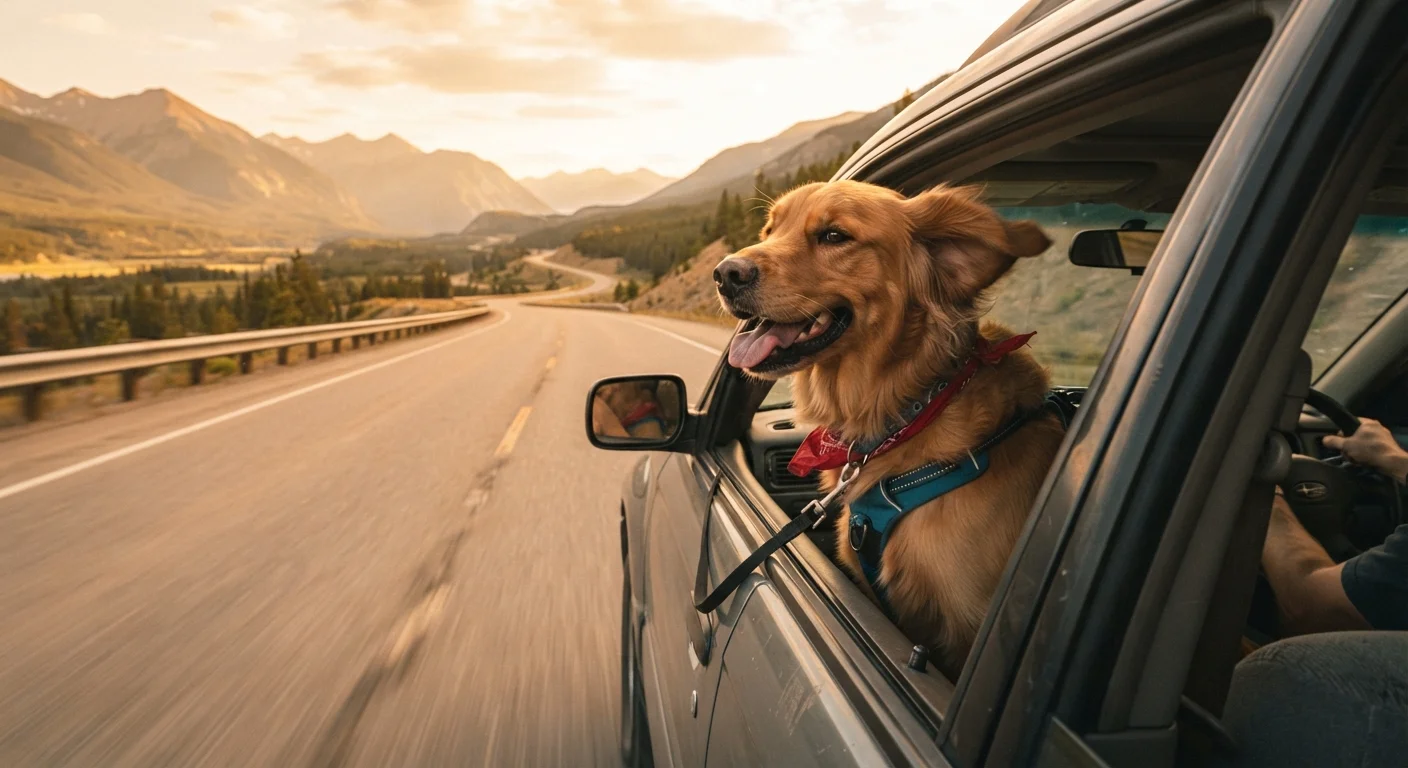
Key Takeaways
- Road trips give you more control over your pet's comfort, schedule, and stress levels.
- Flying is faster but comes with strict airline rules, size limits, and real welfare risks - especially for cargo travel.
- Your pet's temperament, health, and size often matter more than your own travel preferences.
- Both options require advance planning; neither is automatically easier or safer.
- Some pets - due to age, breed, or health - may do better staying home than traveling at all.
Option A
Road Trip
The flexible, pet-paced option.
Best for: Pet owners with anxious or large animals, multi-day trips, or destinations reachable within a day or two of driving.
Option B
Flying with Your Pet
The fast but highly structured choice.
Best for: Small pets traveling in-cabin on short-to-medium flights where speed outweighs the added logistical complexity.
If your pet is large or doesn't fit in an airline-approved carrier
Road Trip
Most airlines don't allow large dogs in the cabin, and cargo travel carries documented welfare and safety risks that many owners reasonably want to avoid.
If your pet is anxious, reactive, or easily stressed by new environments
Road Trip
Driving lets you control the pace, take breaks on your schedule, and keep your pet in a familiar space - reducing the unpredictability that heightens animal stress.
If you're traveling coast-to-coast and your small pet is calm and healthy
Flying with Your Pet
A 5-hour flight is far less physically taxing than a multi-day drive, and a calm, small pet in-cabin can handle the journey comfortably with proper preparation.
If your pet has a brachycephalic (flat-faced) breed profile
Road Trip
Many airlines restrict or ban breeds like bulldogs and pugs due to respiratory risks at altitude - a road trip sidesteps this issue entirely.
If you're traveling with multiple pets of different sizes
Road Trip
Managing different carrier requirements, airline fees, and individual animal needs across one flight adds significant complexity that a road trip largely eliminates.
The Core Trade-Off: Control vs. Speed
Every pet travel decision comes down to a fundamental tension: how much control do you need over conditions, and how fast do you need to get there? Road trips hand you nearly full control - you manage the temperature, stop frequency, food and water timing, and overall pace. Flying compresses travel time dramatically but hands a great deal of control over to airline procedures, airport logistics, and the animal's ability to tolerate an unfamiliar, high-stimulation environment.
Neither option is universally kinder to pets. A six-hour flight might be less stressful than a three-day drive for a mellow, small dog. But for a noise-sensitive cat or a large breed who needs to move, that same flight could be genuinely distressing. The right call depends on your individual animal - their size, temperament, breed, and health history - more than it depends on your own scheduling preferences.
For a deeper dive into the welfare differences between cabin and cargo transport specifically, see our in-cabin vs. cargo breakdown. And if you're not yet certain that bringing your pet along is the right choice at all, our guide on when leaving your pet at home is the safer choice is worth reading first.
Road Trips: Real Advantages and Hidden Hassles
The strongest case for driving is flexibility. You control the route, the rest stops, and the timeline. Pets can stay in their familiar crate or travel bed, have access to water throughout the journey, and stretch during breaks. For anxious animals especially, this predictability matters. That said, road trips aren't effortless - long drives put pets at risk if owners skip rest stops, leave animals unrestrained, or underestimate the heat inside a parked car. Our article on road trip mistakes that put pets at risk covers the most common - and avoidable - errors in detail.
Cost comparisons also favor road trips in most scenarios: there are no per-pet airline fees, no carrier size restrictions to navigate, and no last-minute documentation requirements. If you're managing more than one animal, the logistical savings multiply. See how experienced families handle that complexity in our piece on traveling with multiple pets.
| Criterion | Road Trip | Flying with Your Pet |
|---|---|---|
| Pet size limits | No restrictions | Strict size and weight rules |
| Travel time | Longer, but flexible | Much faster |
| Stress level (anxious pets) | Generally lower | Generally higher |
| Cost (pet-specific) | No airline pet fees | Per-flight pet fees apply |
| Brachycephalic breeds | No restrictions | Often banned or restricted |
| Owner control over conditions | High | Low |
| Documentation required | Minimal | Health certificates often required |
Flying: Where It Works - and Where It Doesn't
Flying wins on one dimension clearly: time. For destinations that would require two or more full days of driving, a direct flight is a legitimate kindness - for you and potentially for your pet. In-cabin travel for small pets is generally considered lower risk than cargo, though it still involves noise, pressure changes, and close quarters. Pets must remain in an approved carrier under the seat for the entire flight, which suits calm, small animals but can be genuinely uncomfortable for others.
Cargo travel is a different category of concern. High-profile incidents - temperature exposure, handling errors, respiratory emergencies in predisposed breeds - have led many veterinarians and welfare organizations to advise against it unless no alternative exists. If flying is unavoidable, understanding the specific risks of each option is essential reading before you book.
Carrier choice also plays a larger role in flight comfort than many owners realize. Our soft-sided vs. hard-shell carrier guide explains how the type of carrier affects airline compliance and your pet's experience in-flight.
2M+
Pets transported by air annually in the US
The US Department of Transportation tracks airline animal incident reports, reflecting the scale of pet air travel in the country.
~1 in 10,000
Reported in-flight animal incidents per animals transported
US DOT airline animal incident data consistently shows a low overall incident rate, though cargo carries a disproportionate share of reported cases.
Making the Call for Your Specific Pet
Here's a practical framework: start with your pet's size and breed. If they don't fit in an under-seat carrier, in-cabin flying is off the table - and cargo should be approached with significant caution. If your pet is brachycephalic (think bulldogs, Persian cats, pugs), many airlines will restrict or ban them outright due to respiratory risks at altitude, and a road trip becomes the default.
Next, consider temperament. Does your pet settle quickly in new environments, or do they show signs of stress - panting, pacing, vocalizing - when routines change? Anxious animals tend to do better with the control and familiarity of a road trip. Calm, adaptable pets can often handle the more structured, faster experience of flying without significant distress.
Finally, factor in health and age. Senior pets or animals managing chronic conditions may be more vulnerable to the physiological stress of either option. Consult your veterinarian before planning any significant journey with an older or medically complex animal - they can help you weigh the risks specific to your pet's profile. For ongoing guidance across all aspects of pet care and travel, our Traveling With Pets hub and Pet Care Basics hub are good places to keep exploring.
This article provides general information for educational purposes and is not a substitute for advice from a qualified veterinarian. Always consult your vet before traveling with a pet, especially one with health concerns.