

Key Takeaways
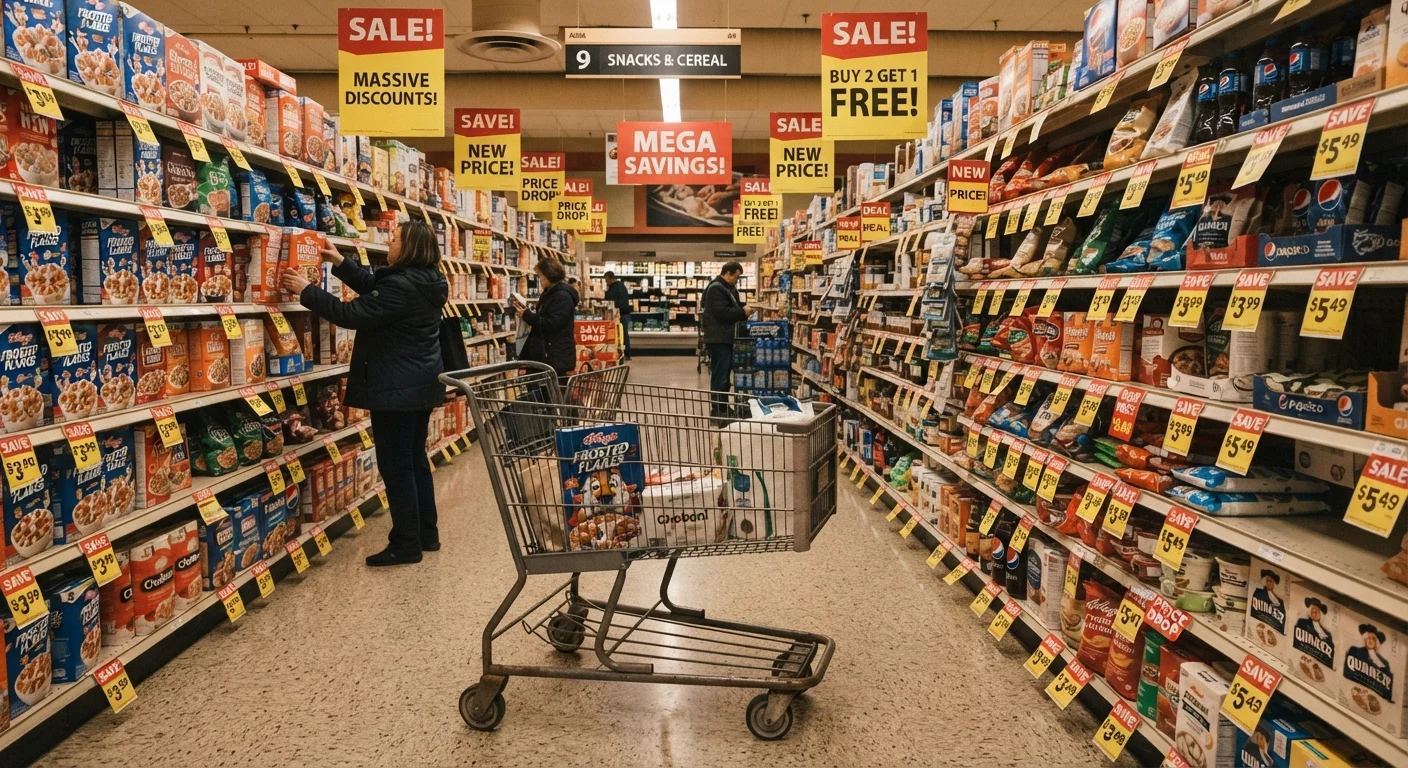
- Price anchoring uses a high reference price to make a lower price feel like a bargain, regardless of actual savings.
- Loss leaders are items priced at or below cost to draw foot traffic and encourage additional purchases.
- Artificial urgency tactics - countdown timers, 'limited stock' labels - exploit the psychological fear of missing out.
- Comparing unit prices, not marked-down totals, is the most reliable way to assess genuine savings.
- Understanding these tactics doesn't make you immune, but awareness gives you a practical edge at checkout.
Price Anchoring
Price anchoring is a retail pricing strategy where a higher reference price is displayed alongside a lower 'sale' price, making the discounted amount feel larger and the deal more attractive. The original or 'anchor' price sets a mental benchmark that influences how shoppers judge value. Even when the anchor price was never the typical selling price, seeing it creates a strong perception of savings.
Anchoring is rooted in cognitive bias research - specifically, the tendency for people to rely heavily on the first piece of numerical information they encounter when making decisions. Loss leaders are a related but distinct tactic: items deliberately priced below cost or margin to attract shoppers who then spend more across the store.
How Anchor Prices Rewire Your Sense of Value
Walk into any retail environment and you'll see it immediately: a price crossed out in red, replaced by a lower number in bold. That crossed-out figure is the anchor - and its job isn't to inform you what the item used to cost. Its job is to reframe what the lower price feels worth.
When shoppers see an item labeled $120 with a sale price of $75, the mind doesn't evaluate whether $75 is reasonable for that item in isolation. It evaluates whether $45 in savings feels good. The anchor has already done its work. This is why the same item at $75 with no reference price often feels more expensive than $75 presented as a markdown from $120 - even though the out-of-pocket cost is identical.
Anchoring works because humans are wired to make relative comparisons, not absolute ones. Retailers capitalize on this by setting anchors strategically - sometimes through inflated manufacturer suggested retail prices (MSRPs), sometimes through brief periods of high pricing before a markdown, and sometimes through pricing that exists primarily on paper. For a deeper look at how this plays out at the shelf level, see our article on why sale prices don't always mean savings.
Test the Anchor by Ignoring It
Before making a purchase, mentally remove the crossed-out 'original' price and ask only: is this item worth what I'm being asked to pay right now? If the answer is yes on its own merits, the deal may be sound. If the appeal depended on the comparison to the anchor, that's worth examining. This single habit can significantly reduce reactive spending on items you wouldn't have sought out unprompted.
Loss Leaders: The Deal That's Really an Invitation
A loss leader is a product a retailer sells at or below its own cost - sometimes dramatically so. The math only works if shoppers who come in for the deal also fill their carts with other items at normal or high margins. Grocery stores are classic practitioners: a deeply discounted rotisserie chicken, for example, draws foot traffic that translates into a full grocery run.
Loss leaders are not inherently deceptive. They are a legitimate business strategy, and consumers who recognize them can benefit - as long as they buy only the lead item and resist the surrounding pull. The problem is that loss leaders are almost never presented in isolation. They're placed strategically within the store to maximize exposure to full-margin products. This connects directly to how store layout itself functions as a persuasion tool - a subject covered in our guide to grocery store layout and purchasing psychology.
~90%
Shoppers influenced by anchor pricing
Consumer psychology research broadly supports that the vast majority of purchase decisions are influenced by reference price framing rather than absolute price evaluation alone.
3-5x
Basket spend lift from loss leaders
Retail industry analysis has found that shoppers attracted by deeply discounted lead items often spend several times the value of that item on additional products in the same trip.
The practical takeaway: if you're shopping a loss leader, go in with a defined list. The discount on the lead item is real; the spending it encourages on everything else may not be.
Urgency, Scarcity, and the Fear of Missing Out
Anchoring and loss leaders work on perceived value. A separate layer of retail psychology targets time and availability. Countdown clocks on e-commerce sites, 'only 3 left in stock' labels, and 'today only' messaging activate a different cognitive lever: loss aversion. Research in behavioral economics consistently shows that the fear of losing a perceived opportunity is a stronger motivator than the equivalent potential gain.
These cues are often manufactured or exaggerated. A countdown timer may reset. 'Limited stock' may apply to a color variant, not the product overall. This doesn't mean every urgency signal is false - genuine clearance and inventory constraints do exist. But urgency framing is applied so broadly in retail that it pays to pause and ask: Would I still want this item if the clock weren't ticking?
Urgency tactics are especially effective when layered on top of anchoring. A heavily anchored item with a countdown timer creates a compounding pressure that bypasses rational evaluation entirely. Recognizing the combination is the first step to stepping back from it. For context on when retailers genuinely do discount inventory, see our breakdown of seasonal sales cycles and real inventory markdowns.
Not Every Urgency Signal Is False
Clearance events tied to genuine inventory turnover - end-of-season apparel, discontinued models, overstock - do involve real time pressure. The challenge is distinguishing these from manufactured urgency. Genuine clearance typically involves irregular sizing or limited color availability, items moving off the floor permanently, and no reappearance of the same 'limited time' price. Our article on when retailers genuinely mark down inventory outlines predictable windows where real discounts tend to occur.
Practical Habits That Cut Through Pricing Noise
Understanding these tactics is useful, but awareness alone doesn't neutralize them - these are cognitive patterns, not knowledge gaps. The more reliable defense is process-based: habits that route your decisions through a different channel than the one retailers are targeting.
- Anchor to unit price, not percentage off. The unit price on the shelf tag - cost per ounce, per count, per liter - reflects actual value in a way that percentage discounts often obscure.
- Check price history before online purchases. Several browser extensions track historical pricing on major retail platforms, letting you see whether a 'sale' price is genuinely lower than the item's typical selling price.
- Separate the deal from the decision to buy. Ask whether you planned to purchase this item before you saw the discount. If the answer is no, the 'savings' are actually unplanned spending.
- Understand loyalty program mechanics. Points and member pricing often feel like bonuses, but they can also mask the true comparative cost of goods - our breakdown of store loyalty programs explains the tradeoffs clearly.
None of these habits require extraordinary discipline. They require a brief pause - exactly what well-executed retail environments are designed to prevent.