

Key Takeaways
- Unit price tells you the actual cost per ounce, count, or liter - not just the total package price.
- Larger packages are not always cheaper per unit; always verify before assuming bulk is a bargain.
- Store-brand and national-brand products on the same shelf can have dramatically different unit prices.
- Sales and multi-buy promotions don't always lower the unit price - checking is the only way to know.
- All shelf tags use the same unit for a category, making direct comparison straightforward.
Unit Price
A unit price is the cost of a product broken down to a standard measure - such as per ounce, per 100 milliliters, per count, or per square foot. It appears on shelf tags in most grocery and big-box stores. Instead of telling you what a package costs, it tells you what you're paying for each unit of the product inside.
Unit pricing is mandated by law in many U.S. states, though the required measurement unit and label format vary by jurisdiction and product category.
What Unit Pricing Actually Is
Walk down any grocery aisle and you'll see shelf tags with two prices. The big number is the total cost of the package. The smaller number - often tucked into a corner - is the unit price: what you're paying per ounce, per liter, per sheet, or per count.
That smaller number is the more useful one. A 32-oz bottle of dish soap priced at $4.99 and a 16-oz bottle priced at $2.79 look like a straightforward size-vs-price tradeoff. The unit price cuts through that: the larger bottle costs about 16 cents per ounce, the smaller one about 17 cents. The difference is modest here - but across a full cart, these comparisons add up.
Unit pricing isn't a store loyalty program or a marketing tool. It's a standardized disclosure, required by law in many states, designed to give shoppers a common denominator for comparing products regardless of how they're packaged.
Unit Pricing Varies by State and Store
While many states require unit pricing for food and household goods, the rules differ - some states exempt small stores, certain product types, or online sales. If you shop at a retailer that doesn't display unit prices, you can always calculate it yourself: divide the total price by the package's weight, volume, or count.
How to Read the Shelf Tag
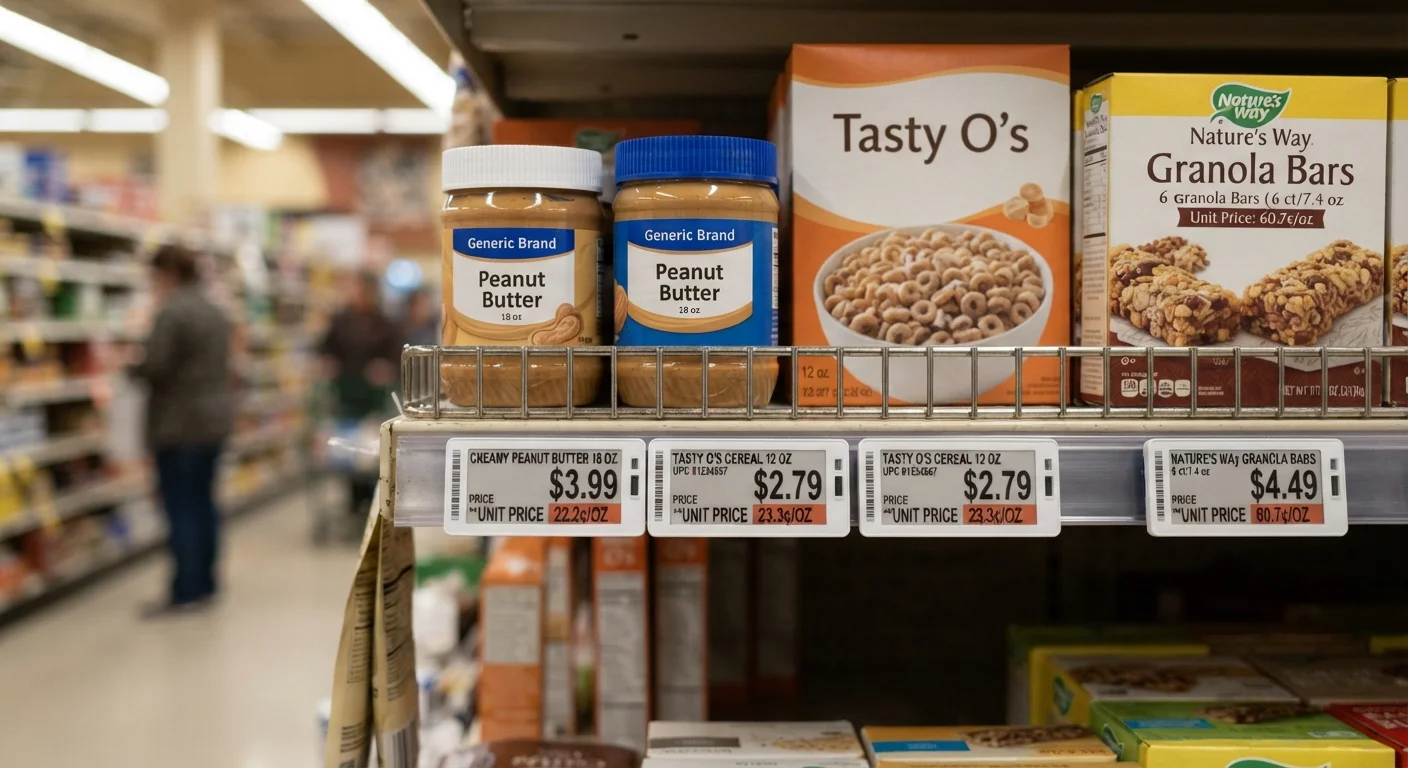
Most shelf tags follow a predictable layout. The total (or "selling") price dominates the center. The unit price appears in smaller print, usually labeled as $/oz, $/100 ct, $/sq ft, or whatever unit applies to that category. Within a single product category, stores use the same base unit across all competing products - making direct comparison possible without any math.
When math is unavoidable - say, a sale tag doesn't include a unit price - the calculation is simple: divide the price by the total quantity. A 28-oz can priced at $1.89 costs roughly 6.75 cents per ounce. A 15-oz can at $1.19 costs about 7.9 cents per ounce. The larger can wins on unit cost.
A few things to watch:
- Sale tags may look different. Promotional shelf tags sometimes omit the unit price or calculate it based on a multi-buy deal (e.g., 2 for $5). Verify the math reflects what you actually plan to purchase.
- Package redesigns can obscure changes. If a product quietly downsizes its package while keeping the price steady, the unit price will reflect that increase even when the shelf tag price stays the same.
- "Value packs" aren't always values. Club-store multi-packs sometimes carry a higher unit price than standard retail sizes - worth checking before assuming otherwise.
Understanding how promotional pricing works alongside unit pricing is useful context. Our article on retail pricing psychology covers how stores set prices to influence perception.
Snap a Photo Before You Decide
If you're torn between two products and the math isn't immediate, photograph both shelf tags and compare them before putting anything in the cart. This avoids the in-aisle memory game of trying to recall one unit price while reading another. Many grocery apps also display unit prices on product listing pages if you prefer to research before you shop.
Where Unit Pricing Changes Your Decisions
The most common misconception is that bigger always means cheaper per unit. Sometimes it does. Sometimes it doesn't - and the only way to know is to look.
Unit pricing also becomes important when comparing a name-brand product to its store-brand counterpart. Packaging differences can make direct visual comparison difficult, but if both shelf tags express cost per ounce, the difference is immediately visible.
It's also worth noting that sale prices don't always mean savings - a "10% off" promotion on an already high unit-price product may still leave it more expensive per ounce than the non-sale alternative next to it.
~30+
U.S. states with unit pricing laws
A majority of U.S. states have enacted unit pricing requirements for retail grocery and drug stores, though requirements vary significantly in scope and enforcement.
2-15%
Estimated savings using unit price comparison
Consumer research has generally found that shoppers who actively use unit pricing can reduce grocery spending measurably, though actual savings depend on purchasing patterns and product categories.
Making Unit Pricing a Habit
The friction of unit pricing is mostly habit. Most people are trained to compare package prices, not per-unit costs. Shifting that default takes a few weeks of conscious practice before it becomes automatic.
A few approaches that help:
- When choosing between two sizes of the same product, default to checking the unit price before reaching for either.
- If you're comparing a store brand to a national brand, use unit price as your primary filter - not package size or visual impression.
- When a product is on sale, recalculate or confirm that the unit price actually dropped. Hidden costs can offset apparent savings in ways that aren't obvious from the sticker price.
Unit pricing works best alongside other label-reading habits. For example, if you're buying packaged food, the per-unit cost is only part of the picture - nutrition label literacy helps you evaluate what you're actually getting per ounce, not just what you're paying.
The unit price is a single, honest number. It doesn't account for taste, quality, storage, or perishability. But as a first filter for cutting through packaging noise and promotion pressure, it's one of the most reliable tools available at the shelf.