

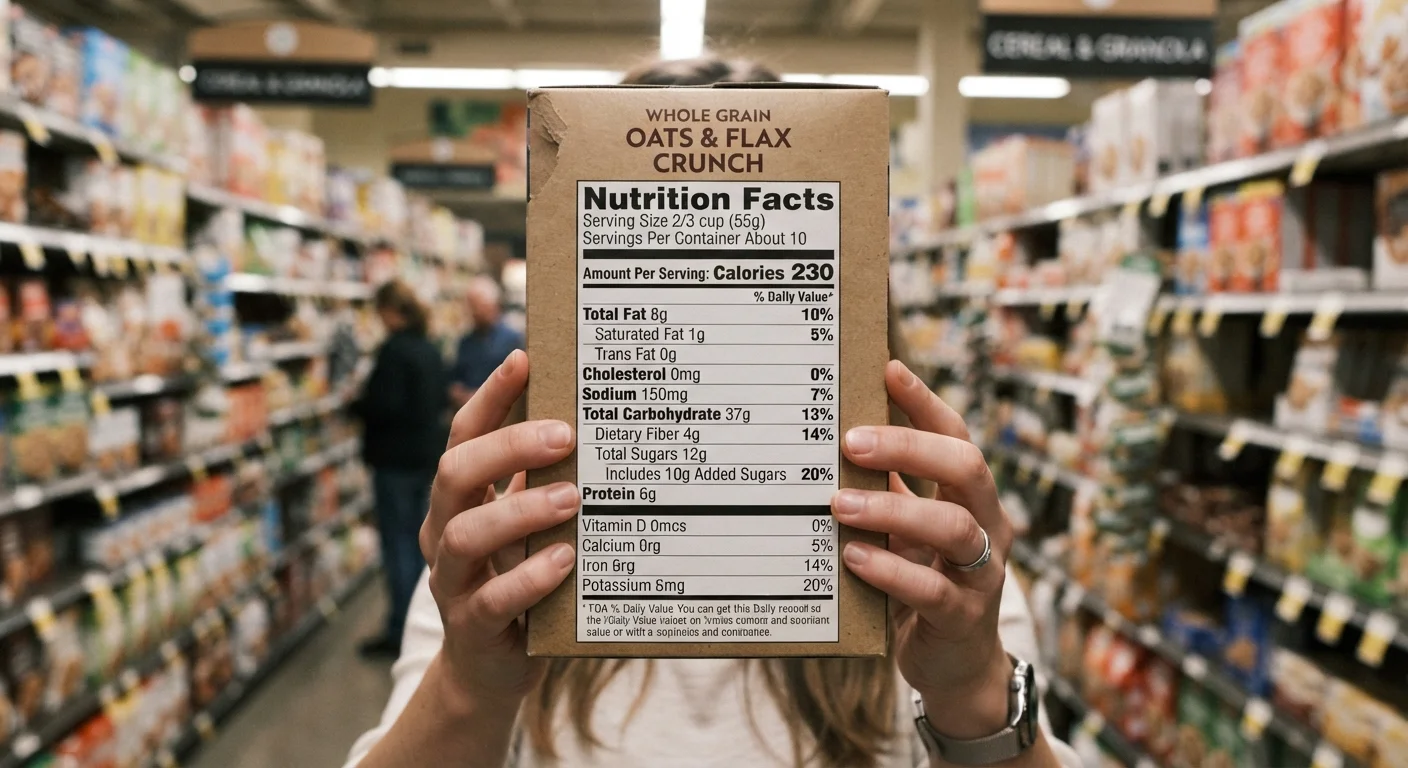
Key Takeaways
- Serving size is the foundation of every other number on the label - always check it first.
- Percent Daily Values are based on a 2,000-calorie reference diet and may not reflect your personal needs.
- Ingredients are listed by weight, so the first few entries dominate the product's composition.
- Added sugars and sodium are the two nutrients most Americans consume in excess of recommended amounts.
- Front-of-package claims like 'natural' or 'light' are marketing terms, not regulated nutritional standards.
What you will need
Why Nutrition Label Reading Matters
The modern grocery store sells thousands of packaged products, many of them marketed with health-adjacent language designed to shape perception before you ever flip the package over. Nutrition label literacy - the ability to accurately read and interpret the Nutrition Facts panel and ingredient list - is one of the most practical tools available for making genuinely informed food choices. Yet surveys consistently find that most consumers misread serving sizes, misunderstand % Daily Values, or rely on front-of-package claims that carry little regulatory weight.
The U.S. Food and Drug Administration updated the Nutrition Facts label format in 2020, making added sugars and vitamin D explicitly visible for the first time, and revising serving sizes to better reflect real-world consumption patterns. Understanding how to read the current label correctly bridges the gap between good intentions and well-grounded decisions at the store shelf.
Front-of-Package Claims Can Mislead
Terms like 'natural,' 'multigrain,' 'made with real fruit,' and 'light' are not strictly defined by the FDA in all contexts and carry no guaranteed nutritional meaning. A product labeled 'multigrain' may still be made entirely from refined grains. Always flip the package and consult the Nutrition Facts panel and ingredient list rather than relying on front-label marketing language.
Label-reading skills also transfer across categories. Just as reading a beauty ingredient list helps you evaluate skincare claims (see reading a beauty ingredient list without a chemistry degree), fluency with food labels helps you cut through nutrition noise regardless of the product.
Labels Inform - They Don't Replace Professional Guidance
Nutrition labels provide factual information about a product's composition, but they cannot account for your individual health history, medical conditions, or dietary needs. If you are managing a chronic condition, food allergy, or specific health goal, consult a registered dietitian or your healthcare provider before making significant changes to your diet based on label reading alone.
How to Read a Nutrition Facts Label Step by Step
The steps below walk through the Nutrition Facts panel from top to bottom - the order in which the FDA structures the information. Work through them with any packaged product in hand.
What you will need
Nutrition Facts Panel
The federally mandated label on packaged foods listing serving size, calorie count, macronutrients, key micronutrients, and % Daily Values.
Ingredient List
Lists every ingredient in the product in descending order by weight, helping you identify dominant components and added sugars.
FDA Daily Value Reference Chart
A publicly available reference from the U.S. Food and Drug Administration explaining what each % Daily Value figure represents for a 2,000-calorie diet.
Start with the serving size
The serving size appears at the very top of the Nutrition Facts panel and is the single most important figure on the label. Every calorie count, gram measurement, and percentage below it is calculated for one serving - not the entire package. Serving sizes are standardized by the FDA to reflect amounts people typically consume, but they may not match what you actually eat in one sitting.
Check both the serving size (in common household units like cups or pieces) and the number of servings per container. A bag that appears to contain one portion may actually list two or three servings. If you eat the whole bag, multiply every value on the label accordingly.
Read total calories in context
Calories reflect the total energy a single serving provides from all macronutrients combined. While calorie needs vary considerably based on age, sex, body size, and activity level, the calorie figure gives you a useful comparison point across similar products. Rather than fixating on this number in isolation, use it alongside the nutrient breakdown to assess whether you're getting meaningful nutrition relative to the energy content - what nutrition professionals sometimes call nutrient density. For a deeper look at what macronutrients actually do in the body, see our guide to macronutrients.
Check nutrients to limit
The Nutrition Facts panel highlights four nutrients that most Americans consume in excess: saturated fat, trans fat, sodium, and added sugars. Diets high in these are associated with increased risk of cardiovascular disease, high blood pressure, and metabolic issues, according to current dietary guidelines. Focus particularly on:
- Added sugars: Listed separately from total sugars since the 2020 label update. The Dietary Guidelines for Americans recommend keeping added sugars below 10% of total daily calories.
- Sodium: The daily adequate intake reference used on labels is 2,300 mg. Processed and packaged foods are the leading source of sodium in the American diet.
- Saturated fat: Aim to keep this low relative to total fat intake. Trans fat should be as close to zero as possible.
Identify nutrients to get enough of
Below the nutrients to limit, the panel lists nutrients that Americans commonly under-consume: dietary fiber, vitamin D, calcium, iron, and potassium. Higher % Daily Values for these nutrients signal a more nutritionally valuable product. Fiber deserves particular attention - most Americans fall well short of recommended intake, yet it plays a key role in digestive health, blood sugar regulation, and cardiovascular health. Learn more in our article on dietary fiber and why most Americans aren't getting enough. For a broader reference on vitamins and minerals, see the micronutrients quick reference guide.
Interpret % Daily Values accurately
The % Daily Value (% DV) column tells you how much of a nutrient one serving contributes toward a daily reference intake, based on a 2,000-calorie diet established by the FDA. This reference point is a population-level standard, not a personal prescription - your actual needs may be higher or lower depending on your age, health status, and activity level. Use % DV for relative comparisons between products rather than as an absolute nutritional target.
Read the ingredient list critically
Ingredients are listed in descending order by weight, meaning the first three to five ingredients make up the bulk of the product. When evaluating a packaged food:
- Look for whole-food ingredients listed early (e.g., whole wheat flour, oats, water).
- Added sugars can appear under many names: high-fructose corn syrup, dextrose, maltose, evaporated cane juice, and more. Counting how many sugar-derived ingredients appear is more informative than any single name.
- A longer ingredient list is not automatically problematic, but ingredients you don't recognize clustered near the top of the list may signal a heavily processed product.
To understand how grain processing affects what ends up on this list, see our piece on whole grains vs. refined grains. For broader context on packaged food processing, understanding ultra-processed foods offers a research-grounded overview.
Use the 5% and 20% Rule as a Quick Guide
The FDA offers a practical shortcut for interpreting % Daily Value: 5% DV or less is generally considered low for a nutrient, while 20% DV or more is considered high. Use this to quickly assess whether a product is a significant source of nutrients you want more of - such as fiber or calcium - or nutrients to limit, such as sodium and saturated fat.
This article provides general nutrition education and is not a substitute for personalized dietary advice from a qualified healthcare professional or registered dietitian.