

Key Takeaways
- Refining removes the bran and germ, stripping out fiber, B vitamins, iron, and healthy fats.
- Whole grains are linked in research to lower risks of heart disease, type 2 diabetes, and digestive issues.
- Enriched refined grains have some nutrients added back, but not all - fiber is rarely restored.
- Most Americans consume far less whole grain than federal dietary guidelines recommend.
- Simple swaps - like choosing whole wheat bread or brown rice - can meaningfully shift nutrient intake.
Option A
Whole Grains
The nutritionally complete, minimally processed option.
Best for: People looking to maximize fiber, vitamins, and minerals from everyday grain-based foods.
Option B
Refined Grains
The widely available, longer-shelf-life alternative.
Best for: Situations where palatability, texture, or shelf stability take priority over nutrient density.
If you want to maximize daily fiber and micronutrient intake
Whole Grains
Whole grains retain bran, germ, and endosperm, delivering substantially more fiber, magnesium, and B vitamins per serving than their refined counterparts.
If digestive sensitivity or texture preferences are a priority
Refined Grains
Refined grains are easier to digest for some individuals and offer a milder texture, though a healthcare provider should guide any diet changes tied to specific conditions.
If you're building long-term heart and metabolic health habits
Whole Grains
Multiple large observational studies associate regular whole grain consumption with reduced cardiovascular and type 2 diabetes risk compared to diets dominated by refined grains.
If budget and shelf life are key considerations
Refined Grains
Refined grains like white rice and white flour store longer and are often less expensive, making them practical staples - especially when paired with other nutrient-dense foods.
What Happens Inside the Mill: The Refining Process
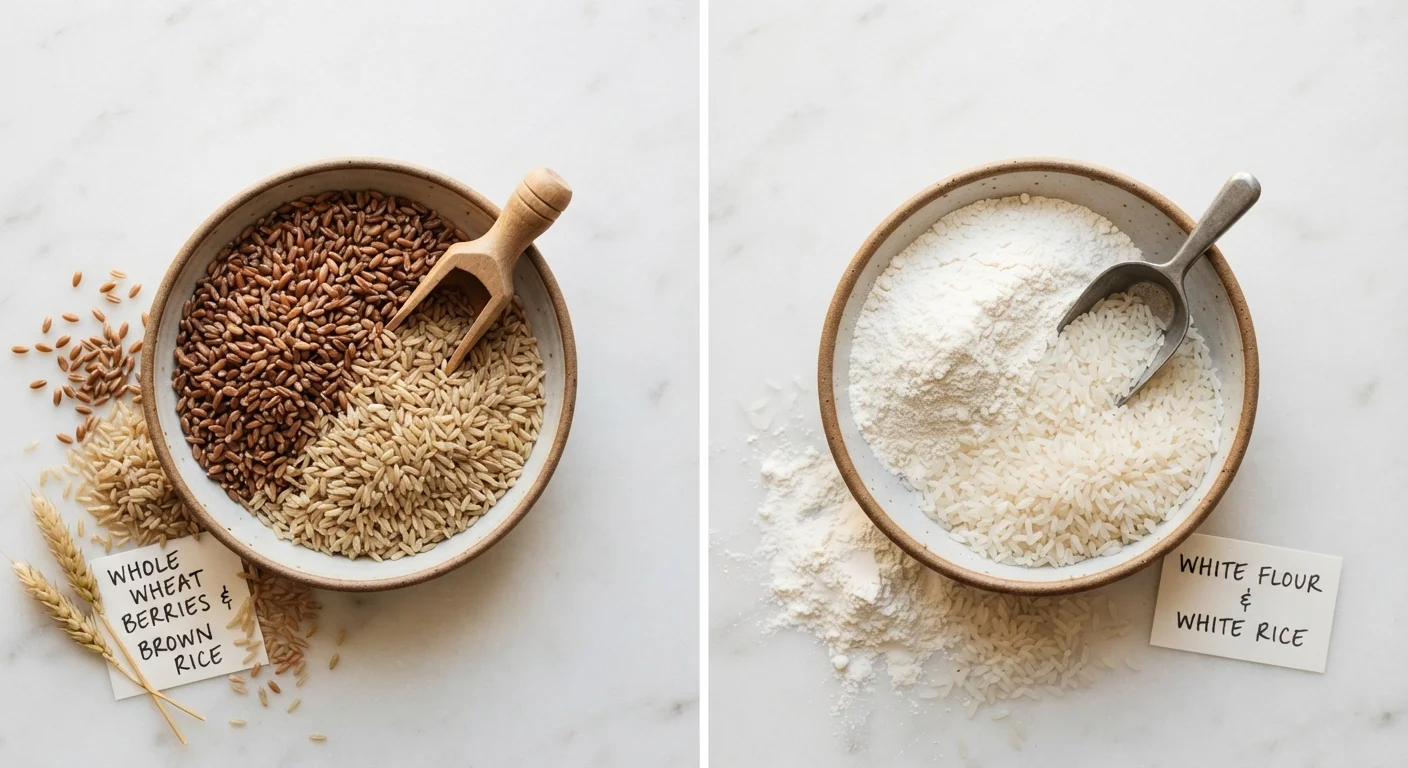
Every grain kernel begins life with three distinct layers: the outer bran, the nutrient-rich germ, and the starchy inner endosperm. When grains are refined - as with white flour or white rice - milling removes the bran and germ, leaving only the endosperm.
That process dramatically changes what ends up on your plate. The bran is the primary source of dietary fiber. The germ contains healthy fats, vitamin E, B vitamins, and minerals like iron and magnesium. Once those two layers are stripped away, what remains is largely starch, with a much simpler nutritional profile.
To partially compensate, many refined grain products in the United States are enriched - meaning selected B vitamins (thiamine, riboflavin, niacin, folic acid) and iron are added back by law. However, enrichment does not restore fiber, healthy fats, phytochemicals, or the full spectrum of minerals lost in milling. As a result, enriched refined grains are nutritionally similar to whole grains in a narrow set of nutrients, but remain substantially different overall.
| Criterion | Whole Grains | Refined Grains |
|---|---|---|
| Kernel layers retained | Bran, germ, and endosperm | Endosperm only |
| Dietary fiber (per serving) | Higher - bran intact | Significantly lower |
| B vitamins | Naturally present | Partially added back (enriched) |
| Minerals (iron, magnesium, zinc) | Broader natural range | Reduced; iron partially restored |
| Healthy fats & vitamin E | Present in germ | Largely absent |
| Phytochemicals & antioxidants | Present (lignans, phenolics) | Mostly removed |
| Glycemic response | Generally more moderate | Typically higher and faster |
| Shelf life | Shorter (germ fats can go rancid) | Longer |
Nutritional Differences That Actually Matter
Fiber is the most consequential nutrient lost during refining. A single serving of whole wheat bread can deliver roughly twice the fiber of its white bread equivalent. Fiber slows digestion, supports gut bacteria, helps moderate blood glucose response, and contributes to feelings of fullness. These effects are largely absent in low-fiber refined grain products.
~25%
Fiber retained after grain refining
Estimates from nutritional analyses suggest refining removes roughly 75% of the dietary fiber present in the whole grain kernel.
3 servings/day
Whole grain intake linked to lower heart disease risk
A 2016 meta-analysis in the British Medical Journal associated approximately 90g of daily whole grain intake with meaningfully reduced cardiovascular disease risk.
<1 serving
Average daily whole grain intake for US adults
According to data analyzed in support of the Dietary Guidelines for Americans, most adults consume well under one daily serving of whole grains despite a recommended minimum of three.
Beyond fiber, whole grains provide a broader range of micronutrients. Magnesium, zinc, and certain antioxidants - including lignans and phenolic acids found in the bran - have no meaningful counterpart in enriched white flour. Research published in journals including The Lancet and Circulation has consistently associated higher whole grain intake with lower markers of systemic inflammation, though the overall dietary pattern matters as much as any single food choice.
For readers trying to make sense of labels at the store, understanding how to read nutrition labels is a practical starting point - ingredient lists reveal whether a grain product is truly whole grain or simply colored to look that way.
What the Research Links to Whole Grain Intake
The evidence base for whole grains is substantial, though most of it comes from large observational studies rather than controlled trials - an important distinction. Observational research consistently associates higher whole grain consumption with reduced risk of cardiovascular disease, type 2 diabetes, colorectal cancer, and all-cause mortality. A 2016 meta-analysis in the British Medical Journal estimated that eating 90 grams of whole grains per day (roughly three servings) was associated with meaningful reductions in heart disease risk compared to eating none.
These associations do not prove that whole grains alone drive the benefit - people who eat more whole grains often have other health-supportive habits as well. Still, major health bodies including the American Heart Association and the Dietary Guidelines for Americans recommend that at least half of all grain servings come from whole grain sources. Currently, average US intake falls well below that benchmark.
It is also worth noting that whole grains are not a cure or treatment for any condition. Individuals managing blood sugar, digestive disorders, or celiac disease should work with a registered dietitian or physician rather than relying on general guidance. Eliminating all refined grains entirely is rarely necessary and may create its own nutritional gaps depending on overall diet composition.
A Note on Gluten and Grain Sensitivity
Both whole and refined grains can contain gluten - a protein found in wheat, barley, and rye. For individuals diagnosed with celiac disease or non-celiac gluten sensitivity, the whole-grain vs. refined-grain distinction is secondary to avoiding gluten-containing grains entirely. Gluten-free whole grain options such as oats (certified gluten-free), quinoa, and brown rice exist, but dietary management for these conditions should always be guided by a healthcare professional.
Practical Ways to Shift Toward More Whole Grains
Switching every grain product at once is neither realistic nor required. Gradual substitution tends to be more sustainable. Swapping white rice for brown or wild rice, choosing whole wheat pasta, or opting for rolled oats instead of instant varieties are low-effort changes that compound over time.
Reading ingredient labels matters here. A product labeled "multigrain" or "wheat bread" is not automatically a whole grain food - look for the word "whole" as the first grain ingredient (e.g., whole wheat flour, whole oat flour). Eating more whole grains doesn't require a premium grocery budget - oats, brown rice, and whole wheat bread are widely available at standard price points.
Context matters too. Refined grains in a diverse, vegetable-rich diet are far less concerning than in a diet otherwise low in fiber and micronutrients. The goal is overall dietary pattern, not perfection with any single food category. For a deeper look at how processed ingredients fit into the broader picture, current research on ultra-processed foods offers useful additional context.
This article is for general informational and educational purposes only and is not a substitute for personalized medical or nutritional advice. Consult a qualified healthcare provider or registered dietitian before making significant changes to your diet, particularly if you have an existing health condition.