

Key Takeaways
- Casual dress prioritizes comfort and personal style with minimal structure or formality.
- Business casual still requires intentionality - it's not just casual with a blazer thrown on top.
- Context, industry, and company culture all influence where the line sits in practice.
- Small details like fit, fabric, and footwear do most of the work in shifting an outfit's register.
- When in doubt, erring slightly more polished is almost always a safer move professionally.
Option A
Casual Dress
The relaxed, personal-expression standard.
Best for: Weekends, informal social gatherings, errands, and low-key hangouts where comfort and self-expression take priority.
Option B
Business Casual
The polished-but-approachable professional middle ground.
Best for: Office environments, networking events, client meetings, and occasions where you want to look put-together without being overly formal.
If you're heading to a weekend brunch or a casual friend hangout
Casual Dress
There's no professional impression to manage, so lean into what feels comfortable and reflects your personal style without overthinking it.
If your office has a 'business casual' dress code
Business Casual
Even in relaxed workplaces, a minimum level of polish signals professionalism and respect for colleagues and clients.
If you're attending a networking event or industry mixer
Business Casual
First impressions count in professional spaces, and business casual strikes the right balance between approachable and credible.
If the invitation says 'casual' but you're unsure of the crowd
Business Casual
A polished-casual outfit - think clean chinos and a neat top - reads well in almost any informal setting without looking overdressed.
Why These Two Dress Codes Keep Getting Confused
The blur between casual and business casual isn't just in your head - workplace norms genuinely shifted through the late 2010s and accelerated after widespread remote work became common in the early 2020s. What once read as underdressed for an office now regularly appears on Zoom calls and in open-plan workspaces. That cultural drift has made both labels harder to decode at a glance.
Understanding the difference matters for more than just looking the part. The clothes you wear signal how you're reading a room - whether you respect the context, understand the unspoken expectations, and feel confident in the space. Getting it right doesn't require a designer wardrobe; it requires knowing which signals each dress code is actually sending.
For broader wardrobe strategy that works across both registers, our outfit formula guide is a useful starting point.
What 'Casual' Actually Means in 2020s America
Casual dress is the most personal of all dress codes. It has the fewest rules, which paradoxically makes it the hardest to define. In practical terms, casual means clothing chosen primarily for comfort, self-expression, and context-appropriateness - without a professional impression to manage.
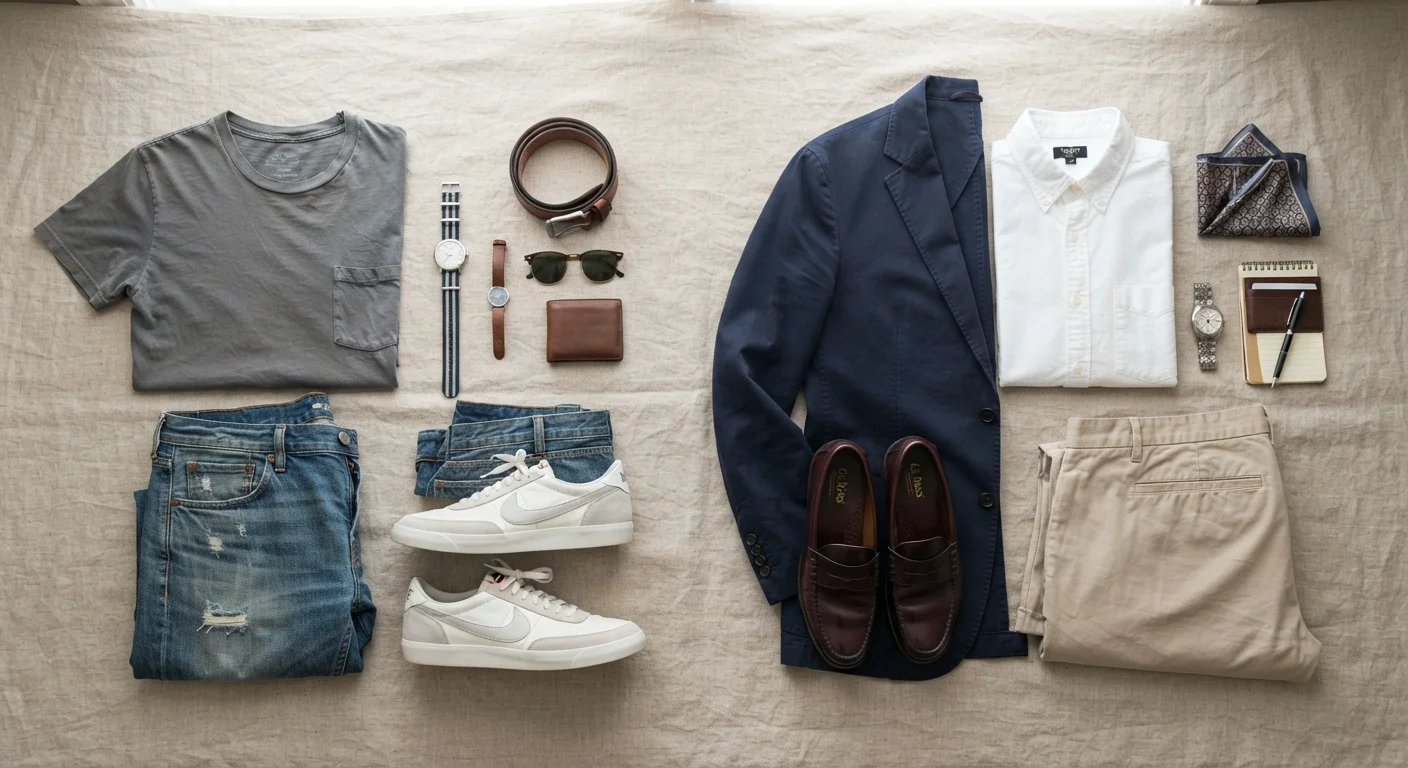
Think: well-fitted jeans or joggers, graphic tees or relaxed tops, sneakers, sandals, hoodies, and casual dresses or shorts depending on the weather. There's no requirement for structure, polish, or matching - though personal style absolutely comes through. The key constraint is that 'casual' doesn't mean 'anything goes.' Stained, visibly worn, or inappropriate clothing still sends a message, even in the most low-key settings.
| Criterion | Casual | Business Casual |
|---|---|---|
| Primary goal | Comfort and self-expression | Professional approachability |
| Typical bottoms | Jeans, joggers, shorts | Chinos, tailored trousers, dark jeans |
| Typical tops | T-shirts, hoodies, casual tees | Button-downs, blouses, polo shirts |
| Footwear | Sneakers, sandals, slip-ons | Loafers, oxfords, clean minimal sneakers |
| Structure/layering | Optional, relaxed | Blazer or cardigan often expected |
| Denim | Any wash or cut welcome | Dark, structured, undistressed only |
| Logos and graphics | Freely worn | Generally avoided in conservative settings |
Fit remains important even in casual contexts. A well-fitting t-shirt and clean jeans will always read better than oversized or unkempt alternatives. For guidance on how lifestyle shapes these choices day to day, see our piece on dressing for your lifestyle vs. your body shape.
What 'Business Casual' Really Requires
Business casual is not casual with ambition. It's a deliberate middle register that says: I'm professional, approachable, and aware of my environment. It emerged as a softer alternative to formal business dress - suits, ties, structured skirts - but it still carries expectations that casual dress doesn't.
Core business casual elements for most American workplaces include: chinos or tailored trousers, button-down or polo shirts, blouses, blazers or structured cardigans, loafers, oxfords, or clean leather sneakers, and midi or knee-length dresses or skirts. Denim can sometimes work - but darker, structured jeans without distressing tend to read better than light-wash relaxed cuts.
Industry Culture Changes Everything
Business casual in a tech startup can look very different from business casual at a law firm or a regional bank. When you're new to an environment, take a few days to observe colleagues before locking in your interpretation. When in doubt, asking HR or a trusted colleague is always a reasonable move - most people appreciate the thoughtfulness.
The industry matters enormously here. A creative agency's business casual looks different from a financial services firm's. When joining a new environment, observe before assuming. If you're preparing for a formal professional setting for the first time, our article on dressing for a job interview explores how outfit choices communicate beyond the surface.
The Details That Do the Heavy Lifting
Fabric, fit, and footwear are the three factors that move an outfit between casual and business casual more than any single clothing item. A linen blazer in a relaxed cut over a plain tee can bridge both worlds. Sneakers - clean, minimal, and paired with structured pieces - have earned a genuine place in business casual contexts at many American companies.
Accessories play a supporting role. A watch, a structured bag, or simple jewelry can elevate a casual base into business casual territory almost instantly. For help calibrating accessory choices without tipping into overdone, our guide to accessorizing without overdoing it covers the principles well.
~50%
U.S. workers now in hybrid or remote roles
Research from Pew Research Center has documented a significant shift toward hybrid work among American workers, which has directly influenced how dress codes are interpreted day to day.
3 details
Fit, fabric, and footwear drive outfit register
Style professionals consistently point to fit, fabric quality, and footwear as the three variables that most reliably elevate or relax an outfit's overall impression.
The easiest general rule: if you're unsure, resolve the ambiguity upward. Arriving slightly more polished than the room requires is far easier to recover from than arriving underdressed - especially in professional contexts.