

Key Takeaways
- A few flexible outfit formulas can cover the majority of everyday American dress occasions.
- Fit and proportion matter more than the price or newness of individual pieces.
- Accessories and outerwear are often the fastest way to shift the same base outfit into a new context.
- Knowing a few go-to combinations reduces decision fatigue and saves time getting dressed.
- Outfit formulas work best when anchored to your actual routine, not an idealized lifestyle.
Why Outfit Formulas Actually Work
Getting dressed shouldn't feel like a daily puzzle. Yet for many people, standing in front of a full closet and feeling like there's nothing to wear is a surprisingly common experience. Outfit formulas - reliable combinations of garment types that consistently work together - cut through that friction.
The idea isn't to dress like a uniform every day. It's to build a mental shorthand: when in doubt, reach for this combination, swap this element to change the mood, and you're out the door. The best formulas are versatile enough to travel across work meetings, weekend errands, and casual dinners without requiring a full wardrobe overhaul.
It helps to understand what actually makes an outfit land before memorizing combinations. If you've ever wondered which element to prioritize first, the breakdown of fit, fabric, and color is a useful place to start - good fit tends to be the non-negotiable foundation that makes everything else easier.
Tailored trousers + a tucked-in shirt
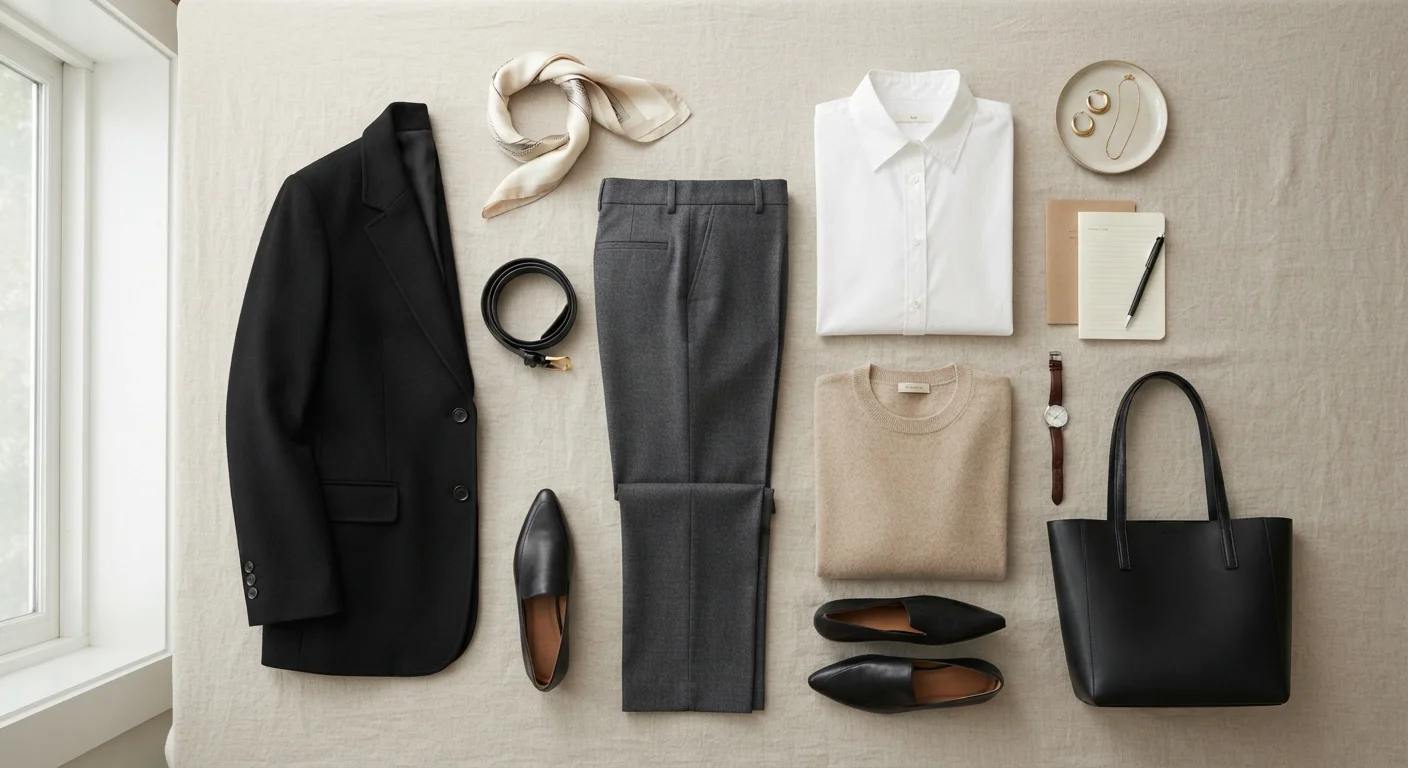
This is arguably the most transferable formula in everyday American dressing. A pair of well-fitting trousers - whether straight-leg, wide-leg, or cropped - paired with a button-down or structured knit shirt creates a foundation that reads professional in a meeting and relaxed at a casual dinner, depending entirely on your footwear and outerwear choices.
The key word is tailored: trousers don't need to be formal, but the fit through the waist and hip matters. A half-tuck rather than a full tuck softens the silhouette for lower-key settings. Swap leather loafers for clean white sneakers and the same outfit moves easily from the office to weekend plans.
Swap your footwear and the same base outfit moves effortlessly from office to weekend.
Dark jeans + a blazer
Dark-wash jeans occupy a unique category - they're technically casual but read much closer to smart thanks to their cleaner finish. Paired with a structured blazer, this combination has become the unofficial uniform for American business-casual environments and is equally strong for dinner out.
The formula works because the blazer does heavy lifting: it signals effort and polish without requiring anything else to change. Choose a blazer that fits across the shoulders and doesn't pull at the chest - that fit point alone will determine whether the whole look comes together. For guidance on navigating exactly where business casual sits today, understanding the current business casual line is a helpful reference.
A well-fitted blazer does enough heavy lifting to elevate almost any pair of dark jeans.
Monochromatic layers in a neutral
Wearing tonal shades of a single neutral - cream, navy, camel, or gray - is one of the most fool-proof formulas available because the coordination work is essentially done for you. The visual effect is elongating and cohesive, and it reads as intentional even when the individual pieces are simple.
The formula also makes cold-weather layering significantly easier, since pieces in the same tonal family layer without competing. Try different textures within the same color family - a ribbed knit, a matte trouser, a woven coat - to keep the look dimensional rather than flat.
Tonal dressing lets different textures do the visual work so coordination takes care of itself.
A midi skirt + a simple fitted top
Midi skirts are among the most occasion-flexible pieces in a wardrobe. At a flattering mid-calf length, they work for professional settings, casual socializing, and most events where the dress code is unclear. The silhouette also plays well with proportions across a wide range of body types and personal styles.
Pair with a tucked-in fitted top - a slim turtleneck, a simple tank with a cardigan, or a clean fitted tee - to keep proportion balanced. The formula skews dressier with heeled mules or ankle boots, and more relaxed with flat sandals or sneakers. This adaptability is what makes it a genuine formula rather than a single outfit.
Midi skirts are among the most occasion-flexible silhouettes - dress them up or down with footwear alone.
Chinos + a clean crew-neck sweater
This combination is the comfortable backbone of casual American dress and works reliably for settings where you want to look put-together without appearing overdressed. Chinos in a mid-tone - olive, tan, navy, or gray - pair neutrally with almost any sweater color, making the formula highly repeatable across different days and moods.
Fit is the deciding factor here: slim or straight chinos that aren't baggy through the thigh, and a sweater with a shoulder seam that lands correctly, will always look more polished than an expensive version of the same combo in poor fits. Add a collar underneath the sweater - a button-down, a tee, or a casual collared shirt - to layer in subtle structure without extra effort.
Fit matters far more than price: well-fitted chinos and a sweater beat an expensive but poorly sized version every time.
A wrap dress or jumpsuit as a single-piece solution
When you need a complete, occasion-ready look without assembling separate pieces, a wrap dress or well-cut jumpsuit functions as an outfit formula unto itself. Both silhouettes offer adjustability - the wrap in particular accommodates a range of fits - and the one-piece nature removes proportion decisions from the equation entirely.
These work for professional settings, celebrations, and travel days alike. The formula's versatility comes through accessories: a structured bag and heels push it toward formal; a denim jacket and sneakers bring it into casual territory. For anyone building a leaner wardrobe, a single piece that spans multiple contexts delivers real practical value.
A well-cut wrap dress or jumpsuit removes proportion decisions entirely - accessories do the rest.
Making the Formulas Work for You
Outfit formulas aren't one-size-fits-all blueprints - they're starting points. Your daily routine shapes which combinations get the most mileage, and that context matters as much as any style principle. For a deeper look at balancing both, the comparison of dressing for body shape vs. lifestyle offers a grounded perspective worth reading alongside this guide.
Once you've identified two or three formulas that align with how you actually spend your days, the next step is accessorizing thoughtfully. A simple formula can read as polished or relaxed depending almost entirely on what you add to it - and accessorizing without overdoing it is a skill that pays dividends across every formula on this list.
Anchor Your Formula to Real Occasions
Before adopting a formula, think through the three or four occasions you actually dress for most weeks - not a hypothetical social life. If you work from home four days a week, a polished office formula may not serve you as well as a versatile casual-to-dinner one. The most useful formulas are the ones that fit your actual calendar, not an aspirational one.
Finally, none of this requires a large or expensive wardrobe. A small set of well-fitting, versatile pieces beats a packed closet of items that don't combine easily. Build around formulas, and your next shopping trip becomes much more intentional.