

| Starter emergency fund target | 3-6 months of essential expenses (Widely cited guideline from financial planning professionals) |
| 401(k) contribution limit (2024) | $23,000 (under 50); $30,500 (50+) (IRS, 2024) |
| IRA contribution limit (2024) | $7,000 (under 50); $8,000 (50+) (IRS, 2024) |
| RMD starting age | Age 73 (SECURE 2.0 Act, effective 2023) |
| HSA eligibility requirement | Enrollment in a qualifying high-deductible health plan (HDHP) (IRS Publication 969) |
| Early retirement withdrawal penalty | 10% in most cases before age 59½ (IRS general rule; exceptions apply) |
Why the Right Account Matters as Much as the Amount
Saving money is only half the equation. Where you keep those savings determines how accessible, protected, and productive they are - and the right answer changes significantly as your life circumstances evolve. A 22-year-old building a first emergency fund has very different needs than a 55-year-old accelerating retirement contributions.
This guide maps the most appropriate savings vehicles to four broad financial life stages. It's general education, not personalized financial advice - a licensed financial professional can help you apply these frameworks to your specific situation.
| Starter emergency fund target | 3-6 months of essential expenses (Widely cited guideline from financial planning professionals) |
| 401(k) contribution limit (2024) | $23,000 (under 50); $30,500 (50+) (IRS, 2024) |
| IRA contribution limit (2024) | $7,000 (under 50); $8,000 (50+) (IRS, 2024) |
| RMD starting age | Age 73 (SECURE 2.0 Act, effective 2023) |
| HSA eligibility requirement | Enrollment in a qualifying high-deductible health plan (HDHP) (IRS Publication 969) |
| Early retirement withdrawal penalty | 10% in most cases before age 59½ (IRS general rule; exceptions apply) |
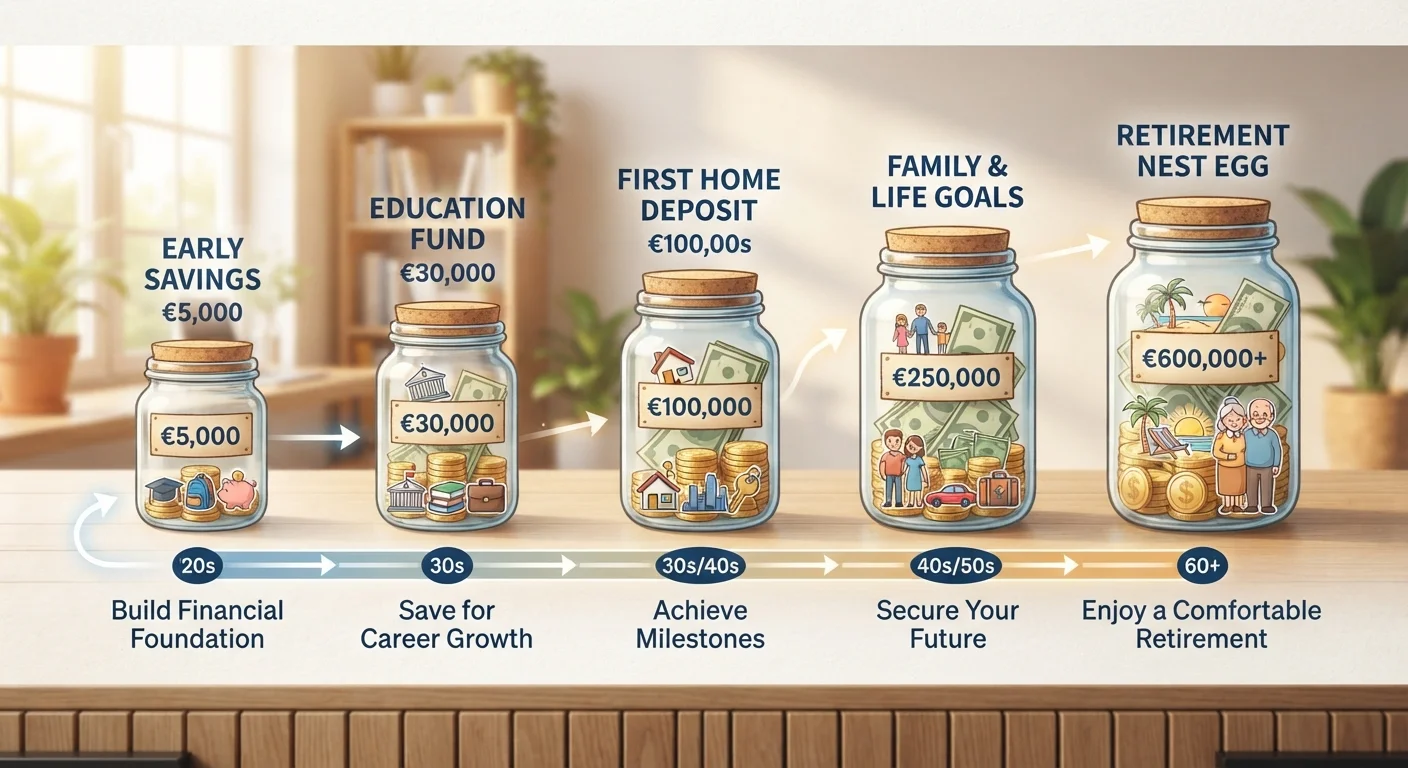
Stage 1: Getting Started (Early Earning Years)
When income is modest and expenses are high relative to earnings, the priority is liquidity and habit-building. Two accounts form the foundation:
- High-yield savings account (HYSA): Offers meaningfully better interest rates than standard savings accounts while keeping funds easily accessible. Ideal for building a starter emergency fund - typically three to six months of essential expenses. See our side-by-side comparison of HYSAs and traditional accounts for a deeper breakdown.
- Employer-sponsored retirement account (401(k) or 403(b)): If your employer offers a match, contributing enough to capture it is a foundational move. Missing a match is effectively leaving compensation on the table.
At this stage, the distinction between an emergency fund and a sinking fund is especially worth understanding - both serve early-stage savers differently.
High-Yield Savings Account (HYSA)
A federally insured savings account that pays a higher annual percentage yield (APY) than a standard savings account, typically offered by online banks. Funds remain accessible and liquid.
Roth IRA
An individual retirement account funded with after-tax dollars. Qualified withdrawals in retirement are tax-free, and account owners are not subject to required minimum distributions during their lifetime.
Health Savings Account (HSA)
A tax-advantaged account available to individuals with a qualifying high-deductible health plan. Contributions, growth, and withdrawals for eligible medical expenses are all tax-free.
Required Minimum Distribution (RMD)
The minimum amount the IRS requires you to withdraw from certain tax-deferred retirement accounts each year, beginning at age 73 under current law.
Catch-Up Contribution
An additional amount that savers aged 50 and older are permitted to contribute to retirement accounts beyond the standard annual limit, designed to help accelerate savings closer to retirement.
Sequence-of-Returns Risk
The risk that poor investment returns early in retirement, combined with ongoing withdrawals, can significantly deplete a portfolio faster than average returns alone would suggest.
Stage 2: Building Momentum (Mid-Career)
With more stable income and clearer financial goals, savers in this stage can diversify beyond basic accounts:
- Taxable brokerage account: Once retirement accounts are funded to a reasonable level, a brokerage account lets you invest for medium-to-long-term goals - like a home down payment in five or more years - with more flexibility than retirement accounts.
- Health Savings Account (HSA): Available to those enrolled in a qualifying high-deductible health plan, an HSA offers a triple tax advantage: contributions are pre-tax, growth is tax-free, and withdrawals for qualified medical expenses are tax-free.
- Roth IRA or Traditional IRA: IRAs supplement workplace retirement accounts and offer different tax treatment depending on your current versus expected future income.
Balancing near-term and long-term goals simultaneously is manageable with the right structure. Our guide on balancing short- and long-term savings goals walks through a practical framework. Also consider automating your contributions to reduce friction and build consistency.
Stage 3: Peak Earning and Pre-Retirement
This stage is often characterized by higher income, fewer immediate financial obligations, and a shorter runway to retirement. The focus shifts toward maximizing tax-advantaged space and reducing investment risk gradually:
- Maxing out retirement accounts: The IRS allows higher annual contribution limits for those 50 and older (catch-up contributions), making this an opportunity to accelerate retirement savings.
- Taxable brokerage accounts for flexibility: Retirement accounts restrict access before age 59½ without penalties in most cases. A brokerage account provides accessible savings that don't carry those restrictions.
- CDs and money market accounts: As retirement approaches, some savers shift a portion of assets into lower-volatility instruments to protect against sequence-of-returns risk.
Costs in this stage can be substantial - major expenses like vehicle ownership and housing often peak. See how car ownership costs shift across a lifetime to better plan around them.
56%
Americans behind on retirement savings
According to a 2023 Federal Reserve Report on the Economic Well-Being of U.S. Households, over half of non-retired adults feel their retirement savings are not on track.
$87,000
Median retirement savings for those 55-64
Federal Reserve Survey of Consumer Finances data indicates significant gaps in retirement preparedness among those approaching retirement age.
4-5%
Typical HYSA APY range in recent years
Rates vary by institution and reflect broader Federal Reserve rate environment; always verify current rates directly with a financial institution.
Stage 4: Retirement and Drawing Down
In retirement, the savings question inverts: you're no longer accumulating, but distributing. The goal becomes making savings last while managing taxes and healthcare costs:
- Traditional IRA and 401(k) withdrawals: These are taxed as ordinary income. Required Minimum Distributions (RMDs) begin at age 73 under current rules, creating planning considerations.
- Roth IRA: Roth accounts have no RMDs during the owner's lifetime, offering flexibility in managing taxable income year to year.
- Money market accounts and short-term CDs: Keeping one to two years of living expenses in stable, liquid accounts reduces the need to sell investments during market downturns.
Setting well-defined savings targets throughout life makes this stage more predictable. Our article on setting savings goals you'll actually reach lays out a milestone-based approach that scales across all stages.
This article is for general informational purposes only and does not constitute personalized financial, tax, or investment advice. Consult a qualified financial professional before making decisions based on your individual circumstances.