

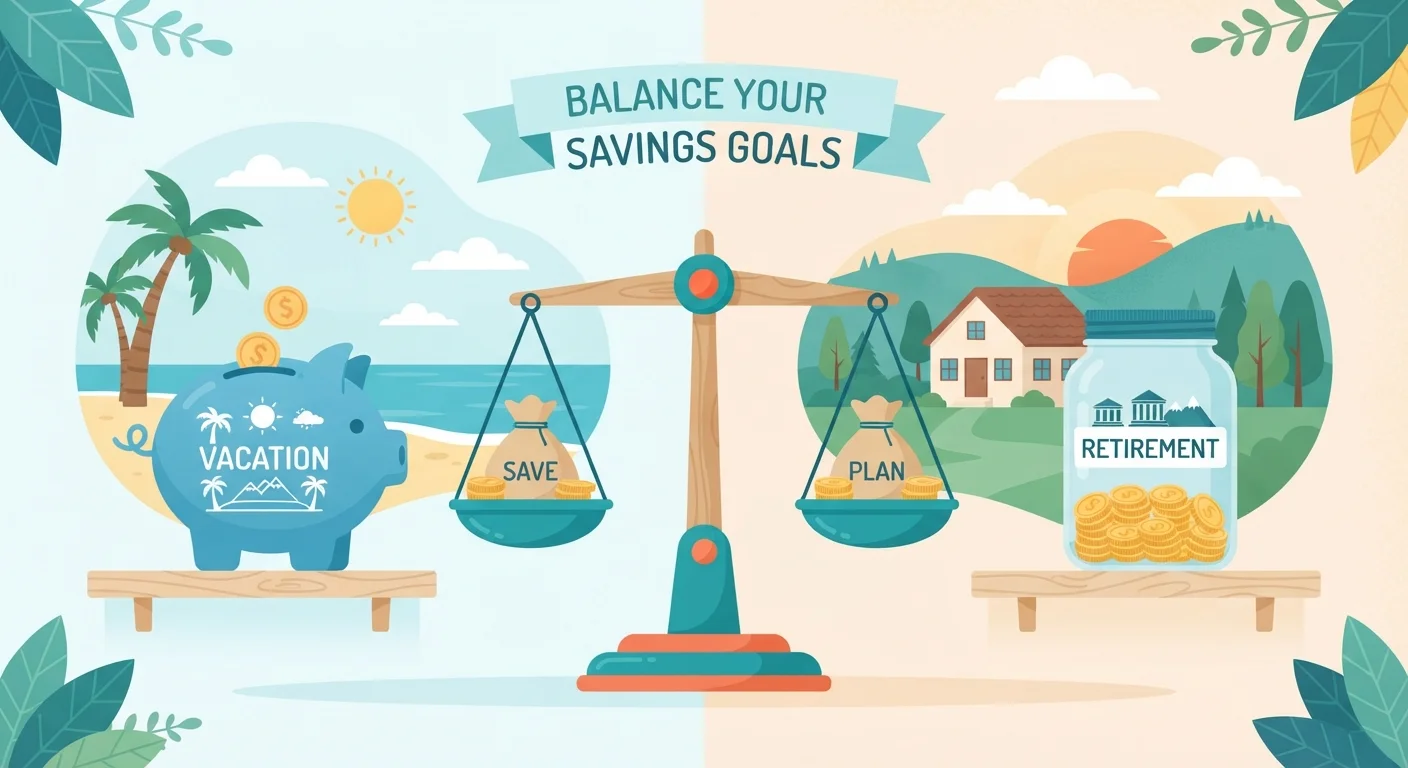
Key Takeaways
- Short-term goals typically have a horizon under three years; long-term goals extend five years or more.
- Prioritizing both simultaneously is possible with a bucketed savings approach and automated contributions.
- Neglecting long-term savings entirely - even briefly - can have a compounding cost over time.
- Different account types suit different horizons; matching them correctly matters for returns and accessibility.
- A clear monthly savings rate, split across goal buckets, is more effective than saving whatever remains.
Our Verdict
Short-term and long-term savings goals compete for the same dollars, but they don't have to cancel each other out. A structured bucketing strategy, paired with automated contributions and the right account types, lets you make progress on both without constantly choosing one over the other. The right balance depends on your income, existing obligations, and timeline - a licensed financial planner can help tailor priorities to your specific situation.
| Best for | Recommended |
|---|---|
| Those new to saving who need a simple starting framework | Bucketed savings with automatic transfers |
| Those with employer retirement benefits and a near-term goal | Capture employer match first, then fund short-term buckets |
| Those with variable or unpredictable income | Percentage-based contributions rather than fixed dollar amounts |
| Those who want to optimize where savings actually live | Match account type to goal horizon |
What Separates Short-Term From Long-Term Goals
The most useful distinction isn't just time - it's what each type of goal demands from your money. Short-term savings goals generally have a horizon of one month to three years. Think: an emergency fund, a vacation, a car down payment, or holiday gifts. These goals require liquidity - you need the money accessible when the moment arrives.
Long-term savings goals typically extend five years or more. Retirement is the clearest example, but so are a home down payment (depending on your market), a child's college fund, or building serious generational wealth. These goals benefit from time in the market, compounding interest, and tax-advantaged account structures.
The tension between them is real. Every dollar directed toward a short-term goal is a dollar not compounding in a retirement account - and vice versa. Understanding this trade-off clearly is the first step toward managing it intentionally. For a deeper look at which accounts best fit each stage of your financial life, see where your savings should live at each stage of life.
Short-Term vs. Long-Term Goals: Key Differences at a Glance
Before building a strategy, it helps to see both approaches side by side. The table below compares the core characteristics of short- and long-term savings goals across the dimensions that matter most when allocating your money.
| Short-Term Goals | Long-Term Goals | |
|---|---|---|
| Typical time horizon | Under 3 years | 5+ years |
| Primary need | Liquidity and accessibility | Growth and compounding |
| Common examples | Emergency fund, vacation, car | Retirement, college fund, home |
| Best account types | High-yield savings, money market | 401(k), IRA, Roth IRA |
| Risk tolerance | Low - preserve capital | Higher - time to recover losses |
| Automation approach | Fixed monthly transfer | Payroll deduction or auto-invest |
Notice that neither goal type is inherently superior - they serve different financial functions. The goal is alignment, not competition.
The Bucketing Framework: How to Fund Both at Once
The most practical way to manage competing priorities is a bucketing strategy: you divide your monthly savings into discrete, named buckets, each tied to a specific goal. Rather than saving whatever is left over after spending - a habit that rarely produces consistent results - you decide your savings rate first, then split it intentionally.
A straightforward starting split for someone with a stable income might look like this:
- Emergency fund bucket: Fund this to three to six months of essential expenses before aggressively building other buckets. Once it's fully funded, redirect that allocation.
- Short-term goal bucket(s): Assign a named sub-goal (vacation, car, home repair) so the purpose stays concrete. Specific goals are easier to protect in a budget crunch.
- Long-term retirement bucket: At minimum, contribute enough to capture any employer match in a workplace plan - that match is part of your compensation. Beyond the match, increase contributions incrementally over time.
Automation is what makes this reliable. Setting up automatic transfers on payday removes the decision from your hands and eliminates the risk of spending what you intended to save. For more on structuring specific targets within each bucket, see setting a savings goal you'll actually reach.
Start With a Percentage, Not a Dollar Amount
Rather than committing to a specific dollar amount each month, try targeting a percentage of your take-home pay - say, 15% total, split across your goal buckets. This approach scales naturally with income changes and removes the mental friction of recalculating contributions every time your paycheck shifts. Even a 1% increase each year can meaningfully accelerate long-term savings without requiring a dramatic lifestyle change upfront.
It's also worth distinguishing between an emergency fund - your financial safety net for unexpected crises - and a sinking fund, which is a planned savings pool for known future expenses. Both matter, and understanding which tool serves which job will sharpen how you structure your buckets.
Matching the Right Account to Each Goal Horizon
Where you keep your savings matters almost as much as how much you save. The right account type depends on your timeline and whether you need liquidity.
56%
Americans unable to cover a $1,000 emergency
A Bankrate survey found that more than half of U.S. adults could not pay for an unexpected $1,000 expense from savings alone, underscoring the urgency of short-term savings.
~33%
Private-sector workers not participating in a retirement plan
According to the U.S. Bureau of Labor Statistics, a significant share of eligible private-sector employees do not participate in available workplace retirement plans.
For short-term goals, prioritize accessibility and capital preservation. High-yield savings accounts and money market accounts are common choices because they offer better returns than standard savings accounts while keeping funds liquid. High-yield savings accounts vs. traditional savings accounts breaks down the rate and access differences in detail.
For long-term goals, tax-advantaged accounts like 401(k)s, IRAs, and Roth IRAs are designed to help your money grow more efficiently over decades. The trade-off is restricted access - early withdrawals often carry penalties and tax consequences, so these accounts should hold only money you won't need for years.
If your income fluctuates month to month, a fixed-dollar savings commitment can feel impossible to maintain. Percentage-based saving - setting aside a consistent share of whatever you earn - adapts automatically to lean months. Saving on a variable income offers practical guidance for freelancers and hourly workers navigating this challenge.
For broader context on the full range of savings goals most Americans encounter across their lives, savings goals across life's major milestones provides a useful roadmap. And if you want foundational budgeting tools to support your savings plan, the Budgeting Basics hub is a practical starting point.
This article is for general informational and educational purposes only and does not constitute personalized financial, investment, or tax advice. Consult a qualified financial professional before making decisions based on your individual circumstances.