

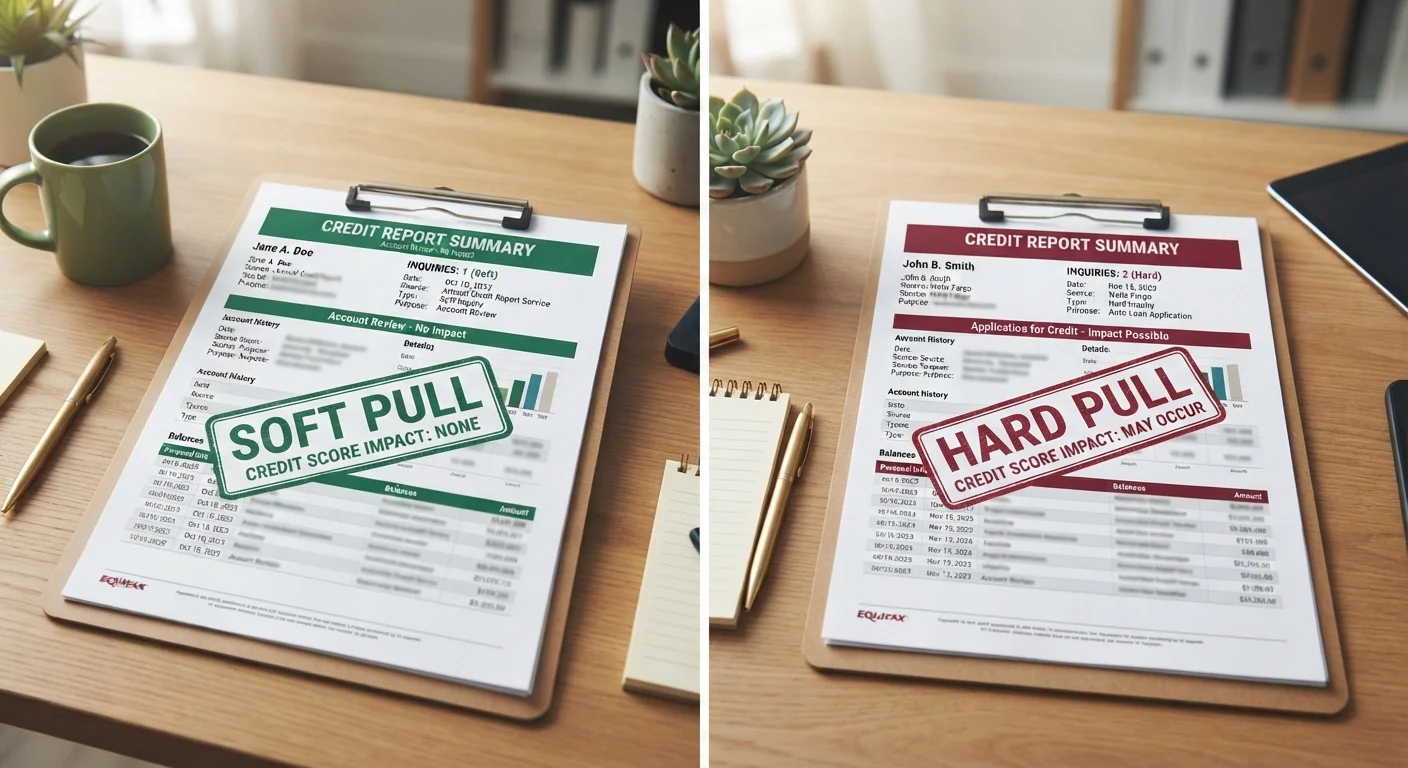
Key Takeaways
- Hard inquiries occur when you formally apply for credit and can temporarily lower your score by a few points.
- Soft inquiries have no impact on your credit score and are often invisible to lenders reviewing your report.
- Multiple hard inquiries for the same loan type within a short window are typically counted as one inquiry by scoring models.
- You can check your own credit as often as you like - that counts as a soft inquiry.
- Hard inquiries remain on your credit report for two years but lose scoring impact after about 12 months.
Option A
Hard Inquiry
The formal credit check that lenders use when you apply for new credit.
Best for: Used when a lender needs a full review of your credit history before approving a loan, credit card, or other financing.
Option B
Soft Inquiry
A background check that does not affect your credit score.
Best for: Used for pre-approvals, background checks, or personal credit monitoring where no lending decision is being finalized.
If you want to monitor your credit regularly without any impact
Soft Inquiry
Checking your own credit generates a soft inquiry. It has zero effect on your score, so reviewing your report frequently is encouraged and risk-free.
If you are rate-shopping for a mortgage or auto loan
Hard Inquiry
You will incur hard inquiries, but scoring models group multiple inquiries for the same loan type within a 14-45 day window into a single event to minimize score impact.
If a company sends you a pre-approved credit offer
Soft Inquiry
Pre-approval screening uses soft pulls, so receiving or even initiating a pre-qualification check will not affect your score.
If you are applying for a new credit card or personal loan
Hard Inquiry
Formal applications require hard pulls. Applying for several cards in quick succession can signal risk to lenders, so space out applications when possible.
What Triggers Each Type of Inquiry
When a lender or other entity accesses your credit file, the access is recorded as an inquiry. Whether that inquiry is "hard" or "soft" depends entirely on the purpose of the check - not the source.
Hard inquiries are triggered when you actively apply for new credit: a mortgage, auto loan, personal loan, student loan, or credit card. The lender pulls your full credit report to make a lending decision, and that pull is recorded as a hard inquiry on your report.
Soft inquiries cover a wide range of situations that do not involve a formal credit application. Common examples include:
- Checking your own credit report or score
- Pre-qualification or pre-approval screening by a lender
- Employer background checks (with your consent)
- Insurance companies reviewing your credit-based insurance score
- Existing creditors reviewing your account (account management reviews)
Understanding which category applies to a given situation helps you make smarter choices about when and how often to apply for credit. For a deeper look at how inquiries appear within your overall report, see The Anatomy of a Credit Report.
| Criterion | Hard Inquiry | Soft Inquiry |
|---|---|---|
| Triggered by | Formal credit application | Pre-approval, self-check, background review |
| Affects credit score | Yes - typically a small, temporary dip | No impact whatsoever |
| Visible to lenders | Yes, on your credit report | Only visible to you, not lenders |
| Stays on report | 2 years | Varies; often not shown to others |
| Scoring model impact duration | Up to 12 months | None |
| Rate-shopping protection | Yes - multiple pulls grouped in 14-45 days | N/A |
| Requires your consent | Yes, via credit application | Sometimes (e.g., employer checks) |
How Each Inquiry Affects Your Credit Score
The key practical difference between hard and soft inquiries is their effect on your credit score.
Soft inquiries do not affect your score at all. They may appear on a version of your credit report that only you can see, but lenders reviewing your file for a lending decision will not see soft inquiries - and scoring models do not factor them in.
Hard inquiries do have a scoring impact, though it is usually modest. According to widely published FICO guidance, a single hard inquiry typically lowers a score by fewer than five points for most consumers. The impact diminishes over time and generally disappears from scoring calculations after about 12 months, even though the inquiry remains visible on your report for two years.
<5 pts
Typical score drop from one hard inquiry
FICO publicly states that a single hard inquiry generally lowers most consumers' scores by fewer than five points.
2 years
Time a hard inquiry stays on your report
Hard inquiries remain visible on your credit report for two years, though their scoring impact fades well before that window closes.
45 days
Rate-shopping window under current FICO models
FICO 8 and later versions consolidate multiple mortgage or auto loan inquiries made within 45 days into a single scoring event.
One important protection built into scoring models is rate-shopping tolerance. When you shop for a mortgage or auto loan, submitting multiple applications to compare rates is normal - and scoring models account for this. FICO, for example, groups hard inquiries for the same loan type made within a 45-day window and counts them as a single inquiry. Older FICO versions use a 14-day window. VantageScore applies a similar approach.
Where hard inquiries can become a concern is with repeated, unrelated credit applications over a short period - for example, applying for several store credit cards in the same month. Each counts separately and the cumulative effect can signal financial stress to lenders. To understand where inquiries fit among all the factors shaping your score, see Credit Scores Decoded.
Inquiries Are a Small Piece of the Puzzle
Hard inquiries fall under the "new credit" category in FICO scoring, which accounts for approximately 10% of your total score. Payment history (35%) and credit utilization (30%) carry significantly more weight. A single hard inquiry is rarely the deciding factor in a credit decision, but a pattern of many applications in a short period can raise lender concerns about financial stress.
Practical Tips for Managing Credit Inquiries
With a clear understanding of both inquiry types, you can take concrete steps to protect your score while still accessing the credit you need.
- Check your own credit freely. There is no penalty for monitoring your own report. Use annualcreditreport.com to access your reports from the three major bureaus. This always generates a soft inquiry.
- Use pre-qualification tools before applying. Many lenders offer pre-qualification that uses a soft pull. This lets you gauge your approval odds without affecting your score.
- Cluster rate-shopping within a short window. If you are comparing mortgage or auto loan offers, submit applications within a two-week period to take advantage of scoring model protections.
- Space out credit card applications. Since each card application is a separate hard inquiry with no rate-shopping grouping, avoid applying for multiple cards in quick succession.
- Review your report for unauthorized inquiries. Hard inquiries you do not recognize could indicate identity theft. Disputing an Error on Your Credit Report walks through the formal dispute process.
Keeping inquiries in perspective is important. While hard pulls do matter, they carry less weight than payment history or credit utilization. For a full picture of behaviors that quietly erode a score over time, see Habits That Quietly Damage Your Credit.
This article is for general informational and educational purposes only and does not constitute personalized financial or credit advice. Consider consulting a qualified financial professional for guidance specific to your situation.