

| When you receive it | Periodically or upon request, once a threshold is met |
| Form of return | Real currency - statement credit, bank deposit, or withdrawable balance |
| Spending restrictions | None - usable anywhere once redeemed |
| Common delivery channels | Credit/debit card programs, cashback apps, shopping portals |
| Typical confirmation delay | 30-90 days for portal-based cashback |
| Key risk | Earning caps, inactivity expiration, or unmet redemption minimums |
Three Terms, Three Very Different Mechanics
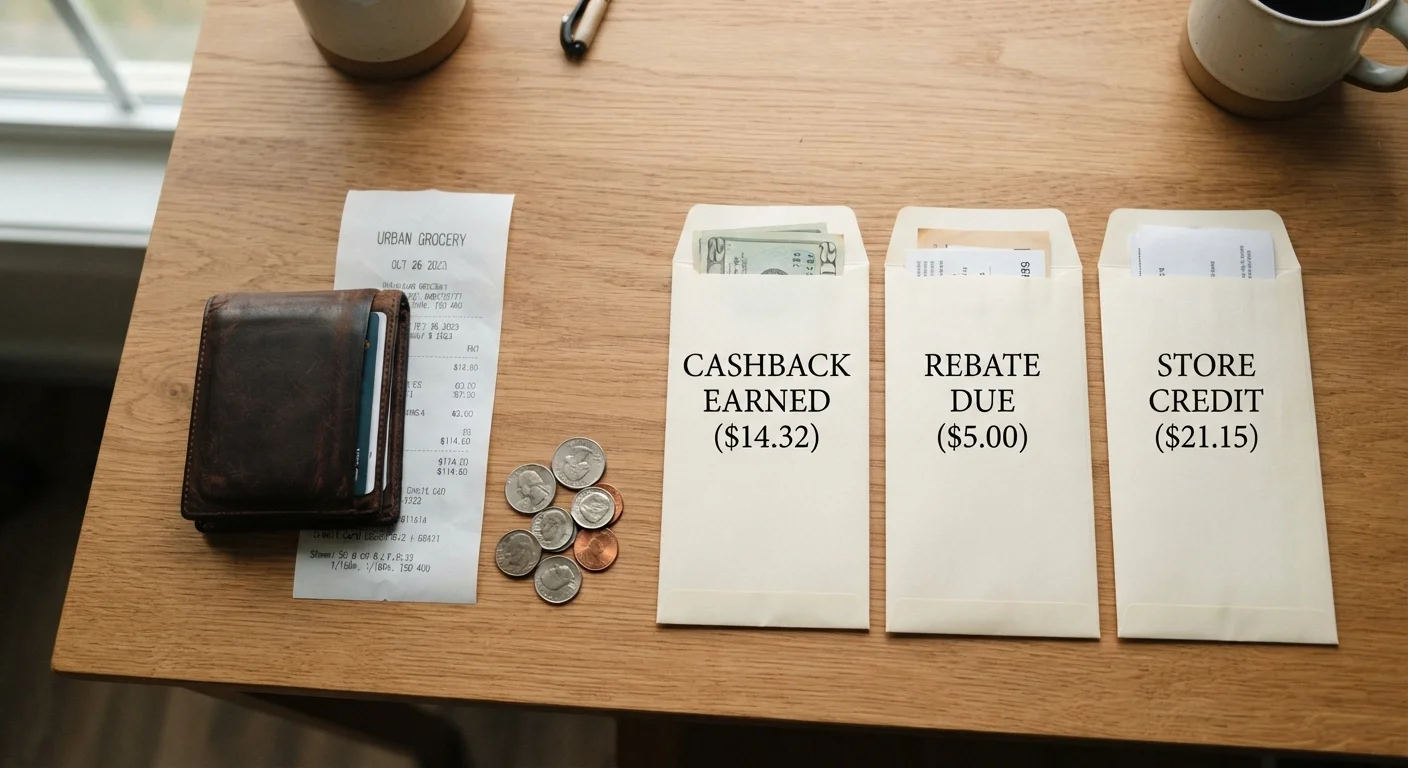
Retailers and card issuers use the words cashback, rebate, and store credit interchangeably in marketing copy - but they work quite differently in practice. Each one affects when you receive value, in what form, and under what conditions. Conflating them can lead to unpleasant surprises: money you expected back that's locked to one store, or a check you forgot to mail in that expired months ago.
This reference breaks down each mechanism so you can quickly identify what a promotion is actually offering before you factor it into your budget. For a broader look at how discount mechanics interact, see our breakdown of common discount strategies.
Cashback
A return of a percentage of your spending paid back as real, unrestricted currency - via statement credit, bank deposit, or withdrawable digital balance. It does not lock value to a single retailer.
Rebate
A partial refund that requires a separate claim process after purchase. You pay full price at checkout and recover a portion only after submitting required documentation within a deadline.
Store Credit
A balance or voucher redeemable only at the issuing retailer. It cannot be converted to cash and may carry expiration dates or minimum spend conditions.
Statement Credit
A reduction applied directly to your credit card balance, reducing what you owe rather than depositing cash into a bank account. Functionally equivalent to cash in most contexts.
Net Cost
The actual amount you pay for a purchase after all rebates, credits, and returns are factored in. Useful for comparing the true value of different promotional offers.
Redemption Threshold
The minimum amount of cashback or rewards you must accumulate before you are allowed to redeem them. Common thresholds range from $5 to $25 depending on the program.
Cashback: Immediate or Periodic Return of Real Money
Cashback is a return of a percentage of what you spent, paid back to you as actual currency - either as a statement credit on a credit card, a deposit into a linked bank account, or a digital balance you can withdraw. The key characteristic is that it converts back to unrestricted money, not locked purchasing power.
| When you receive it | Periodically or upon request, once a threshold is met |
| Form of return | Real currency - statement credit, bank deposit, or withdrawable balance |
| Spending restrictions | None - usable anywhere once redeemed |
| Common delivery channels | Credit/debit card programs, cashback apps, shopping portals |
| Typical confirmation delay | 30-90 days for portal-based cashback |
| Key risk | Earning caps, inactivity expiration, or unmet redemption minimums |
Two common delivery methods exist. Card-linked cashback - offered by credit and debit card programs - accumulates as you spend and is typically redeemable once a minimum threshold is met (often $25). Portal or app cashback works when you shop through a specific intermediary platform; the platform earns a referral commission and passes a portion back to you, usually after a confirmation period of 30-90 days to allow for returns.
Key conditions to watch: minimum redemption thresholds, earning caps per category or quarter, and whether the cashback expires if your account is inactive. For context on how cashback fits inside loyalty ecosystems, see how retail loyalty programs actually work.
Rebates: Savings You Have to Claim After Purchase
A rebate is a partial refund offered by a manufacturer or retailer that you receive after completing a separate claim process - not automatically at checkout. The price you pay at the register is the full price; the rebate reduces your net cost only if you successfully submit the required documentation within a specified window.
Mail-in rebates are the traditional form: you send a UPC barcode, original receipt, and a completed form to a processing center, then wait weeks for a check or prepaid card. Digital rebates streamline this by letting you submit photos via an app, but the principle is the same - claim, wait, receive.
40-60%
Estimated share of mail-in rebates never claimed
Industry observers have long noted that a large portion of rebate offers go unredeemed, which is a primary reason manufacturers use them - though precise figures vary by product category and offer design.
30 days
Typical rebate submission window from purchase date
Many rebate offers require documentation to be postmarked or submitted digitally within 30 days; missing this window forfeits the savings entirely.
Common pitfalls include missing the submission deadline (often just 30 days from purchase), submitting incomplete documentation, and forgetting to cash the check before it expires. Because rebate fulfillment depends on consumer action, a meaningful share of issued rebates are never claimed - which is why the offer exists in the first place. Always photograph your materials before sending anything and set a calendar reminder for follow-up.
Store Credit: Value Locked to One Retailer
Store credit is purchasing power that can only be spent at the issuing retailer. It may arrive as a gift card, an account balance, a voucher, or a promotional code. Unlike cashback, you cannot withdraw it as cash; unlike a rebate check, it has no universal spending power.
Store credit is issued in several scenarios: as the result of a return when the original payment method is unavailable or past the refund window, as a reward in a loyalty program, or as a promotional incentive ("spend $50, get $10 in store credit"). It can be genuinely useful when you already shop regularly at that retailer - but it loses value quickly if your purchase was a one-time event or if the retailer's prices aren't competitive on the items you actually need.
Watch for expiration dates and minimum spend requirements that activate the credit. Some promotional store credits are only usable on future purchases above a certain threshold, which can push you toward spending more than you intended. This is a tactic worth understanding in context - the psychology behind retail discounts explains how these structures influence buying behavior. Before committing to a deal that returns store credit, check the fine print carefully - what to look for in promotional terms is a useful next step.
Store Credit Is Not the Same as a Refund
When a retailer issues store credit instead of returning money to your original payment method, the funds are now tied to that retailer's ecosystem. If you received store credit because a refund window had closed, understand that your flexibility to spend elsewhere has been reduced. Always check a retailer's return policy before purchase to know which refund form applies in which scenario.