

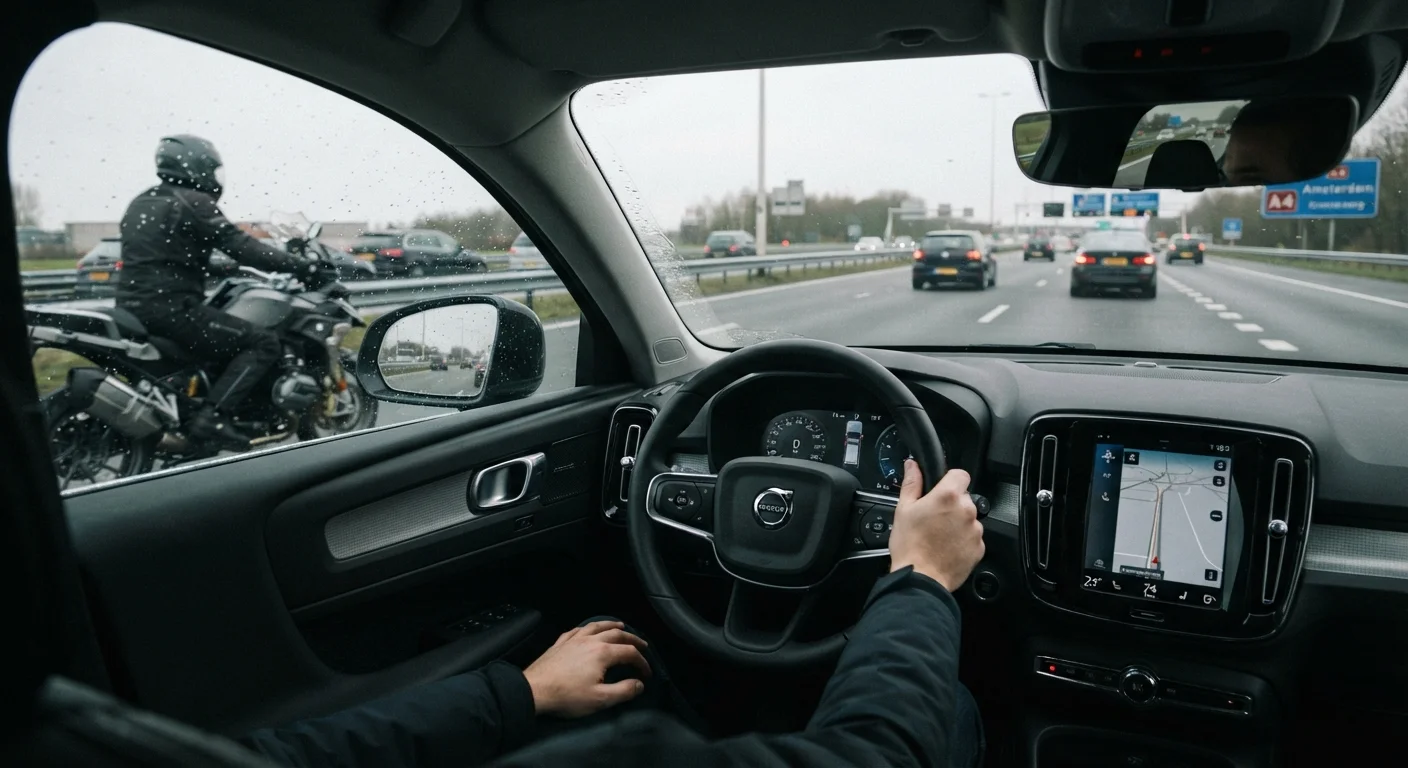
Key Takeaways
- Mirrors adjusted correctly still leave blind spots; a physical head check is always necessary.
- Blind spot size varies significantly by vehicle type, seating position, and mirror adjustment.
- Blind spot monitoring technology assists but does not replace active driver awareness.
- Lane-change crashes are among the most preventable collision types with proper scanning habits.
Why Blind Spots Are Bigger Than Most Drivers Realize
Most drivers learned about blind spots during their first driving lesson and promptly moved on. The concept feels simple: there are areas your mirrors can't cover, so glance over your shoulder before changing lanes. In practice, though, the geometry of blind zones is more complex - and more dangerous - than that brief lesson suggested.
A typical passenger car has at least two primary blind spots on the rear quarters, but additional dead zones exist directly behind the vehicle, along the A-pillars (the structural columns framing the windshield), and low and close to the front bumper. Larger vehicles - trucks, SUVs, vans - have correspondingly larger and more numerous blind zones. Understanding that blind spots are zones, not just quick glance angles, changes how you manage them.
For a deeper look at how attention lapses in specific scenarios, see our guide on driving situations that demand more focus.
Myth
If I check my mirrors before changing lanes, I've covered my blind spots.
Fact
Mirrors show what's directly behind and slightly to the side - the rear quarters remain hidden without a physical head turn.
Mirrors are designed to capture rearward visibility, but the human field of view and standard mirror angles together still leave a wedge-shaped zone on each rear quarter that no mirror reaches. Depending on your vehicle and seating height, this zone can be large enough to hide an entire motorcycle or compact car. A quick glance over your shoulder - turning your head roughly 45 degrees toward the relevant side - is the only way to confirm the zone is clear before moving into it.
Myth
My blind spot monitoring system will catch anything my mirrors miss.
Fact
BSM systems have defined detection ranges and are not calibrated to reliably detect cyclists, pedestrians, or vehicles at significantly different speeds.
Blind spot monitoring radar typically covers a zone extending about 10-20 feet rearward and one lane width to each side. Vehicles that enter and exit this zone rapidly, or that approach from unusually steep angles, can register inconsistently. Cyclists and motorcyclists return a smaller radar signature and are more frequently missed. Treating a silent BSM indicator as confirmation the lane is empty is a documented cause of near-miss and collision events.
Myth
SUVs and trucks have better visibility because the driver sits higher up.
Fact
Higher seating actually creates larger blind zones close to and directly in front of the vehicle, not smaller ones.
Elevated seating improves sightlines in the distance but dramatically worsens close-proximity visibility. A child, a cyclist, or a low obstacle directly in front of a tall SUV or pickup may be entirely invisible from the driver's seat. The front blind zone for some full-size trucks can extend 15 feet or more forward of the bumper. Backup cameras address the rear, but front-proximity awareness requires deliberate caution at very low speeds - such as exiting a parking space or driveway.
Myth
Once I've checked my blind spot and it's clear, I can proceed with the lane change.
Fact
A fast-moving vehicle can enter your blind zone in the fraction of a second between your check and your steering input.
At 65 mph, a vehicle closes roughly 95 feet per second. If a car two lanes over is traveling 15 mph faster than you, it travels about 22 feet in the time it takes to complete a head turn and begin moving the wheel. The window between a clear check and occupancy in that zone is narrow but real. This is why a smooth, deliberate lane change with continuous mirror monitoring - rather than a single check followed by a sharp steer - produces a significantly safer result.
Myth
A-pillar blind spots are minor and only matter in parking lots.
Fact
A-pillar blind spots can conceal pedestrians, cyclists, and motorcyclists at intersections and during turns at any speed.
The A-pillar - the structural column between the windshield and the front side window - is necessarily thick on modern vehicles because it contains airbags and must meet rollover standards. At a right-hand turn, the right A-pillar can mask a pedestrian or cyclist in the crosswalk. Briefly rocking your head forward to look around the pillar before completing a turn is a simple habit that accounts for the geometry most drivers forget exists.
The Mirror Habits That Create a False Sense of Security
Many drivers set their side mirrors so they can see the rear corner of their own vehicle. This feels reassuring - it creates a visual anchor - but it wastes roughly one-third of each mirror's useful field of view on bodywork you already know is there. The Society of Automotive Engineers has long advocated positioning side mirrors further outward, so the rear flanks of the car are just barely visible at the mirror's inner edge. This significantly reduces the classic rear-quarter blind zone, though it does not eliminate it.
Don't Anchor Mirrors to Your Own Car Body
Positioning side mirrors so your own vehicle's rear quarter is prominently visible creates a comfortable reference point but wastes the mirror's coverage on a surface you don't need to see. Adjust mirrors outward until your car's flank is just barely at the inner edge. It will feel unfamiliar at first, but it significantly reduces the classic rear-quarter dead zone.
Mirror angle also shifts with seat position. If multiple people drive the same vehicle, mirrors adjusted for one driver may leave a different driver with substantial unseen zones. Making mirror adjustment part of every seat setup - alongside mirrors, seat height, and steering wheel - is a habit that costs seconds and potentially saves lives.
When changing lanes at highway speed, blind spot errors become especially consequential. Our article on highway merging and reading traffic explains how speed and gap judgment compound the risk.
Technology Helps - But It Has Real Limits
Blind spot monitoring (BSM) systems use radar or ultrasonic sensors to detect vehicles in the adjacent lanes and alert the driver, typically through an amber icon in the mirror housing. These systems are genuinely useful, and crash data suggests they reduce lane-change collisions. But they come with important caveats that manufacturers bury in owner manuals.
~840,000
Annual U.S. blind spot crashes
The National Highway Traffic Safety Administration has estimated that blind spot-related crashes account for a substantial share of lane-change collisions each year in the United States.
~11%
Reduction in lane-change crashes with BSM
Research published by the Insurance Institute for Highway Safety found blind spot monitoring systems were associated with meaningful reductions in lane-change and sideswipe crashes.
Most BSM systems are calibrated to detect passenger vehicles traveling at comparable speeds. They can miss cyclists, motorcyclists, pedestrians, and vehicles that are stationary or moving significantly faster or slower than your car. They also tend to have defined detection zones - if a vehicle is close enough to have partially passed through the zone and is now alongside you at an odd angle, some systems will not register it.
The practical takeaway: treat BSM as a supplementary alert system, not a clearance signal. A physical head check before any lane change remains the most reliable confirmation that the space is actually clear. If you're new to driving, build the physical check habit before you rely on any sensor aid.
No Sensor Replaces the Physical Head Check
Blind spot monitoring, cross-traffic alerts, and camera systems are valuable tools, but every one of them has documented gaps in what they detect. Before any lane change, a physical head turn toward the relevant blind zone is the final, most reliable confirmation available to the driver. Build this habit early and maintain it regardless of what technology your vehicle offers.