
Getting Behind the Wheel for the First Time: What No One Tells You About Early Driving

Key Takeaways
- Learn where every control is located before you start the engine for the first time.
- A consistent pre-drive check takes under two minutes and prevents many common problems.
- Scanning far ahead - not just the car in front - is the most important visual habit to develop.
- Parking lots and low-traffic roads are the safest places to practice new maneuvers.
- Confidence behind the wheel grows through deliberate, progressive practice - not just seat time.
Start here
Understanding the Controls Before You Move
Next
The Pre-Drive Routine Every New Driver Needs
Then
Where Your Eyes Should Actually Be Going
Practice
Basic Maneuvers: What Feels Hard at First
Build on it
Building Confidence Gradually and Safely
Understanding the Controls Before You Move
Before you ever start the engine, sit in the driver's seat and spend a few minutes locating every control you'll need. This sounds basic, but most new drivers skip it - and then scramble to find the wipers mid-rain or accidentally hit the horn instead of turning.
Automatic transmission
A gearbox that shifts gears on its own without requiring the driver to use a clutch pedal. Most vehicles sold in the U.S. are automatics.
Blind spot
The area beside and slightly behind a vehicle that mirrors cannot fully capture. A shoulder check - physically turning your head - is needed to see into this zone.
Scanning
The habit of continuously moving your eyes across the road environment - ahead, mirrors, and sides - rather than fixing your gaze on one spot.
Following distance
The gap between your vehicle and the one ahead. A three-second gap is a widely used rule of thumb for normal driving conditions.
Dashboard warning light
An indicator on your instrument panel that alerts you to a potential issue - such as low tire pressure, low fuel, or an engine fault - that needs attention.
Familiarize yourself with the following before driving:
- Pedals: In an automatic transmission vehicle, two pedals - the brake (left) and accelerator (right). Never rest your left foot on the brake; use only your right foot for both.
- Gear selector: Park (P), Reverse (R), Neutral (N), and Drive (D). Always confirm you're in Park before leaving the vehicle.
- Mirrors: Adjust the rearview mirror so you can see the full rear window. Side mirrors should show a sliver of your own vehicle and a wide view of what's beside you.
- Steering wheel controls: Locate turn signals, wipers, and horn before moving.
- Dashboard warning lights: Learn what the most common indicators mean - fuel, engine, and tire pressure lights in particular.
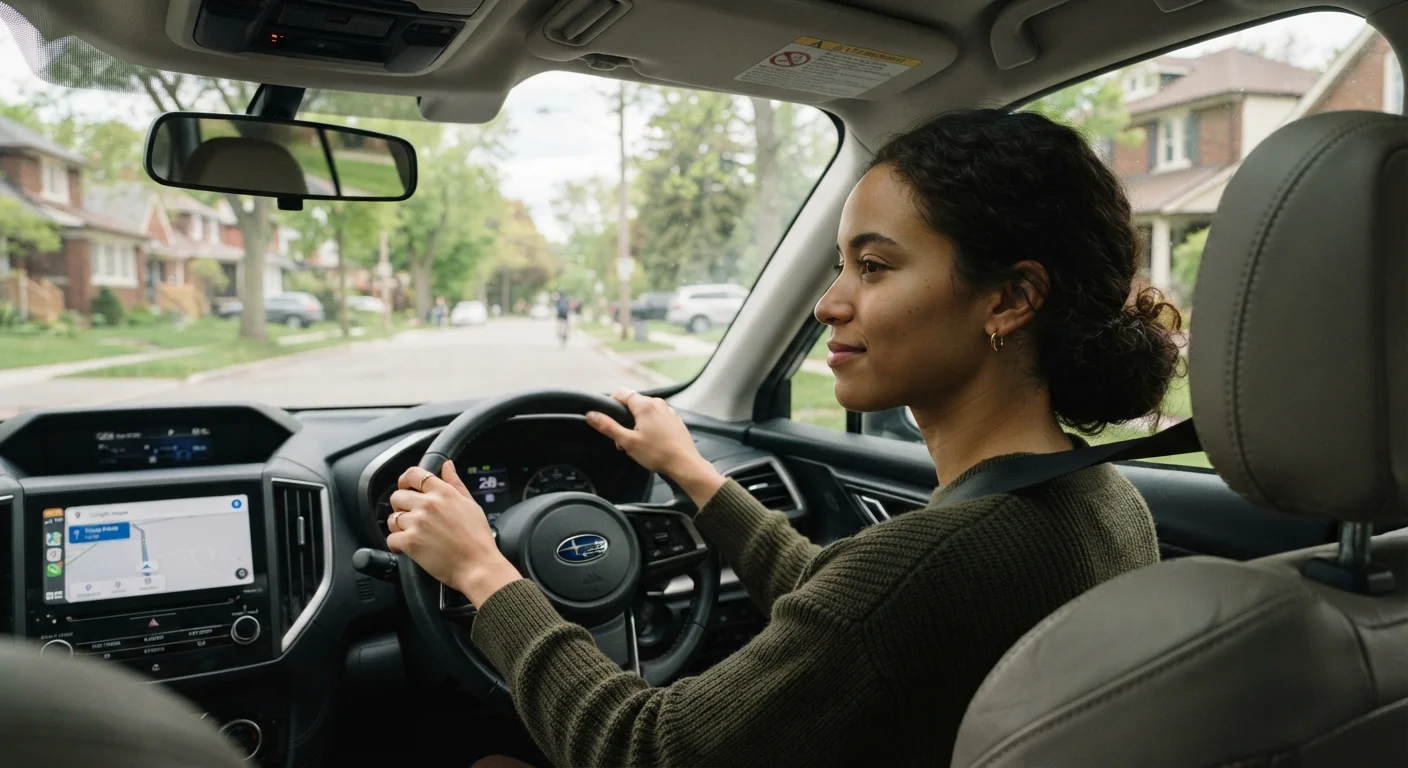
Hands belong at 9 o'clock and 3 o'clock - not the old 10-and-2 position. Modern airbags deploy upward, and arms at 10 and 2 can be forced into your face during deployment.
The Pre-Drive Routine Every New Driver Needs
A consistent check before every drive takes less than two minutes and catches problems - low tires, obstructions behind the car, a broken light - before they become hazards on the road.
Walk around the vehicle before getting in. Look at each tire for obvious flatness, check that nothing is behind or under the car, and glance at the lights if you're driving in low visibility. Once inside, confirm your seat position allows you to reach the pedals comfortably with a slight knee bend - not fully extended and not cramped. Adjust mirrors before starting the engine, not while moving.
For a detailed walkthrough of this habit, see this practical pre-drive routine - it's worth making it automatic from your very first session.
Make Your Seatbelt a Reflex
Fastening your seatbelt before touching the gear selector - every single time - is the single easiest safety habit to build from day one. Don't wait until you feel comfortable driving to start; make it non-negotiable from your very first session. It takes about three weeks of consistent repetition for a behavior to become truly automatic.
Fastening your seatbelt should be the last step before touching the gear selector - every single time. Building it as a non-negotiable reflex early is far easier than correcting the habit later.
Where Your Eyes Should Actually Be Going
New drivers almost universally stare at the road immediately in front of the hood. It's an instinct - the car feels big and unfamiliar, and the nearby pavement feels like the most important thing to monitor. In practice, this habit is one of the biggest early mistakes.
Experienced drivers scan far ahead - ideally 12 to 15 seconds of travel time down the road. At 30 mph, that's roughly 660 feet. Seeing a situation develop from a distance gives you time to react smoothly rather than brake sharply.
Your scanning pattern should cycle through:
- The road ahead, far and mid-distance
- Your rearview mirror every 5 to 8 seconds
- Side mirrors when near intersections or preparing to change position
- A shoulder check before any lane change - mirrors alone are not enough
Understanding why mirrors have limits is essential early on. Our article on blind spots and mirror geometry explains the specific zones most drivers miss and the habits that correct for them.
Basic Maneuvers: What Feels Hard at First
Certain maneuvers trip up almost every new driver, not because they're genuinely difficult, but because they require divided attention - steering while also monitoring mirrors, signals, and speed simultaneously.
Don't Brake Mid-Corner
Braking while you're already turning reduces the tires' grip on the road and can cause the vehicle to understeer (push wide) or become difficult to control. Always slow to an appropriate speed before you begin the turn, then accelerate gently as you exit. This applies at every speed, but is especially important to learn correctly from the start.
Turning
New drivers frequently turn too early or too wide. A useful reference: begin your steering input when the turn is roughly even with your front passenger window. Slow to a comfortable speed before the turn, not during it. Braking mid-corner reduces traction and control.
Parking
Pull-through parking is easiest to start with. Reversing into a space builds useful spatial awareness and is worth practicing deliberately. Back slowly, using both mirrors and brief shoulder checks - never rely on a single point of reference.
Stopping distances
Most beginners underestimate how much road a car needs to stop. At 30 mph, a typical vehicle needs roughly 75 feet to come to a complete stop under normal conditions. Wet or icy roads extend that considerably. Following a three-second gap behind the vehicle ahead gives you a reliable buffer in most conditions.
For a more comprehensive reference on speed management and road behavior, see Safe Driving from Start to Finish - a thorough guide covering U.S. road scenarios from basic to advanced.
Building Confidence Gradually and Safely
Confidence behind the wheel is not something you either have or don't - it's built deliberately, through progressive exposure to more complex conditions as simpler ones become automatic.
A sensible progression for most new drivers:
- Empty parking lot: Steering feel, braking, low-speed turns
- Quiet residential streets: Stop signs, basic turns, pedestrian awareness
- Light suburban roads: Traffic lights, left turns across traffic, mild congestion
- Busier arterial roads: Higher speeds, merging, more complex intersections
- Highway driving: Only after the above feel comfortable
Night driving, rain, and highway merging are each their own learning curve - treat them as separate skills to introduce one at a time, not all at once.
As you grow more comfortable with driving itself, it's worth starting to understand the broader responsibilities of vehicle ownership - from insurance to maintenance. The Vehicle Ownership hub and Car Maintenance hub are good next stops when you're ready to go beyond the basics of driving.
This article is for general informational and educational purposes only. Always follow your state's licensing requirements and, where possible, learn under the supervision of a qualified driving instructor.