

Key Takeaways
- Tailgating is a leading contributing factor in rear-end collisions, which account for roughly 29% of all crashes.
- At 60 mph, a car travels 88 feet per second - a one-second gap offers almost no margin for driver reaction.
- Both aggressive intent and inattention can cause tailgating; the physical danger is identical in either case.
- A three-second following gap is the widely taught minimum, but conditions like rain or heavy loads demand more.
- Being tailgated creates real risks too - knowing how to respond safely can prevent a chain-reaction crash.
Tailgating
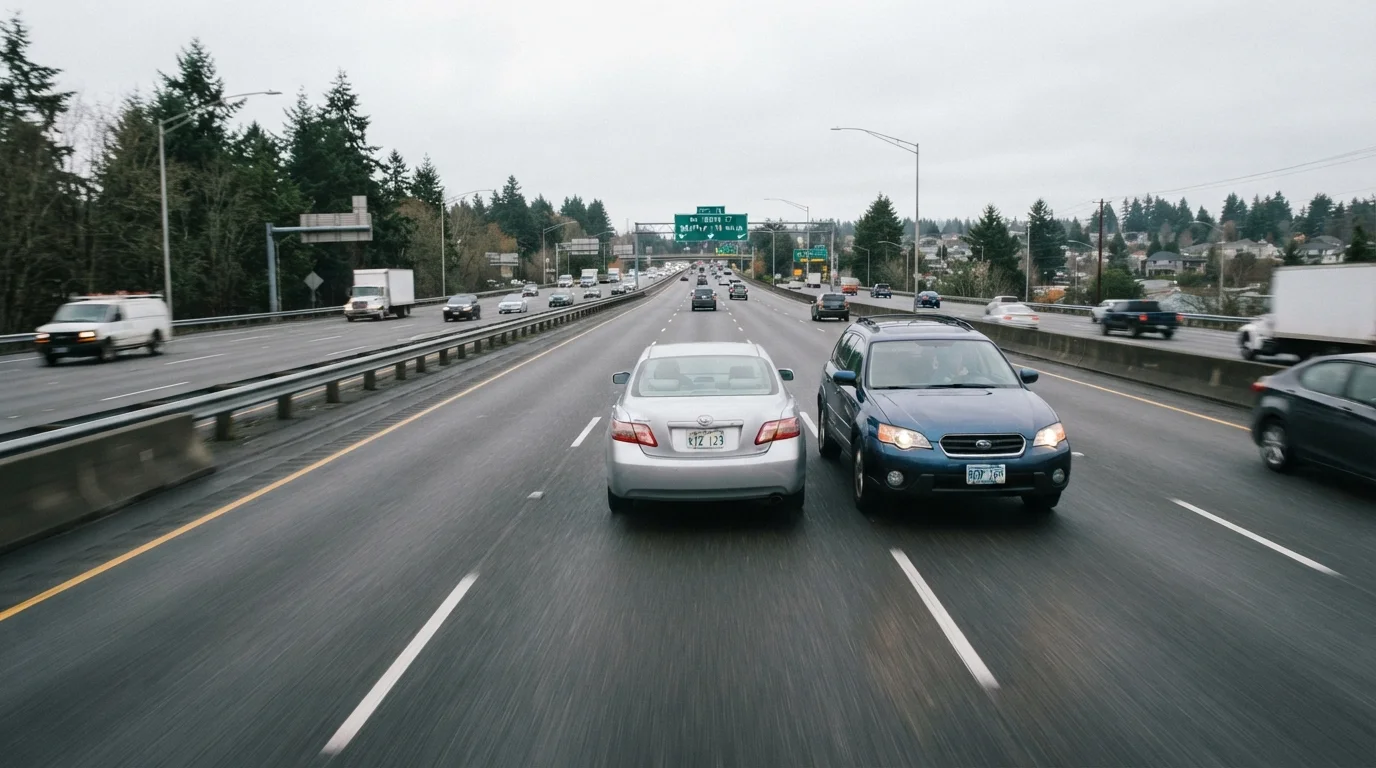
Tailgating means driving too close to the vehicle ahead - so close that you wouldn't have enough distance to stop safely if that car braked suddenly. It's one of the most common forms of aggressive or inattentive driving in the U.S. and a leading factor in rear-end collisions.
Traffic engineers and safety researchers measure following distance using time gaps rather than car lengths, because stopping distance scales with speed. A gap of less than two seconds is generally considered unsafe at any highway speed.
The Physics That Make Tailgating So Dangerous
At 60 mph, a vehicle covers approximately 88 feet every second. The average driver takes between 1.5 and 2.5 seconds to perceive a hazard and move their foot to the brake - that's 132 to 220 feet before braking even begins. Add the actual stopping distance, and a car traveling at highway speed needs roughly 300 feet to come to a full stop under good conditions.
A tailgating driver who closes that gap to one or two seconds has already consumed most of that buffer before their foot leaves the accelerator. There is no physics-based solution at that point - only luck.
Stopping distance also increases non-linearly with speed. Doubling your speed roughly quadruples stopping distance, which is why following too closely on a highway is disproportionately more dangerous than in a parking lot crawl. Understanding the science behind following distance puts these numbers into practical context for everyday driving.
~29%
Share of all U.S. crashes that are rear-end collisions
According to the National Highway Traffic Safety Administration (NHTSA), rear-end crashes represent roughly 29% of all reported collisions annually.
88 ft/sec
Distance traveled per second at 60 mph
At 60 mph, a vehicle covers 88 feet each second, meaning a one-second following gap provides almost no margin for reaction and braking.
1.5-2.5 sec
Typical driver perception-reaction time
Traffic safety research consistently places average driver reaction time between 1.5 and 2.5 seconds - time during which the vehicle continues at full speed.
Why Drivers Tailgate: Psychology Behind the Behavior
Tailgating isn't always aggressive - though it can be. Safety researchers and traffic psychologists identify several distinct patterns:
- Frustration and aggression: A driver who feels the car ahead is going too slowly may follow closely as a form of social pressure. This is the most commonly recognized form, and it's a component of what's broadly called aggressive driving.
- Inattention: Many tailgaters have no hostile intent - they've simply drifted forward while distracted or fatigued, unaware of how the gap has shrunk.
- Underestimation of speed: Speed perception degrades at highway velocities. A gap that looks adequate at a glance may be far shorter than it appears, especially when both vehicles are moving fast.
- Herd behavior: In dense traffic, drivers match the spacing of those around them rather than calculating what's actually safe.
Defensive driving techniques directly address all of these patterns by training drivers to maintain situational awareness rather than react to social cues or match the crowd.
Use the Three-Second Count as a Habit
Pick a fixed roadside marker - a sign, overpass, or shadow line. When the vehicle ahead passes it, count 'one-one-thousand, two-one-thousand, three-one-thousand.' If you reach the marker before finishing the count, you're too close. Make this check automatic every few minutes on any highway drive.
What Tailgating Actually Costs: Crashes, Fines, and Liability
Rear-end collisions are among the most frequent crash types in the U.S., and following too closely is consistently cited as a primary contributing factor. Beyond the human toll, the practical consequences are significant:
- Legal penalties: Every state prohibits following too closely. A citation typically carries a fine and license demerit points. If a crash results, a tailgating driver faces a strong presumption of fault.
- Insurance consequences: An at-fault rear-end collision can raise premiums substantially and stay on your record for years.
- Civil liability: Injured parties can pursue damages covering medical costs, lost wages, and vehicle repair. If the rear driver was tailgating, establishing liability is often straightforward.
These consequences compound when speed is involved. A rear-end collision at 40 mph causes dramatically more damage - and injury - than one at 15 mph. New and inexperienced drivers are particularly at risk; habits that make new drivers vulnerable explores why crash rates are highest in the first year of licensure.
Rear-End Fault Is Rarely Shared Equally
In most U.S. states, the rear driver in a rear-end collision carries a strong legal presumption of fault, because maintaining a safe following distance is a driver's legal duty. While exceptions exist - such as sudden illegal lane changes - tailgating leaves very little room to argue otherwise in court or with an insurer.
How to Respond When You're Being Tailgated
Being the lead vehicle in a tailgating situation is stressful - and reactive decisions made in that moment can escalate danger. Here's what works:
- Increase your own buffer. Gradually ease off the accelerator to create more space between you and the car ahead. This gives you more stopping distance and reduces the chain-reaction risk if you need to brake.
- Avoid sudden braking. Brake-checking a tailgater is dangerous and can result in a collision for which you may share fault.
- Signal and change lanes when safe. If you're in a passing lane, moving right allows the tailgater to proceed and removes the pressure entirely.
- Don't engage. Eye contact, gestures, or speed changes meant to retaliate escalate risk for everyone on the road.
This kind of hazard awareness connects directly to broader perceptual skills. Understanding your blind spots is equally important when changing lanes to escape a tailgater - a hasty move into an unseen vehicle is its own serious hazard.
This article is for general informational purposes only. Always consult applicable local traffic laws and regulations for guidance specific to your jurisdiction.