

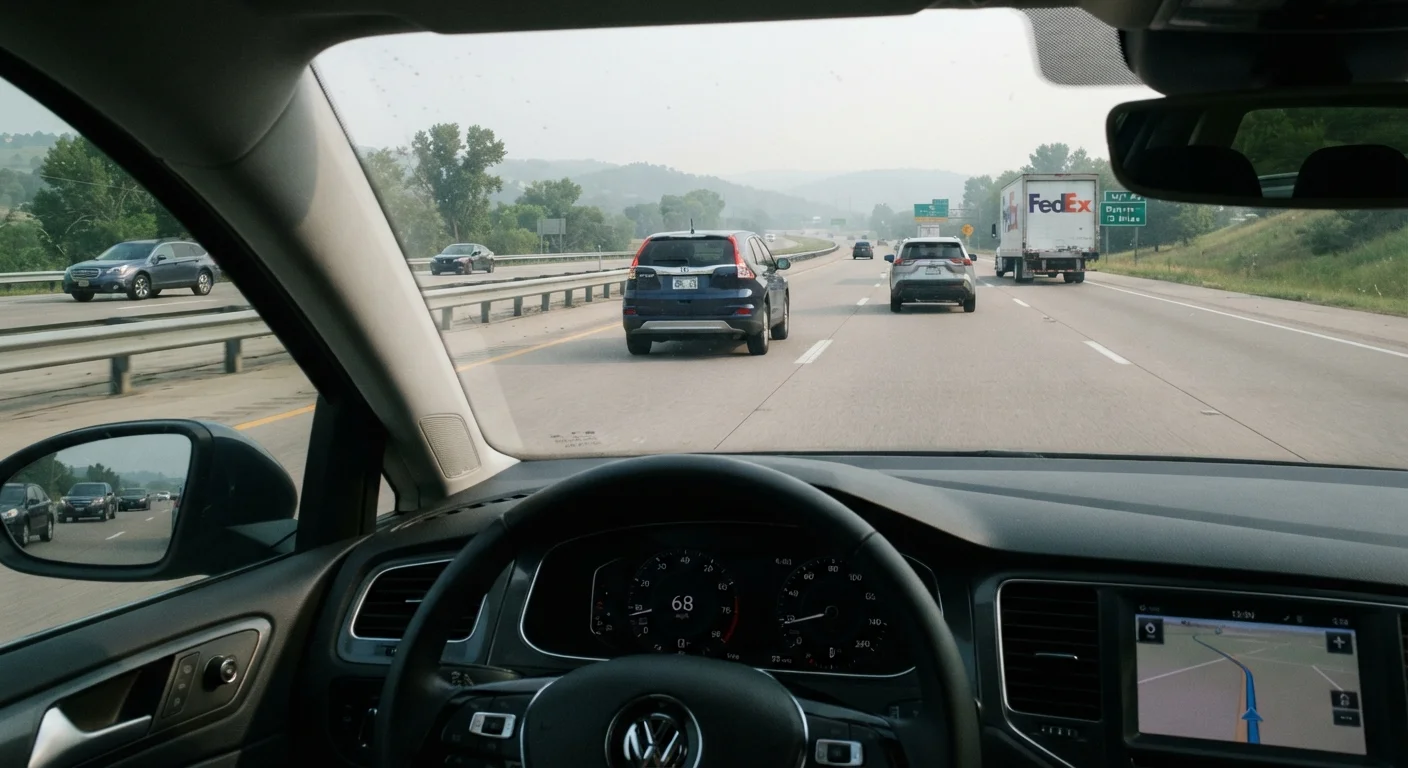
Key Takeaways
- The three-second rule is a useful baseline, but it is not sufficient in many common driving conditions.
- Stopping distance increases with speed at a non-linear rate - doubling your speed more than doubles the distance needed to stop.
- Wet, icy, or gravel roads can dramatically extend braking distance beyond what the three-second rule accounts for.
- Reaction time - typically 1.5 seconds for an alert driver - consumes a significant portion of your available gap before brakes are even applied.
- Large vehicles, towing, and fatigue all require additional following distance beyond standard recommendations.
Following Distance
Following distance is the space - measured in time or length - between your vehicle and the one directly in front of you. It determines how much time you have to perceive a hazard, react, and bring your vehicle to a stop before striking the car ahead. A greater following distance means more time to respond and more room to stop safely.
Stopping distance is the sum of reaction distance (how far you travel during perception and response) and braking distance (how far your vehicle travels after braking begins). Both components grow significantly with speed, making gap management increasingly critical at highway speeds.
Why the Three-Second Rule Exists - and Where It Falls Short
Traffic safety educators introduced the three-second rule because it is simple, adaptable across speeds, and easy to apply without mental arithmetic. Unlike older car-length rules - which became misleading as vehicles grew larger and highways got faster - a time-based gap automatically scales with speed. At 30 mph, three seconds gives you roughly 132 feet. At 60 mph, it gives you about 264 feet.
The problem is that this rule was designed for alert drivers on dry pavement in well-maintained vehicles - an idealized set of conditions. Most real driving falls outside that baseline. Rain, tire wear, distraction, tailgating pressure from other drivers, and the physical characteristics of what you're driving all erode the safety margin that three seconds is supposed to provide.
For a deeper look at how attention and conditions interact on the road, see the situations that demand extra focus covered in our related guide.
~1.5 sec
Average reaction time for an alert driver
Research referenced by the National Safety Council indicates that perception-reaction time for an unimpaired, attentive driver typically falls between 1.5 and 2.5 seconds depending on conditions.
4×
Increase in braking distance when speed doubles
Because braking distance increases with the square of speed, doubling your speed quadruples - not doubles - the distance required to stop, a relationship established by basic physics.
~50%
Increase in stopping distance on wet roads
Driver education standards and road safety research commonly cite wet pavement as extending stopping distances by roughly 50% compared to dry conditions at the same speed.
The Physics of Stopping: Reaction Time Plus Braking Distance
Stopping a vehicle involves two distinct phases. First, reaction distance: the distance your car travels while your brain perceives a hazard and your foot moves to the brake pedal. For an alert, unimpaired driver, this takes roughly 1.5 seconds - meaning at 60 mph you have already covered 132 feet before braking even begins.
Second, braking distance: the additional distance your vehicle travels while the brakes are actually working. Braking distance increases with the square of your speed - so doubling your speed quadruples the braking distance, not merely doubles it. At 30 mph on dry pavement a typical car might stop in around 75 feet of braking distance. At 60 mph, that figure jumps to approximately 300 feet.
Combined, these two phases mean a driver going 60 mph may need more than 400 feet to come to a full stop. A three-second gap at 60 mph provides only 264 feet. This is the core reason the rule requires adjustment at higher speeds.
“The gap you leave in front of you is not empty space - it is time. And time is the one resource you cannot recover once it is gone.”
— Cars & Driving Editorial Team, Cars & Driving Editorial Team, summarizing the core principle of following-distance science
When to Extend Your Gap Beyond Three Seconds
Several common conditions call for a longer following distance than the standard rule suggests:
- Adverse weather: Wet roads increase stopping distances by approximately 50%. Ice and packed snow can extend them two to four times beyond dry-pavement figures. When precipitation is falling, add one to two full seconds to your gap at minimum.
- Highway speeds: At 65-75 mph, most driving safety professionals recommend four seconds or more. The additional margin accounts for the longer braking distance at speed.
- Towing or carrying heavy loads: A loaded trailer significantly increases your vehicle's total weight and braking demand. The heavier the load, the more distance you need.
- Following large commercial vehicles: Trucks require more distance to stop and also block your sightlines. Increasing your gap gives you earlier visual access to what lies ahead of the truck.
- Fatigue or impairment: Even mild tiredness measurably slows reaction time. If you feel fatigued, give yourself extra buffer - and consider whether you should be driving at all.
Night driving introduces its own visibility challenges that compound the need for additional following distance, especially on unlit roads.
A Simple Way to Check Your Gap
Pick a static object on the roadside - a sign, a shadow line, or a road marking. When the vehicle ahead passes it, start counting: one-one-thousand, two-one-thousand, three-one-thousand. If you pass the same point before finishing the count, ease off the accelerator and rebuild your gap. In rain or at highway speeds, extend your count to four or five seconds.
Following Distance and Rear-End Collision Risk
Rear-end collisions are among the most common crash types on American roads, and insufficient following distance is a primary contributing factor. The physics and psychology of tailgating make this pattern particularly dangerous: drivers who follow closely tend to underestimate their speed relative to the car ahead, and their available gap dissolves faster than intuition suggests.
It is also worth noting that the vehicle behind you may be following too closely even when you are not. Maintaining your own proper distance creates a buffer that can absorb sudden changes in traffic flow, reducing the likelihood that a chain-reaction stop will catch either you or the driver behind you off guard.
For a broader foundation in safe driving practices, our complete reference for American roads covers following distance alongside speed management, lane discipline, and emergency response techniques.