

| Governing standard for U.S. road signs | MUTCD (Manual on Uniform Traffic Control Devices) (Federal Highway Administration) |
| Meaning of a solid yellow centerline on your side | No passing permitted for your direction of travel |
| Flashing yellow arrow - right of way | Yield required; turn is permitted but unprotected |
| Gore area usage | Not a travel lane; driving through is illegal |
| School zone speed limit applicability | Often active only during posted hours or when children are present (Varies by state law) |
| Left-lane travel rule | Mandatory keep-right laws exist in many U.S. states (Varies by jurisdiction) |
Why Sign Misreading Is More Common Than You Think
Most drivers pass their knowledge test once and rarely revisit the rulebook. Over time, assumptions fill the gaps-and those assumptions don't always match what the signs actually say. The Federal Highway Administration's MUTCD governs U.S. road signs and markings, but the average driver has never read it. The result: confident misinterpretation of signs encountered every single day.
Misreading a sign rarely causes an immediate crash, which is part of the problem-it reinforces the wrong behavior. Understanding what signs genuinely mean, rather than what they seem to mean at a glance, is a foundational piece of driving safely. For a broader look at how perception gaps affect safety, see what most drivers get wrong about blind spots.
| Governing standard for U.S. road signs | MUTCD (Manual on Uniform Traffic Control Devices) (Federal Highway Administration) |
| Meaning of a solid yellow centerline on your side | No passing permitted for your direction of travel |
| Flashing yellow arrow - right of way | Yield required; turn is permitted but unprotected |
| Gore area usage | Not a travel lane; driving through is illegal |
| School zone speed limit applicability | Often active only during posted hours or when children are present (Varies by state law) |
| Left-lane travel rule | Mandatory keep-right laws exist in many U.S. states (Varies by jurisdiction) |
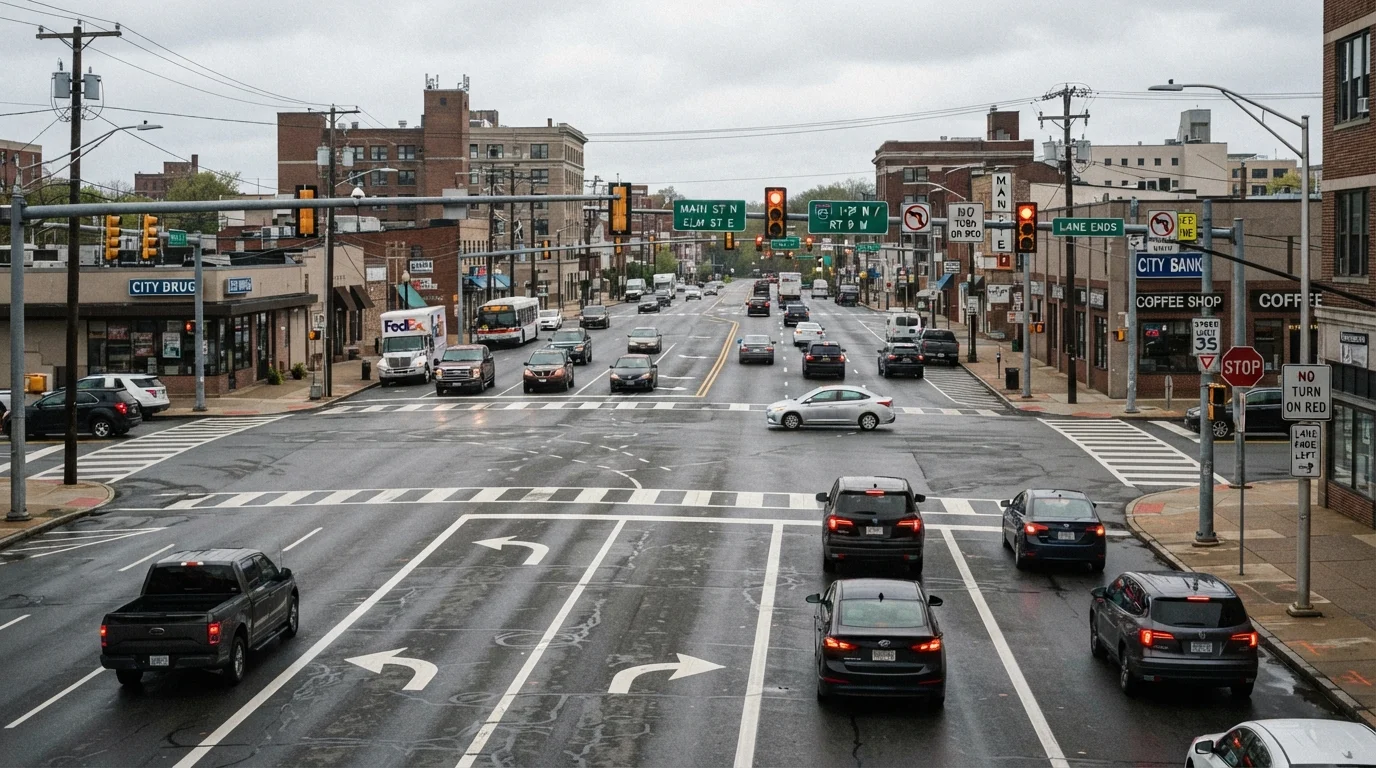
Signs and Markings That Drivers Routinely Misread
"Speed Limit" vs. "Maximum Speed" - A posted speed limit is a legal maximum under ideal conditions, not a target or a minimum. Driving at the limit in rain, fog, or heavy traffic may still be unsafe and can be cited as negligent driving in some states.
Flashing yellow arrow - This signal permits a left turn, but requires drivers to yield to oncoming traffic and pedestrians. Many drivers treat it like a protected green arrow. It is not. A collision risk exists any time that distinction is blurred.
"Do Not Pass" solid yellow centerline - A solid yellow line on your side of the road means passing is prohibited for your direction of travel. A solid line on the opposite side means only they cannot pass. Double-solid means neither direction may pass. Drivers frequently misread which line applies to them.
White edge lines - The solid white line at the right edge of a travel lane is not a bicycle lane boundary; it marks the edge of the roadway. Crossing it doesn't automatically indicate an illegal maneuver, but it means you've left the travel lane.
"Keep Right Except to Pass" signs - These are mandatory in many states, not advisory. Remaining in the left lane when not passing is illegal in those jurisdictions, regardless of your speed.
Yield vs. merge - A yield sign requires you to slow or stop and give right-of-way to conflicting traffic. Many drivers treat it as a slow-roll with minimal attention. At highway on-ramps especially, the distinction between yielding and merging has meaningful safety implications. Understanding highway merging correctly is a related skill worth reviewing.
School zone speed limits - These often apply only when children are present or during posted hours-not automatically at all times. However, when they are in effect, enforcement is strict and fines are typically elevated. School zones are among the driving situations that demand the most focused attention.
MUTCD
The Manual on Uniform Traffic Control Devices, published by the Federal Highway Administration, is the national standard governing the design and placement of road signs, signals, and markings across U.S. public roads.
Gore area
A triangular buffer zone marked with diagonal stripes at highway lane splits or exits. It separates diverging traffic flows and is not a travel lane.
Two-way left-turn lane
A center lane marked by solid and dashed yellow lines on each side, reserved exclusively for vehicles preparing to make a left turn from either direction of travel.
Flashing yellow arrow
A traffic signal indicating that left turns are permitted but unprotected-drivers must yield to oncoming traffic and pedestrians before proceeding.
Edge line
A solid white line painted along the right edge of a travel lane, marking the boundary between the roadway and the shoulder or roadside.
Pavement Markings That Often Go Misunderstood
Diagonal yellow stripes (gore areas) - The striped zones you see at lane splits or highway exits are not travel lanes. They are gore areas-buffer spaces designed to keep vehicles safely separated during lane transitions. Driving through them is illegal and dangerous.
Shared center turn lane - A two-way left-turn lane (marked by solid and broken yellow lines on each side) is for initiating left turns only. It is not a merge lane for accelerating into traffic, and it is not a passing lane. Using it as either creates a direct collision risk with drivers turning from the opposite direction.
White dashed lines vs. solid white lines - Dashed white lines separate lanes of traffic moving in the same direction and may be crossed with care. A solid white line discourages lane changes (such as near intersections or in tunnels) and in some contexts prohibits them entirely.
Keeping these distinctions clear is part of the broader practice of reading the road accurately-a skill that pays off most in complex or unfamiliar driving situations.