

Key Takeaways
- Simple tasks like air filter swaps and wiper blade changes are safe, cost-effective DIY projects for most drivers.
- Brake system, suspension, and fuel system work carries real safety risk and typically warrants a qualified mechanic.
- Knowing your own skill level and tool access honestly is the most important factor in the DIY decision.
- A consistent maintenance log protects resale value whether the work is done at home or in a shop.
- Deferred maintenance - DIY or otherwise - tends to compound into costlier repairs over time.
Our Verdict
DIY maintenance makes financial and practical sense for a defined set of simple, low-risk tasks. For anything involving safety-critical systems - brakes, steering, fuel - a qualified mechanic is the prudent choice. The dividing line isn't about being handy; it's about the consequences of getting it wrong.
| Best for | Recommended |
|---|---|
| Drivers comfortable with basic tools and routine upkeep | DIY maintenance for simple tasks |
| Safety-critical repairs or complex diagnostics | Professional shop service |
| High-mileage vehicles needing thorough inspections | Professional shop service |
| Routine checks before a long road trip | DIY maintenance for basic checks, shop for anything flagged |
Why the DIY vs. Shop Question Matters
Every car owner eventually faces the same calculation: spend an hour in the driveway with a YouTube tutorial, or drop the car off and pay shop rates? The honest answer depends far less on pride or frugality than on three practical factors - the nature of the task, your actual skill and tool access, and the cost of a mistake.
Labor typically accounts for 40-60% of a standard repair bill, which is why DIY appeals to budget-conscious drivers. But some jobs demand a lift, a torque wrench calibrated to spec, or specialized diagnostic equipment that a home garage simply doesn't have. And certain errors - an improperly bled brake line, a loose wheel bearing, a fuel fitting that isn't fully seated - can have consequences that far outweigh any savings. Understanding how deferred or botched maintenance compounds over time is a useful framework here: the question isn't just "can I do this?" but "what happens if I do it wrong?"
Tasks That Are Genuinely DIY-Friendly
A handful of routine jobs require minimal tools, carry low risk if done imperfectly, and have clear how-to guidance in any owner's manual. These are solid candidates for the driveway:
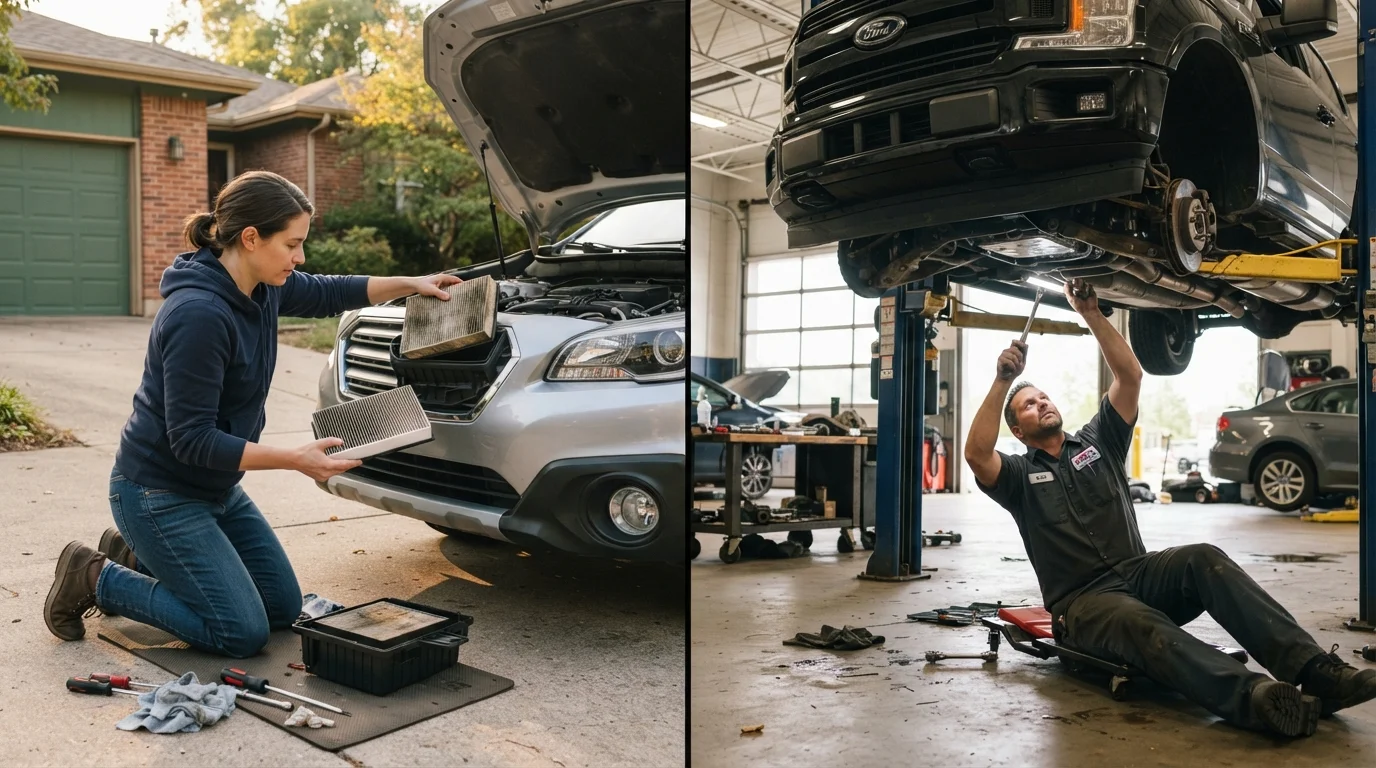
- Engine air filter replacement: Typically involves releasing a few clips, swapping the filter, and reseating the housing. Interval guidance is in your owner's manual.
- Wiper blade replacement: Most blades attach with a simple hook-and-tab mechanism. No tools needed.
- Cabin air filter: Usually accessible behind the glove box or under the dashboard; often a five-minute job.
- Checking and topping off fluids: Windshield washer fluid, coolant reservoir, and brake fluid reservoir levels are visible checks. Adding fluid is low-risk; diagnosing why a reservoir is low is a different matter.
- Battery terminal cleaning: A wire brush and baking soda solution can address corrosion buildup on terminals. Disconnect the negative cable first.
When you tackle these yourself, log them. A consistent service record supports resale value and helps a mechanic spot patterns - see why keeping a maintenance log pays off in the long run.
Start With Your Owner's Manual
Before attempting any maintenance task, consult the owner's manual for your specific vehicle. It lists correct fluid specifications, torque values, and service intervals that generic tutorials may get wrong. Many manufacturer manuals are also available as free PDFs on automaker websites.
Where DIY Crosses Into Real Risk
The category of tasks that should default to a qualified mechanic is defined by one question: does a failure here put the driver, passengers, or other road users at risk?
Don't Let Confidence Outpace Competence
A common pattern in DIY repair errors is underestimating complexity mid-job - for example, discovering a corroded bolt or a seized caliper after the wheel is already off. Before starting any job, verify you have every required tool and a clear understanding of each step. If you encounter an unexpected complication, stopping and consulting a professional is always the safer call.
- Brake system work: Pad replacement looks straightforward, but improper reassembly, air in the hydraulic line, or an incorrectly compressed caliper piston can result in brake fade or failure. Rotor and caliper work amplifies that risk further.
- Suspension and steering components: Ball joints, tie rod ends, and control arm bushings affect vehicle handling and alignment. Incorrect torque specs on these parts can cause sudden failure at speed.
- Timing belt or chain service: An error here can destroy an engine; this job requires precision tooling and exact procedural knowledge.
- Fuel system repairs: Working around fuel lines or injectors introduces fire risk. This area warrants a professional environment with proper ventilation and safety equipment.
- Airbag system work: Accidental deployment during service can cause serious injury. Any SRS (Supplemental Restraint System) work should be done by a trained technician.
If you're unclear what's on a repair estimate for any of these systems, understanding mechanic's estimate terminology before you sign is a smart first step.
The Comparison at a Glance
The table below summarizes how DIY and professional shop service stack up across the factors that matter most to everyday drivers.
| DIY Maintenance | Professional Shop | |
|---|---|---|
| Typical cost | Parts cost only | Parts plus labor (40-60% of bill) |
| Safety-critical repairs | High risk if done incorrectly | Trained technician, proper tooling |
| Diagnostic capability | Limited without OBD scanner | Full diagnostic equipment available |
| Warranty implications | May void warranty if done improperly | Work documented, warranty protected |
| Time investment | Variable; learning curve applies | Drop-off convenience, set timelines |
| Best suited for | Filters, fluids, wipers, battery checks | Brakes, suspension, fuel, timing |
For drivers managing a high-mileage vehicle, the calculus often shifts further toward professional service - worn components interact in ways that benefit from an experienced eye. The maintenance approach for high-mileage cars covers where that threshold typically sits. Similarly, before any long trip, a structured check of tires, fluids, and belts - informed by what you know how to inspect yourself - is a practical use of DIY awareness; see how to prepare your car for a long road trip for a full checklist.