

Key Takeaways
- A complete service record can meaningfully support your vehicle's resale value.
- Documented maintenance history helps mechanics diagnose problems faster and more accurately.
- A log protects warranty claims by proving required services were performed on schedule.
- Both paper binders and digital apps can work - consistency matters more than format.
- Every entry should include the date, mileage, work performed, parts used, and cost.
Why a Maintenance Log Is Worth the Effort
Most drivers know they should keep service records, but fewer actually do it consistently. That gap is costly. A maintenance log is not just an organizational tool - it is documentation that can influence warranty outcomes, speed up repairs, and add tangible credibility when you sell the vehicle.
When a mechanic can see exactly when your transmission fluid was last changed or which brand of coolant was used in a previous flush, diagnosis becomes faster and more accurate. Without that history, mechanics often must assume worst-case scenarios and charge for additional diagnostic time. A well-kept log eliminates that guesswork.
From a financial standpoint, buyers and dealers treat documented service history as a signal of responsible ownership. A car with receipts and records typically commands more confidence - and, in many cases, a stronger negotiating position - than an identical vehicle with no paper trail. For more on the financial consequences of skipping services, see how neglected maintenance compounds into bigger costs.
Up to 10%
Potential resale value boost from documented service history
Industry appraisal guidelines consistently note that verifiable maintenance records can improve a used vehicle's perceived value and negotiating position.
1 in 3
Drivers who lack any organized vehicle service records
Consumer research from automotive associations suggests a significant share of vehicle owners keep no consistent documentation of maintenance or repairs.
What Every Log Entry Should Include
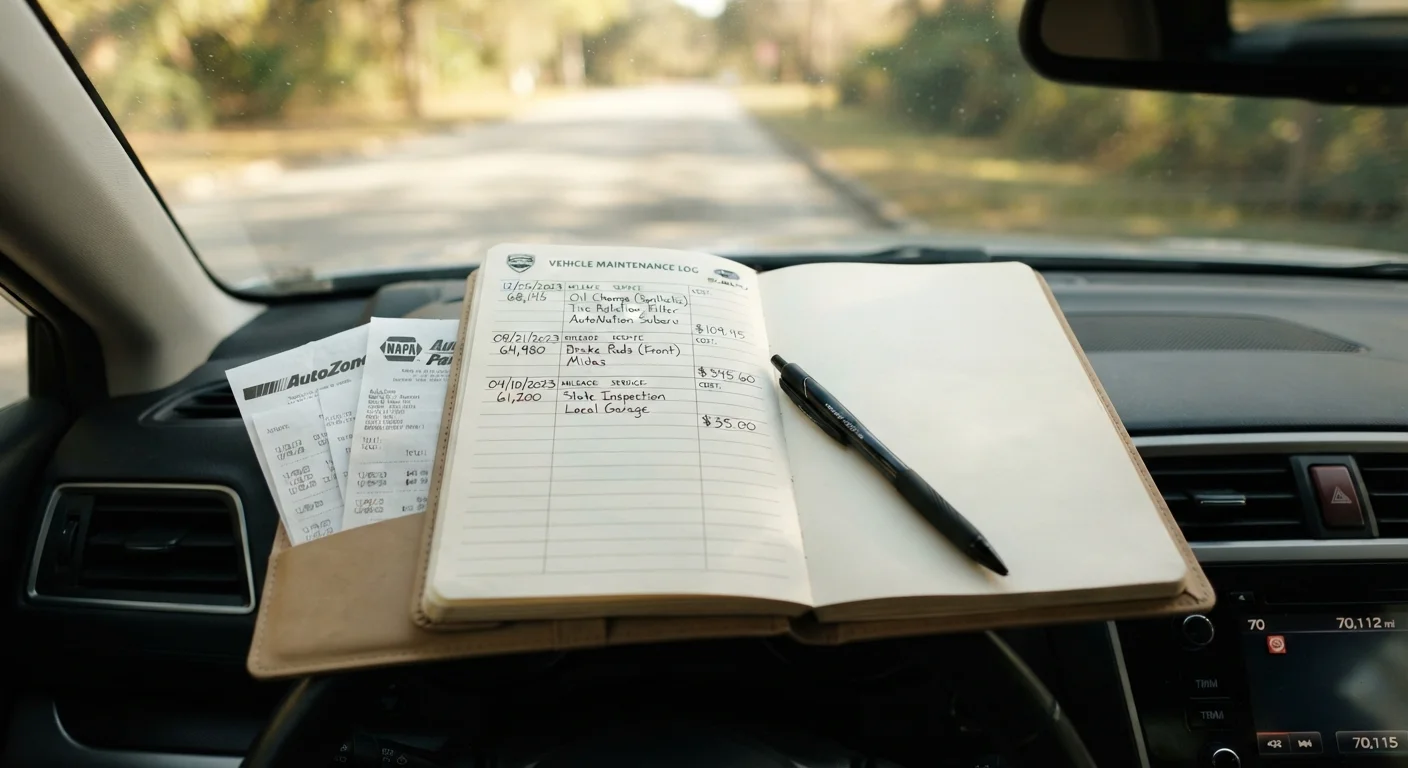
The value of a maintenance log is only as good as the information inside it. A complete entry for each service visit or DIY task should capture:
- Date - when the service occurred
- Odometer reading - the mileage at time of service
- Work performed - a plain-language description (e.g., "oil and filter change," "replaced rear brake pads")
- Parts used - type, specification, or part number where relevant
- Labor or parts cost - total amount paid
- Service provider - shop name or "DIY" if self-performed
Attaching or scanning the original receipt adds a layer of verification that is particularly useful for warranty claims. Many manufacturers require proof that services were performed at the intervals specified in the owner's manual - a dated receipt tied to an odometer reading satisfies that requirement cleanly.
Scan Receipts Before They Fade
Thermal paper receipts - the kind printed by most service shops - can fade to near-illegibility within a few years. Take a quick photo or scan of each receipt the same day you receive it. Store digital copies in a dedicated folder on your phone or cloud drive so the record survives even if the paper doesn't.
Best Practices for Building and Maintaining Your Log
A log you abandon after two entries helps no one. These practices help make record-keeping a sustainable habit rather than a chore.
Log every service immediately after it is completed.
Memory fades quickly, and a two-week delay often means mileage, part details, or costs get recorded inaccurately. Immediate entry keeps the record precise and trustworthy.
Store physical receipts alongside your written entries.
A written summary is useful, but an original receipt with a shop's stamp and itemized parts list carries far more weight in a warranty dispute or resale negotiation. It is independent verification of the claim.
Note what was inspected, not just what was replaced.
When a mechanic checks a component and finds it within spec, that inspection still has value. It establishes a baseline and narrows the timeline of when a problem may have begun.
Track upcoming service intervals alongside past ones.
A log that only looks backward misses half its utility. Noting the next scheduled service - say, the mileage for the next transmission fluid change - turns the log into a proactive planning tool.
Transfer your log when you hand off the vehicle.
A complete service record transfers with the car, not with the owner. Handing over documented history adds credibility, helps the new owner plan upcoming services, and demonstrates the vehicle has been cared for.
Whether you do your own maintenance or rely entirely on a shop, the principles are the same. If you're weighing those two paths, understanding the tradeoffs between DIY and professional service is a useful starting point. And pairing your log with a structured seasonal routine - like the one outlined in a seasonal car maintenance checklist - helps ensure you never miss a scheduled interval.
Getting Started Today
You do not need to reconstruct years of lost history before you begin - start fresh from today's odometer reading. Pull your most recent oil change receipt, note the mileage, and create your first entry. That single action sets the baseline.
For high-mileage vehicles in particular, a log becomes even more critical as wear patterns begin to emerge. Keeping a high-mileage car running reliably often depends on tracking which components have already been replaced versus those approaching end of life.
The Car Maintenance hub offers additional practical guidance on keeping your vehicle reliable through every stage of ownership.