

Key Takeaways
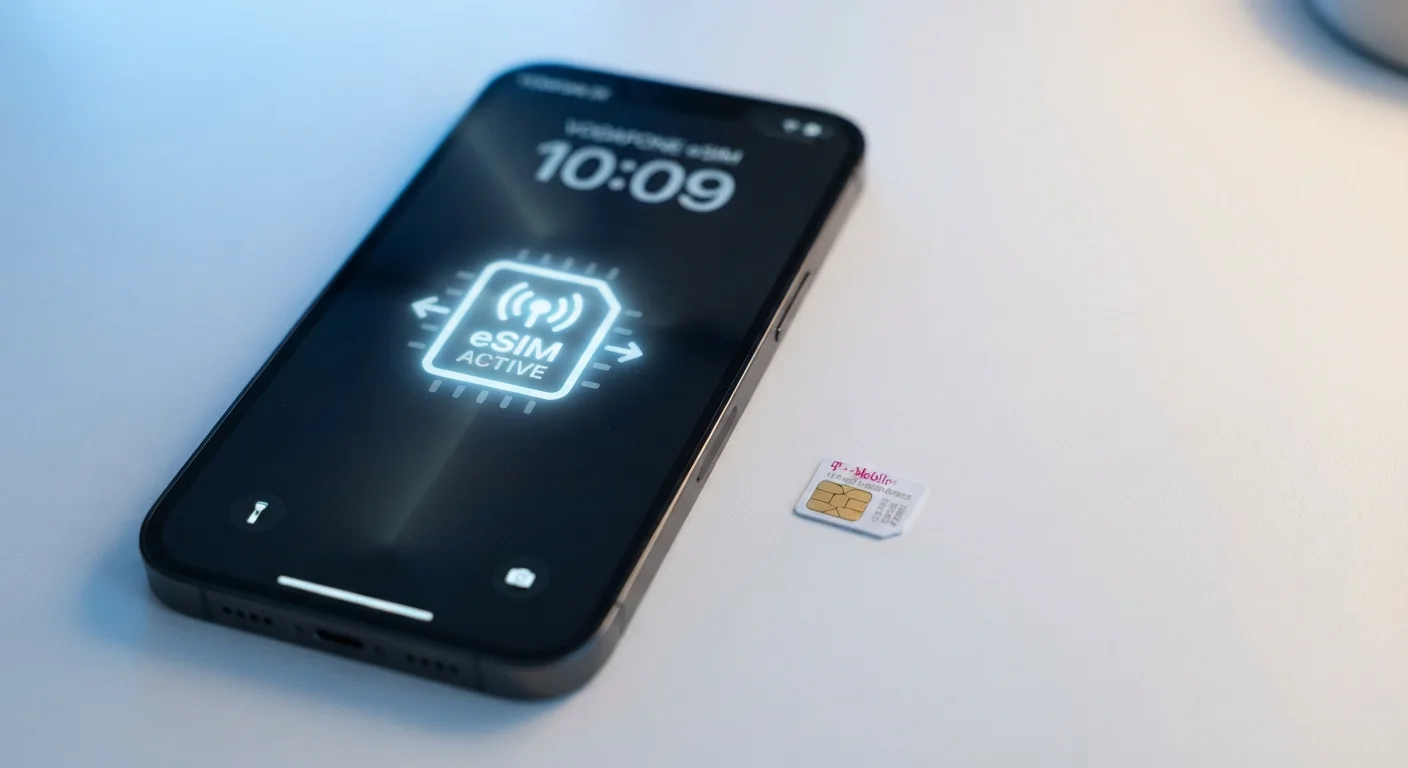
- eSIM is a chip already inside your phone - you activate a carrier plan through software, not by inserting a card.
- Physical SIM cards are still widely supported and aren't going away anytime soon, despite industry momentum toward eSIM.
- Travelers often benefit from eSIM because switching to a local carrier plan takes minutes with no physical card needed.
- Some phones support both eSIM and a physical SIM simultaneously, giving users dual-number flexibility.
- eSIM availability depends on both your device and your carrier - not every plan or provider supports it yet.
- Losing a physical SIM card is a real risk; eSIM profiles are tied to your device and easier to recover remotely.
Option A
eSIM
The built-in, software-based alternative to a physical card.
Best for: Frequent travelers, plan-switchers, and anyone buying a new flagship smartphone who wants carrier flexibility without swapping hardware.
Option B
Physical SIM Card
The removable chip that has connected phones to carriers for decades.
Best for: Users who frequently swap phones, travel to regions with limited eSIM support, or prefer a tangible, familiar setup process.
If you travel internationally and want an easy way to use local data plans
eSIM
Switching to a local carrier abroad takes just a few taps - no hunting for a SIM card vendor or fumbling with tiny hardware at the airport.
If you frequently swap the same SIM between multiple phones
Physical SIM Card
Moving a physical SIM between devices is still simpler than transferring eSIM profiles, which can require carrier involvement and may have transfer limits.
If you want to keep two numbers active on one device
eSIM
Many modern phones support a physical SIM plus an eSIM simultaneously, making it straightforward to separate personal and work lines without carrying two handsets.
If you live in a rural area or use a smaller regional carrier
Physical SIM Card
eSIM support among smaller and regional U.S. carriers is still inconsistent - a physical SIM ensures compatibility with a broader range of providers.
If you're worried about losing your connection if your phone is lost or stolen
eSIM
An eSIM profile can be remotely managed or reissued by your carrier; a physical SIM in a stolen device is immediately accessible to whoever has the phone.
What Each One Actually Is
A physical SIM card (Subscriber Identity Module) is the small removable chip you slot into your phone. It stores a unique identifier that tells your carrier who you are and grants access to their network. For decades, this was the only way to connect a phone to a cellular plan. For a primer on the terminology, the Cell Phone Glossary Every American Consumer Should Know covers SIM-related terms in plain language.
An eSIM (embedded SIM) is a small chip soldered directly into your device's motherboard. It performs the same core function - authenticating your identity with a carrier - but there's no physical card to insert or remove. Instead, you download a carrier profile digitally. Most recent flagship smartphones, smartwatches, and tablets support eSIM, and some newer iPhone models in the U.S. have eliminated the physical SIM slot entirely.
Understanding how cell phone carriers actually work also helps here: both SIM types are simply the handshake between your device and whichever network you've subscribed to.
| Criterion | eSIM | Physical SIM Card |
|---|---|---|
| Activation method | QR code or app download | Insert card into device |
| Swappable between phones | Requires carrier transfer process | Remove and insert - immediate |
| International use | Add local plan digitally, no hardware | Need to source a local SIM card |
| Dual-SIM support | Yes, on compatible devices | Only if device has dual SIM slots |
| Lost/stolen device risk | Profile manageable remotely | Card physically accessible to thief |
| Carrier availability | Major carriers; limited MVNO support | Virtually universal support |
| Network/call quality | Identical to physical SIM | Identical to eSIM |
| Hardware required | None - embedded in device | Physical chip and SIM tray |
What Changes When You Go eSIM
The most tangible change is the activation process. With a physical SIM, you receive a card (by mail or in-store), pop it in, and you're live. With eSIM, you scan a QR code, tap through an app, or accept a push notification from your carrier. For many people, this is genuinely faster and less fiddly - no SIM ejector tool required.
International travel is where eSIM tends to shine most clearly. Instead of sourcing a local SIM card when you land abroad, you can purchase and activate a local or regional data plan before your plane touches down. This can mean the difference between having navigation ready at arrivals and spending 20 minutes at a kiosk. Check with your specific carrier about international eSIM plan availability, as options vary widely. You can also explore prepaid, postpaid, and family plan differences for context on how plans are structured.
Device upgrades also work differently. When you get a new phone with eSIM, your carrier typically lets you transfer your plan digitally - no waiting for a new SIM to arrive in the mail. However, the number of times you can transfer an eSIM profile varies by carrier policy, so it's worth checking before you make a habit of swapping devices frequently.
~50%
Of global smartphone shipments with eSIM support
Industry analysts estimate roughly half of smartphones shipped globally include eSIM capability, a proportion that continues to grow each year.
3 formats
Physical SIM sizes still in use today
Standard, micro, and nano SIM formats have all been in circulation, though nano SIM is now dominant - illustrating how physical SIM has also evolved over time.
What Stays Exactly the Same
Here's what doesn't change: your phone number, your plan, your coverage. Whether your carrier profile lives on a plastic chip or an embedded silicon component, the network experience is identical. You get the same LTE or 5G speeds, the same data limits, and the same billing cycle. If you want to understand how 5G factors into this, what 5G actually is - and what it isn't is a useful read.
Your carrier relationship stays the same too. eSIM doesn't automatically unlock your phone from a carrier, nor does it grant access to any additional networks. A locked eSIM phone is just as restricted as a locked physical SIM phone. For more on that distinction, see locked vs. unlocked phones explained.
Finally, call quality, voicemail, SMS, and data all function identically. The SIM format is an authentication mechanism - it doesn't affect how your voice is encoded or how packets of data move across the network.
eSIM and Unlocked Phones: Not the Same Thing
A common misconception is that eSIM automatically means an unlocked phone. It doesn't. eSIM is a hardware and activation format; carrier locking is a software restriction applied by your carrier. An eSIM phone can be just as locked to a single carrier as any physical SIM device. If you're planning to switch carriers, confirm your device's unlock status separately from its eSIM capability.
Practical Considerations Before You Switch
Before assuming eSIM is the right move for you, run through these checkpoints:
- Device compatibility: eSIM requires hardware support. Most phones released after 2020 by major manufacturers include it, but budget and older devices often don't.
- Carrier support: All three major U.S. carriers support eSIM, but many smaller MVNOs (Mobile Virtual Network Operators) are still catching up. Verify with your specific provider before making the jump.
- Profile limits: Most eSIM-capable phones can store multiple carrier profiles but only activate one (or two on dual-SIM models) at a time. The number of stored profiles varies by device.
- Device repair considerations: If you need a factory reset or significant repair, you may need to re-download your eSIM profile. Keep your carrier account credentials accessible.
Neither format is objectively superior for every person. The right choice depends on how you use your phone, where you travel, and which carriers serve your area best.