

Key Takeaways
- Zero-based budgeting assigns every dollar of income to a specific category so income minus expenses equals zero.
- Envelope budgeting divides cash (or digital equivalents) into spending categories; when an envelope is empty, spending stops.
- Zero-based budgeting demands more ongoing tracking effort but works well for variable or complex income situations.
- Envelope budgeting provides a strong behavioral guardrail against overspending but can be less practical for digital-first finances.
- Both methods share a core principle: intentional, pre-planned allocation rather than reactive spending.
Option A
Zero-Based Budgeting
The comprehensive, dollar-by-dollar allocation framework.
Best for: People who want total visibility into every spending category and are comfortable working with spreadsheets or budgeting apps.
Option B
Envelope Budgeting
The tactile, cash-first system built around spending limits.
Best for: People who struggle with overspending and want a physical or visual constraint that makes limits impossible to ignore.
If you want granular control over every spending category
Zero-Based Budgeting
Zero-based budgeting forces you to account for every dollar before the month begins, making it easier to spot waste and redirect money toward goals.
If you consistently overspend and need a hard stop
Envelope Budgeting
The physical or visual limit of an envelope makes overspending tangible and immediate - there is no 'I'll make it up next month' option.
If your income varies month to month
Zero-Based Budgeting
Zero-based budgeting lets you re-allocate income from scratch each month, adapting naturally to fluctuating earnings.
If you prefer simplicity over precision
Envelope Budgeting
Envelopes require minimal ongoing math - once you've divided your cash, the system enforces itself without spreadsheets or apps.
If most of your spending is digital or card-based
Zero-Based Budgeting
Zero-based budgeting pairs naturally with digital tools and app-based tracking, making it far more practical for cashless households.
How Each Method Works
Both zero-based and envelope budgeting operate on the same foundational premise: every dollar of income should have a designated job before you spend it. The similarity ends there.
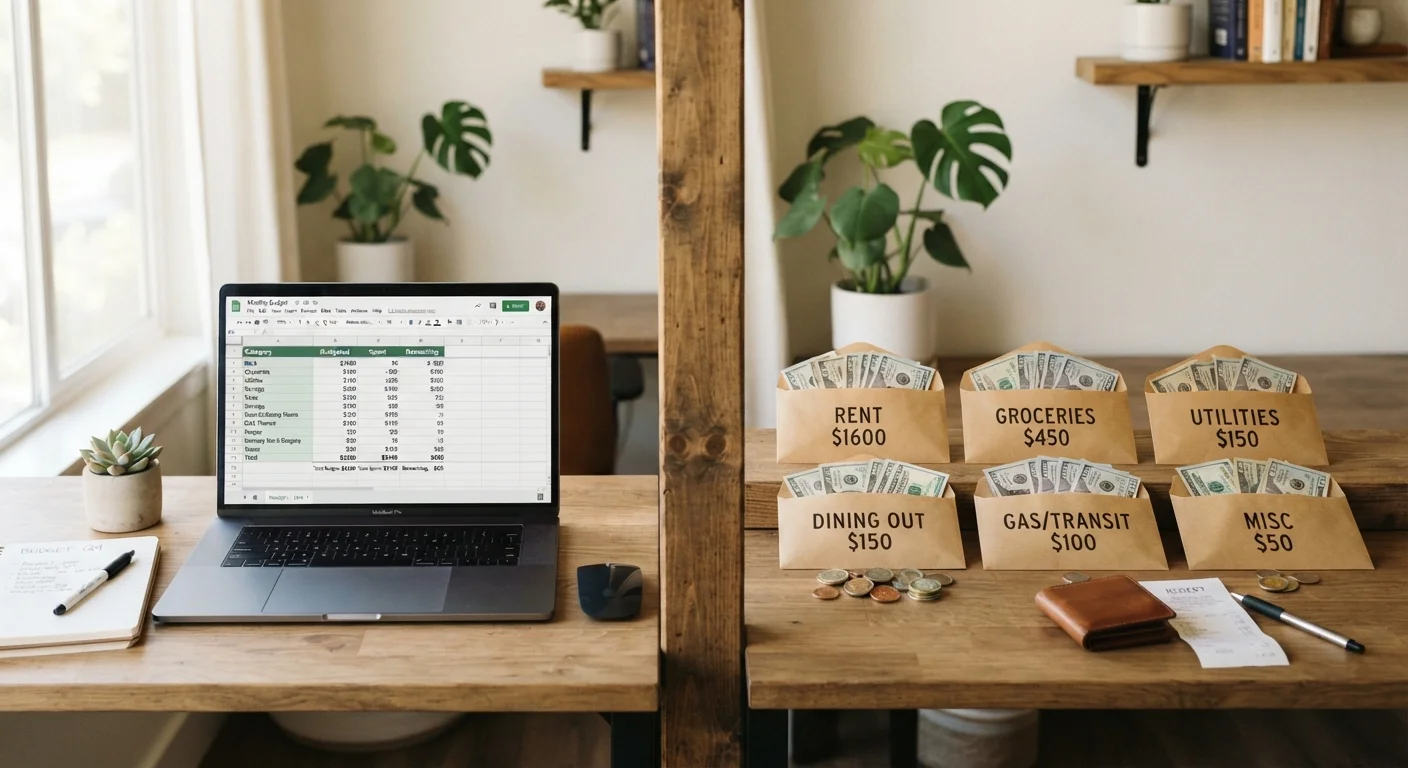
Zero-based budgeting (ZBB) means building a budget from scratch each period - typically monthly - so that your total income minus your total assigned expenses equals exactly zero. You're not eliminating your money; you're giving every dollar a category, whether that's rent, groceries, savings, or debt repayment. If you earn $4,500 in a given month, your budget must allocate exactly $4,500 across all categories before the month begins. Apps and spreadsheets make this easier to track in real time.
Envelope budgeting takes a more tactile approach. You divide your cash - or a digital equivalent - into labeled envelopes for each spending category. When the grocery envelope holds $300, you spend no more than $300 on groceries that month. Once the envelope is empty, spending in that category stops until next month. Originally designed around physical cash, the method now has digital adaptations that replicate the same constraint. See how envelope budgeting adapts to digital spending for a closer look at what still holds up.
| Criterion | Zero-Based Budgeting | Envelope Budgeting |
|---|---|---|
| Core mechanic | Allocate every dollar to a category | Divide cash into spending envelopes |
| Setup effort | Moderate - requires full income/expense mapping | Low - divide funds and go |
| Ongoing effort | High - continuous transaction tracking | Low - envelope balance is self-enforcing |
| Flexibility | High - easy to adjust mid-month | Low - fixed until next funding cycle |
| Behavioral guardrail | Moderate - requires self-discipline to follow | Strong - empty envelope physically stops spending |
| Best for income type | Variable or complex income | Steady, predictable income |
| Digital compatibility | Excellent - pairs with apps and spreadsheets | Moderate - requires workarounds for card spending |
| Savings integration | Explicit - savings is its own budget category | Possible - requires a dedicated savings envelope |
Effort, Flexibility, and Real-World Trade-Offs
The choice between these frameworks often comes down to two factors: how much ongoing effort you're willing to invest, and how much behavioral friction you actually need.
Zero-based budgeting demands regular attention. You rebuild the budget at the start of each period, track transactions against categories throughout the month, and adjust when life doesn't follow the plan. This makes it highly flexible - irregular income, unexpected expenses, and shifting priorities are all manageable because you're reviewing the full picture continuously. The trade-off is time and discipline. Without consistent logging, the budget becomes a fiction rather than a guide.
Envelope budgeting is lower-maintenance once set up. The physical or digital envelope does the enforcing for you - no transaction logging required beyond keeping an eye on remaining balances. That simplicity is its greatest strength for overspenders. However, it can feel rigid when real-life expenses don't map neatly onto predetermined envelopes, and card-based spending requires workarounds that dilute the method's core mechanic.
Neither Method Is One-Size-Fits-All
Some people find success blending elements of both: using zero-based budgeting for the full picture while applying envelope-style limits to specific high-risk categories like dining out or entertainment. The most important factor is consistent follow-through, not which framework you choose. You can also explore zero-based budgeting compared to the 50/30/20 rule if you're weighing a percentage-based approach as well.
For a broader look at how these and other frameworks compare, the guide to budgeting methods covers a wider range of approaches and what each one does well. It's also worth reviewing the trade-offs of strict budgeting before committing to either method.
~33%
Americans who follow a formal budget
Surveys consistently show that fewer than one in three U.S. adults maintains a structured monthly budget, according to data compiled by financial research organizations.
$1,000+
Typical monthly discretionary spending gap
Research from the U.S. Bureau of Labor Statistics suggests many households significantly underestimate their discretionary spending relative to what they actually spend.
This article is for general informational purposes only and does not constitute personalized financial advice. Consider consulting a qualified financial professional regarding your specific situation.