

Key Takeaways
- Envelope budgeting's core principle - spending only what you allocate - is sound regardless of era.
- Cash-based envelopes lose their edge when most transactions are digital or card-based.
- Digital envelope apps replicate the category-limit structure without requiring physical cash.
- Overspending in one category still requires a conscious trade-off in another - that friction is the point.
- The method works best for variable discretionary spending, not fixed monthly bills.
Forces pre-commitment to spending limits by category
Allocating money before the month begins reduces the likelihood of rationalized overspending - a well-documented advantage of pre-commitment strategies in personal finance behavior.
Makes trade-offs visible and deliberate
Moving money between categories requires a conscious decision, surfacing the real cost of spending choices in a way that passive card tracking does not.
Highly effective for variable discretionary categories
Groceries, dining, clothing, and entertainment - the areas where spending variance is highest - respond well to hard category caps with visible limits.
Low complexity to understand and explain
The concept requires no financial background to grasp, making it accessible for people starting a budgeting practice for the first time.
Adapts reasonably well to digital tools
Budgeting apps with category-limit features replicate the envelope structure without requiring physical cash, preserving the core behavioral mechanism.
Physical cash is impractical for most modern spending
The majority of US consumers now pay primarily by card or digital wallet, making literal cash envelopes cumbersome and disconnected from daily transaction reality.
Doesn't handle fixed bills or autopay naturally
Rent, insurance, and subscription charges operate outside variable spending logic, requiring a separate tracking system alongside the envelope structure.
Subscriptions and auto-charges bypass category limits
Recurring charges hit accounts automatically and don't interact with envelope caps, creating gaps in the budget picture unless manually accounted for.
Requires consistent manual effort to maintain
Without automatic transaction categorization, users must manually assign and track every purchase - a time cost that leads many people to abandon the system.
Can feel overly rigid during irregular months
Months with irregular expenses - a car repair, a medical bill, a travel cost - can stress rigid category allocations and require frequent rebalancing that undermines the system's simplicity.
Our Verdict
The envelope method's underlying logic - give every dollar a category and stop spending when that category runs dry - remains one of the more honest, friction-based approaches to controlling discretionary spending. Where it struggles is in a payments landscape dominated by cards, autopay, and subscriptions that don't interact naturally with physical cash. Adapting the structure digitally preserves most of the benefit, but only if the user maintains the same discipline the original cash system enforced automatically.
Readers who struggle with overspending in specific variable categories (groceries, dining, entertainment) and want a tangible, category-by-category structure rather than a top-down percentage approach.
What Envelope Budgeting Actually Is
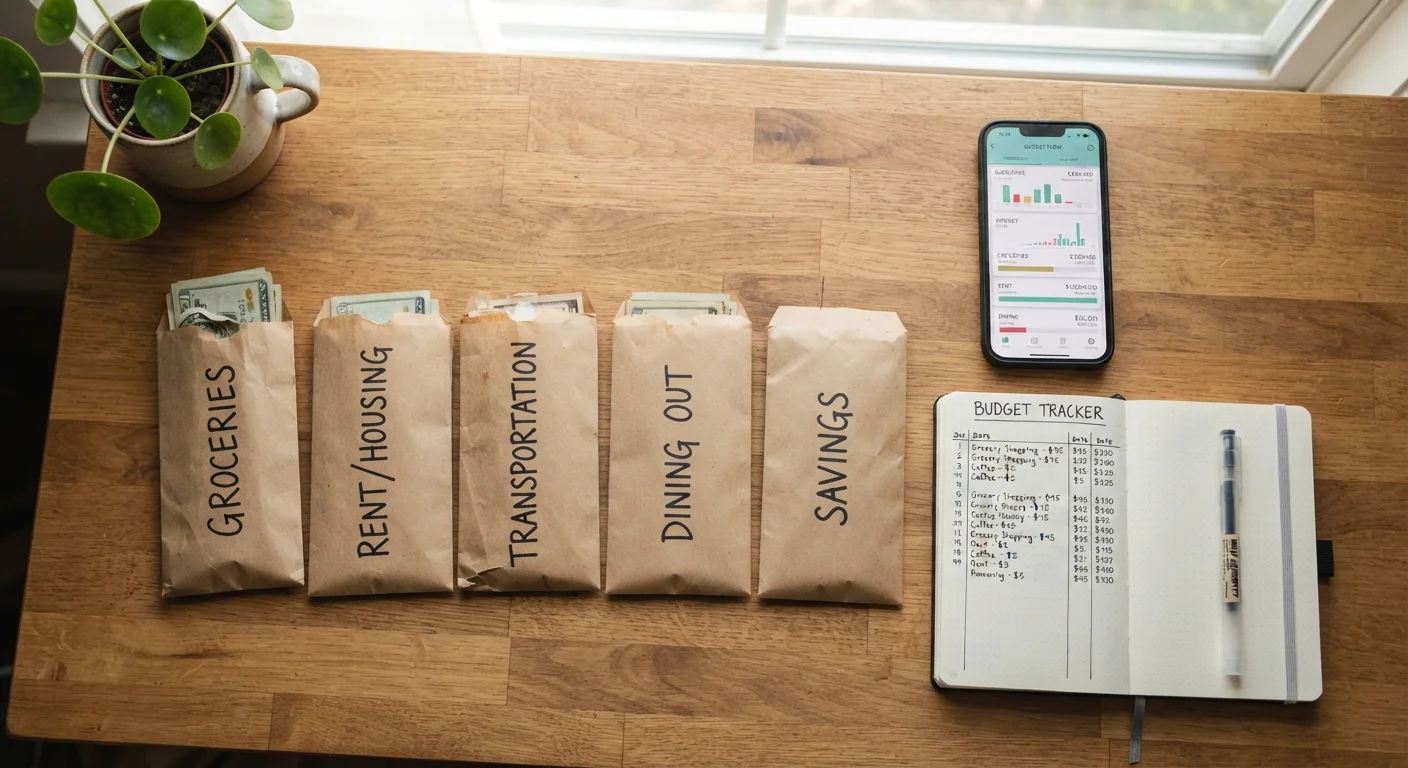
The envelope method is a cash-allocation system developed long before smartphones or digital banking. The mechanics are simple: divide your take-home pay into labeled envelopes - one per spending category - and when an envelope is empty, spending in that category stops until the next pay period. No borrowing from next month, no overdraft, no vague mental accounting.
Its appeal was always behavioral, not mathematical. Unlike percentage-based plans or spreadsheet budgets, the envelope system creates a physical spending limit you can see and feel diminish. That tactile friction is what made it effective for many households managing tight cash flows for decades.
Today, most Americans rarely carry cash. Understanding what the method still does well - and where it breaks down - matters before deciding whether to adapt it or move on. See how it stacks up against other frameworks in our comparison of common budgeting approaches.
What Still Works
Forces pre-commitment to spending limits by category
Allocating money before the month begins reduces the likelihood of rationalized overspending - a well-documented advantage of pre-commitment strategies in personal finance behavior.
Makes trade-offs visible and deliberate
Moving money between categories requires a conscious decision, surfacing the real cost of spending choices in a way that passive card tracking does not.
Highly effective for variable discretionary categories
Groceries, dining, clothing, and entertainment - the areas where spending variance is highest - respond well to hard category caps with visible limits.
Low complexity to understand and explain
The concept requires no financial background to grasp, making it accessible for people starting a budgeting practice for the first time.
Adapts reasonably well to digital tools
Budgeting apps with category-limit features replicate the envelope structure without requiring physical cash, preserving the core behavioral mechanism.
The strongest part of envelope budgeting is its category-level accountability. Most people who overspend don't do so across every area of life - they have one or two problem categories where spending quietly balloons. Groceries creep up. Dining out becomes a default. The envelope method forces a pre-commitment to a specific dollar amount per category before spending happens, which research in behavioral economics consistently links to better self-control than post-hoc tracking.
The trade-off mechanic also holds up well: when one envelope runs out early, you must consciously move money from another. That decision - do I really want to cut entertainment to cover dining? - surfaces the real cost of choices in a way that card spending rarely does.
Digital envelope apps (several exist as general budgeting tools with envelope-style category limits) port this structure into card-based spending. They won't be named here, but this category of tool is easy to find. For a deeper look at how envelope budgeting compares directly with zero-based approaches, see zero-based vs. envelope budgeting.
Where It Falls Short
Physical cash is impractical for most modern spending
The majority of US consumers now pay primarily by card or digital wallet, making literal cash envelopes cumbersome and disconnected from daily transaction reality.
Doesn't handle fixed bills or autopay naturally
Rent, insurance, and subscription charges operate outside variable spending logic, requiring a separate tracking system alongside the envelope structure.
Subscriptions and auto-charges bypass category limits
Recurring charges hit accounts automatically and don't interact with envelope caps, creating gaps in the budget picture unless manually accounted for.
Requires consistent manual effort to maintain
Without automatic transaction categorization, users must manually assign and track every purchase - a time cost that leads many people to abandon the system.
Can feel overly rigid during irregular months
Months with irregular expenses - a car repair, a medical bill, a travel cost - can stress rigid category allocations and require frequent rebalancing that undermines the system's simplicity.
The method's biggest structural weakness in a digital era is fixed expenses. Rent, insurance, loan payments, and utility autopay don't fit envelope logic - they're not variable and can't be stopped when money runs low. Envelopes work for discretionary spending; treating fixed bills as "envelopes" adds complexity without adding insight.
Subscription spending is a particular blind spot. Streaming services, gym memberships, and software subscriptions are charged automatically and invisibly, bypassing any envelope entirely. Unless these are tracked and accounted for separately, the method gives a false picture of available spending. Our article on easy-to-overlook spending categories covers exactly the kind of costs that can fall through envelope gaps.
Envelope Budgeting and Irregular Income
The classic envelope method assumes a predictable paycheck arriving on a regular schedule, which aligns poorly with gig work, freelancing, or commission-based income. If your monthly income varies significantly, you'll need to establish a baseline spending plan built on a conservative income estimate rather than your highest-earning months. Some people in this situation fund envelopes from a separate 'holding' account rather than directly from each paycheck. The category-limit principle still applies, but the funding mechanism needs adjustment.
Adapting the Method Without Losing Its Value
~80%
US consumers using non-cash payment methods
Federal Reserve payments studies consistently show the large majority of US consumer transactions are made by card, ACH transfer, or digital wallet rather than cash.
3-5
Average number of active subscriptions per household
Industry research on subscription spending suggests most US households carry multiple recurring charges that are rarely reviewed against budget plans.
The most practical adaptation is a hybrid: use envelope-style category limits only for your variable discretionary spending - groceries, dining, personal care, entertainment - while managing fixed expenses separately as line items. This keeps the system proportionate to where your actual spending variability lives.
If you prefer digital tools, look for budgeting apps that allow you to set category spending caps and alert you when you approach them. The alert replaces the tactile feedback of a thinning envelope; it's less visceral but functionally similar if you actually act on it.
One rule worth keeping regardless of format: when a category runs out, the spending stops. The moment you allow yourself to silently overspend a digital category without a deliberate trade-off, you've removed the mechanism that makes the method work. For a broader picture of how this fits into a complete budgeting practice, the complete guide to personal budgeting offers end-to-end planning context.
This article is for general informational and educational purposes only and does not constitute personalized financial advice. For decisions specific to your financial situation, consider consulting a qualified financial professional.