

Key Takeaways
- Store brands typically cost 20-30% less than name-brand equivalents in the same category.
- Quality parity is high in staple categories like pantry staples, cleaning supplies, and over-the-counter medications.
- Some categories - including tools, electronics accessories, and personal care - show more consistent quality gaps.
- Many store-brand products are manufactured by the same companies that produce national brands.
- Testing a single unit before committing to bulk purchases is a practical risk-reduction strategy.
Significant price savings on everyday staples
Store brands typically cost 20-30% less than national equivalents in the same category, and the gap can be wider in some product lines. On recurring purchases like pantry staples or cleaning supplies, the annual savings across a household are substantial.
Quality parity in regulated categories
Generic over-the-counter medications must meet FDA bioequivalence requirements, and food-grade staples are subject to the same safety standards regardless of label. Regulatory floors reduce the quality risk meaningfully in these segments.
Often made by name-brand manufacturers
A notable share of private-label products are produced by the same companies that make the national brands, sometimes in the same facility. The label is different; the production origin frequently is not.
Retailer satisfaction guarantees reduce risk
Major retailers commonly back their store-brand lines with return or exchange policies, lowering the financial downside of trying an unfamiliar product. This effectively removes much of the trial risk.
Simple ingredient or spec comparisons are possible
For many categories - cleaners, canned goods, medications - label comparison is straightforward. When active ingredients and concentrations match, functional equivalence is a reasonable conclusion.
Inconsistent quality across product categories
Store brands perform reliably in some areas and noticeably less well in others. Without category-level knowledge, shoppers risk making switches that don't hold up, turning apparent savings into a replacement cost.
Materials and durability harder to assess at purchase
For tools, hardware, and electronics accessories, quality differences are often in material grades and tolerances that aren't visible in-store. A cheaper cable or hand tool may fail significantly sooner, erasing the savings.
Formulation complexity creates real variation in personal care
Skincare, hair care, and cosmetics depend on ingredient concentration and formulation chemistry, not just ingredient lists. Store-brand versions may differ in ways that produce noticeably different results for individual users.
Flavor and texture differences in processed foods
Proprietary recipes in seasoned, flavored, or processed food categories create genuine taste differences that aren't about quality floors - they're about formulation preferences. Household acceptance can be unpredictable.
Safety certification gaps in electronics accessories
Not all store-brand or generic electronics accessories carry recognized third-party safety certifications. In categories like chargers and adapters, the absence of certification represents a meaningful risk that the lower price doesn't offset.
Our Verdict
Store brands deliver genuine value in many everyday categories, particularly pantry staples, household cleaners, and generic medications where FDA or food-safety standards keep quality floors high. They are less reliable in categories where formulation complexity, materials quality, or long-term durability matter more. A category-by-category approach - rather than blanket brand loyalty or blanket avoidance - is the most cost-effective strategy.
Budget-conscious shoppers who want to stretch grocery and household budgets without sacrificing performance on routine purchases.
What Store Brands Actually Are
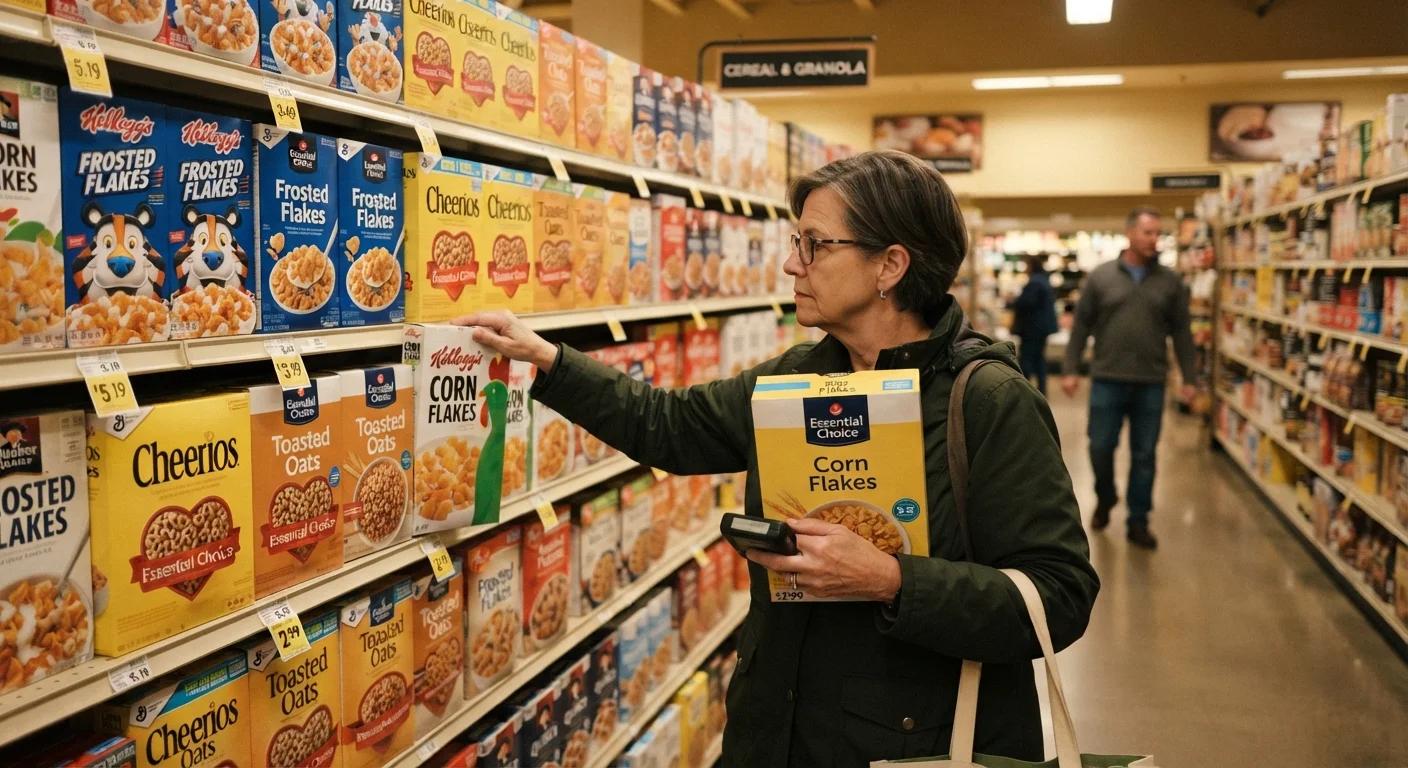
Store brands - also called private-label or generic products - are goods manufactured and sold under a retailer's own label rather than a nationally marketed brand. The retailer either owns a production facility or, more commonly, contracts with a third-party manufacturer to produce goods to its specifications.
That last detail matters: a significant share of private-label products are produced in the same factories, sometimes on the same lines, as the name-brand equivalents you see on adjacent shelves. The formulation may differ slightly - or not at all. This reality is one reason blanket skepticism about store brands is often misplaced.
Understanding the economics helps frame the quality conversation. National brands spend heavily on advertising, category management fees paid to retailers, and brand-building infrastructure. Those costs are embedded in the price. Store brands skip most of that overhead, which is why the savings can be real without necessarily reflecting a difference in the underlying product. For a deeper look at how pricing psychology shapes what feels like a deal, see how retailers use price anchoring and loss leaders.
Where Store Brands Perform Well
Significant price savings on everyday staples
Store brands typically cost 20-30% less than national equivalents in the same category, and the gap can be wider in some product lines. On recurring purchases like pantry staples or cleaning supplies, the annual savings across a household are substantial.
Quality parity in regulated categories
Generic over-the-counter medications must meet FDA bioequivalence requirements, and food-grade staples are subject to the same safety standards regardless of label. Regulatory floors reduce the quality risk meaningfully in these segments.
Often made by name-brand manufacturers
A notable share of private-label products are produced by the same companies that make the national brands, sometimes in the same facility. The label is different; the production origin frequently is not.
Retailer satisfaction guarantees reduce risk
Major retailers commonly back their store-brand lines with return or exchange policies, lowering the financial downside of trying an unfamiliar product. This effectively removes much of the trial risk.
Simple ingredient or spec comparisons are possible
For many categories - cleaners, canned goods, medications - label comparison is straightforward. When active ingredients and concentrations match, functional equivalence is a reasonable conclusion.
Several categories consistently show little meaningful quality difference between store and name brands:
- Over-the-counter medications: Generic drugs must meet the same FDA bioequivalence standards as their brand-name counterparts. The active ingredient, dosage, and safety profile are legally required to match.
- Pantry staples: Flour, sugar, canned vegetables, dried pasta, and cooking oils have simple, standardized compositions. Taste and texture differences, when they exist, tend to be minor.
- Cleaning supplies: Bleach is bleach at equivalent concentrations. Many store-brand cleaners use the same surfactant chemistry as premium lines.
- Paper products: Ply count and sheet size are easy to compare directly, making it straightforward to evaluate value without brand cues.
If you're also weighing whether to stock up on staples in bulk, store brands in these categories can amplify savings further - provided storage and usage rate make bulk buying practical.
Where the Quality Gap Is More Noticeable
Inconsistent quality across product categories
Store brands perform reliably in some areas and noticeably less well in others. Without category-level knowledge, shoppers risk making switches that don't hold up, turning apparent savings into a replacement cost.
Materials and durability harder to assess at purchase
For tools, hardware, and electronics accessories, quality differences are often in material grades and tolerances that aren't visible in-store. A cheaper cable or hand tool may fail significantly sooner, erasing the savings.
Formulation complexity creates real variation in personal care
Skincare, hair care, and cosmetics depend on ingredient concentration and formulation chemistry, not just ingredient lists. Store-brand versions may differ in ways that produce noticeably different results for individual users.
Flavor and texture differences in processed foods
Proprietary recipes in seasoned, flavored, or processed food categories create genuine taste differences that aren't about quality floors - they're about formulation preferences. Household acceptance can be unpredictable.
Safety certification gaps in electronics accessories
Not all store-brand or generic electronics accessories carry recognized third-party safety certifications. In categories like chargers and adapters, the absence of certification represents a meaningful risk that the lower price doesn't offset.
Not every category rewards a switch to store brands. Some areas where shoppers more frequently report performance differences:
- Electronics accessories: Cables, chargers, and adapters vary widely in materials and safety certifications. In this category, the cost of a failure can exceed the original savings.
- Hand tools and hardware: Steel grade and manufacturing tolerances affect durability in ways that aren't visible at the point of purchase.
- Certain personal care products: Formulation complexity in skincare, hair care, and cosmetics means ingredient quality and concentration can differ meaningfully - and skin responses are individual.
- Flavored or highly processed foods: When flavor is the primary product, proprietary recipes create genuine differences that are more about preference than quality floors.
These gaps don't mean store-brand versions are always inferior - but they do mean the risk of disappointment is higher, and hidden costs of cheap purchases are worth factoring in before assuming the lower price is a straightforward win.
A Practical Framework for Deciding
20-30%
Typical store-brand price discount vs. national brands
Industry analyses of grocery and household categories consistently find private-label products priced roughly 20-30% below comparable national brand items on the same shelf.
~1 in 5
Grocery items purchased that are store-brand
Private-label products have grown to account for a substantial share of US grocery unit sales, reflecting increasing consumer comfort with retailer-labeled goods across categories.
Rather than defaulting to a brand position in either direction, a few straightforward tests help calibrate where to switch:
- Check whether standards exist. Categories with enforceable quality floors - pharmaceuticals, food safety, electrical safety certifications - narrow the real-world quality gap considerably.
- Buy one before buying many. Try a single unit or package before switching your household entirely. This is especially relevant for food items where texture, taste, or consistency matters to your household, and for any product where a failure has a meaningful cost.
- Compare the ingredient or specification list. For cleaning products, foods, and supplements, the label reveals a lot. Identical active ingredients at identical concentrations are a strong signal of functional equivalence.
- Factor in return policies. A retailer's own brand often comes with a generous satisfaction guarantee, which lowers the financial risk of testing an unfamiliar product.
When Store-Brand Switching Makes Sense at Scale
Households that systematically switch to store brands in lower-risk categories - pantry staples, cleaning supplies, paper products, and generic medications - while keeping national brands in higher-complexity categories can capture most of the available savings with minimal quality tradeoff. The goal isn't to switch everything; it's to switch where the evidence supports it. Starting with one or two categories and evaluating the result before expanding is a lower-risk entry point than overhauling your entire shopping list at once.
Building store-brand switching into a broader budgeting habit - rather than treating it as a one-time decision - can have a compounding effect on household spending over time. For foundational budgeting context, budgeting basics covers how to track and plan spending systematically. And keeping an eye on whether sale prices on name brands actually represent savings is another useful check before assuming a promotional price beats a store-brand regular price.