

Key Takeaways
- Kitchen sponges can harbor billions of bacteria per cubic centimeter due to their warm, moist, food-rich environment.
- Microwaving or boiling a sponge does not eliminate all bacteria and may concentrate harmful strains.
- Replacing sponges every one to two weeks is more effective than attempting to sanitize them repeatedly.
- Letting sponges dry completely between uses significantly slows bacterial growth.
- Dish cloths and silicone scrubbers present different but manageable hygiene trade-offs compared to traditional sponges.
Why Sponges Breed Bacteria So Effectively
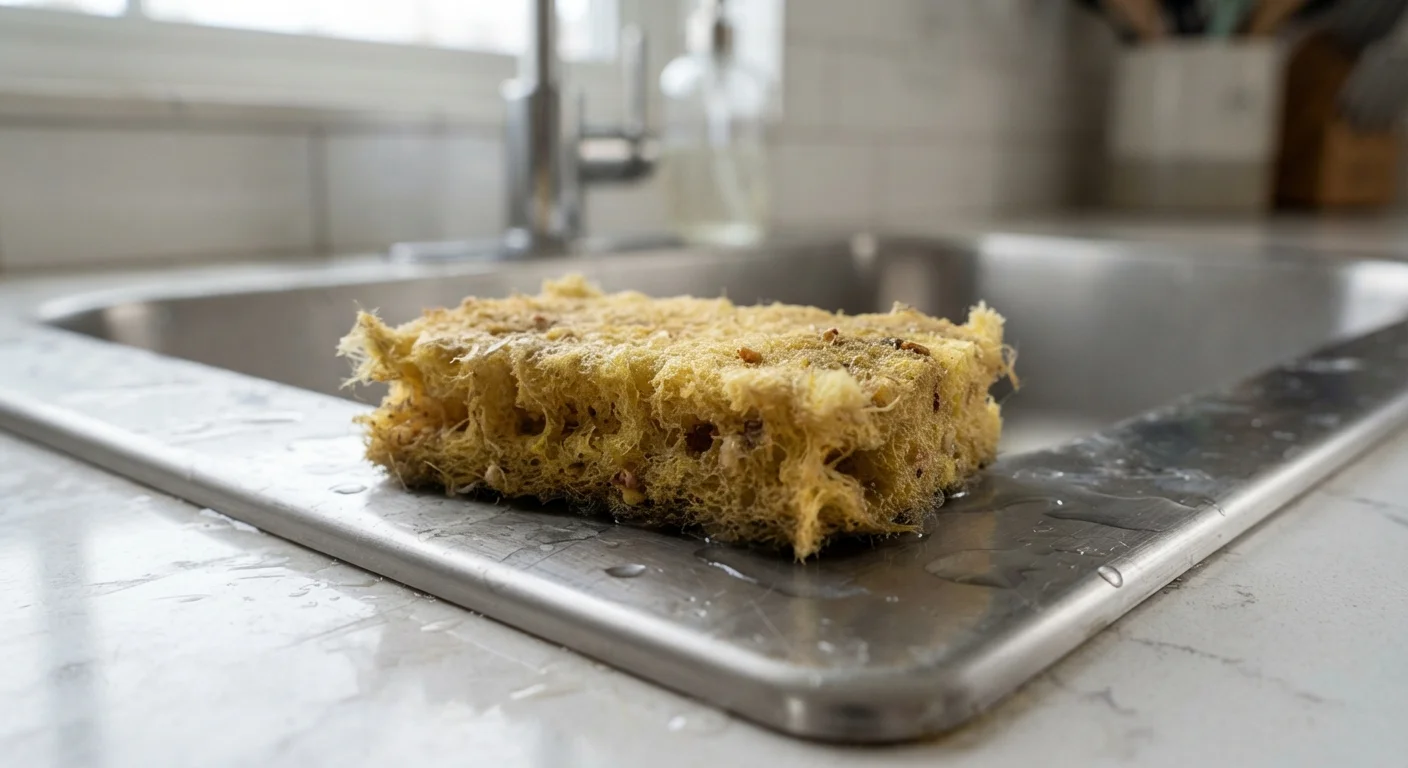
Few household items pack as much microbial activity into a small surface area as the kitchen sponge. Research published in Scientific Reports found that used kitchen sponges can contain bacterial densities rivaling those of fecal matter - a finding that surprised even the researchers involved. Understanding the mechanics behind this helps explain why the sponge is so hard to keep clean.
Three factors converge to make sponges ideal bacterial habitat: moisture, warmth, and a constant supply of nutrients from food residue. The sponge's open-cell foam structure creates thousands of tiny pockets that trap water and food particles, giving bacteria protected spaces to colonize that soap and rinsing can't easily reach. After each use, the sponge sits damp at room temperature - near-perfect incubation conditions.
The bacterial communities that develop aren't random. They tend to include genera like Moraxella (linked to that characteristic sponge odor), along with potential opportunistic pathogens from raw meat, eggs, and produce residue. It's less a single contamination event and more a continuously evolving ecosystem.
362 types
Bacterial species found in used kitchen sponges
A 2017 study in Scientific Reports identified up to 362 different bacterial species in used household kitchen sponges, with densities among the highest recorded for any household surface.
45 billion
Bacteria per square centimeter in heavily used sponges
Research has estimated bacterial concentrations in used sponges at tens of billions per square centimeter, comparable to densities found in human intestinal environments.
Common Myths About Sponge Hygiene - Corrected
Most of us have heard confident claims about how to "properly" clean a kitchen sponge. The problem is that several of the most widely repeated methods either don't work as advertised or may make things measurably worse. Here's what the evidence actually shows.
Myth
Microwaving a damp sponge for two minutes kills all the bacteria and makes it safe to reuse.
Fact
Microwaving reduces bacterial counts but does not sterilize the sponge, and research suggests it may favor survival of hardier, more concerning strains.
The 2017 Scientific Reports study that analyzed used kitchen sponges found that regularly sanitized sponges - including those microwaved - actually contained higher proportions of potentially harmful bacteria than unsanitized ones. The working hypothesis is that sanitization kills off competing bacteria, allowing more stress-tolerant strains to repopulate unchallenged. Microwaving is not useless, but treating it as a reset button that makes the sponge equivalent to a fresh one is not supported by the evidence.
Myth
A sponge that smells fine is safe to use - the odor tells you when bacteria are a problem.
Fact
Odor is produced by specific bacterial species, not by bacterial density overall. A sponge can carry high loads of pathogenic bacteria without any detectable smell.
The familiar musty smell of a used sponge comes primarily from Moraxella osloensis, a species that thrives in moist fabrics and foams. Many of the bacteria that pose a greater food-safety concern - including certain strains of E. coli or Salmonella introduced from raw food - don't produce a detectable odor. Using smell as your primary hygiene gauge will consistently mislead you.
Myth
Soaking a sponge in a diluted bleach solution effectively disinfects it for continued use.
Fact
Bleach soaking can reduce surface bacteria, but the interior porous structure of a sponge limits penetration, leaving protected bacterial colonies largely intact.
Bleach is an effective disinfectant on hard, non-porous surfaces where it achieves full contact. Inside a sponge's dense foam matrix, the solution dilutes and doesn't reach trapped bacteria in deeper pockets. Studies comparing various sanitizing methods consistently show that none restore a used sponge to the hygiene level of a new one. Bleach soaking as a temporary measure between replacements has some merit, but it shouldn't substitute for routine replacement.
Myth
Dish soap thoroughly cleans the sponge itself while you're washing dishes.
Fact
Dish soap cleans surfaces it contacts, but rinsing a sponge with soapy water does not penetrate or sanitize its interior bacterial communities.
Soap works by surrounding and lifting grease and debris off surfaces - it disrupts bacterial membranes on contact, but only where it reaches in sufficient concentration. Squeezing soapy water through a sponge creates turbulence but not the sustained, high-concentration contact needed to meaningfully reduce established bacterial colonies. The sponge functions as a cleaning tool for your dishes, not a self-cleaning surface.
Myth
Running a sponge through the dishwasher on a hot cycle fully sanitizes it.
Fact
Dishwasher cycles can reduce bacterial counts on sponges, but results are inconsistent and depend heavily on water temperature and cycle type.
Some dishwasher cycles - particularly those reaching high-temperature sanitize settings - do reduce bacterial load more reliably than microwaving. However, sponges vary in composition, and many consumer dishwashers don't maintain sanitizing temperatures throughout the full cycle. The CDC and food safety bodies generally recommend replacing sponges rather than relying on repeated cleaning cycles, regardless of method. The cost-per-sponge math also tends to favor replacement over the effort of recurring sanitation routines.
Practical Strategies That Actually Reduce Risk
The most effective approach to sponge hygiene isn't elaborate sanitation - it's a combination of rotation, drying, and realistic replacement schedules.
- Replace frequently: Most food safety guidance suggests replacing kitchen sponges every one to two weeks under regular use. If you're cooking with raw meat or poultry daily, lean toward weekly replacement.
- Dry between uses: Storing the sponge in a holder that allows full airflow, away from the sink basin, dramatically slows bacterial growth. A wet sponge left flat on a countertop stays moist far longer than one stored upright or hung.
- Designate by task: Use separate sponges for dishes versus counters and raw food cleanup. This limits cross-contamination rather than trying to eliminate all bacteria from one sponge.
- Consider alternatives: Dish cloths made from cotton or microfiber can be laundered at high temperatures and reused hygienically. Silicone scrubbers dry faster and are dishwasher-safe, though they may be less effective on baked-on residue.
For a broader framework on maintaining cleanliness throughout the home, see our guide to building a home cleaning routine that actually sticks. And if you're pairing your kitchen hygiene habits with safe product use, it's worth reviewing which cleaning products can be safely combined - some common pairings are more dangerous than people realize.
Raw Meat Contact Raises the Stakes
If a sponge has been used to wipe surfaces that contacted raw poultry, beef, or seafood, treat it as contaminated and replace it immediately rather than attempting to sanitize it. Cross-contamination from these sources carries a meaningfully higher food-safety risk than general household bacteria. Designating a separate paper towel or disposable wipe for raw meat spills is a straightforward way to keep sponges out of this higher-risk category altogether.