

Key Takeaways
- HEPA is a performance standard, not just a marketing term - it requires 99.97% capture efficiency at 0.3 microns.
- "HEPA-type" or "HEPA-style" labels do not meet the same standard as true HEPA filters.
- HEPA filters capture particles but do not remove gases, odors, or volatile organic compounds (VOCs).
- Proper fit and sealed housing matter as much as filter quality - air bypassing the filter negates its effectiveness.
- HEPA matters most for households with allergies, asthma, or pets that shed dander.
HEPA Filtration
HEPA stands for High Efficiency Particulate Air. It refers to a filtration standard requiring that a filter capture at least 99.97% of airborne particles that are 0.3 microns in diameter. A product must meet this performance threshold to legitimately carry the HEPA designation.
The 0.3-micron particle size is used because it represents the most penetrating particle size (MPPS) - the hardest for fibrous filters to trap. Filters are actually more efficient at capturing particles both larger and smaller than 0.3 microns.
The Standard Behind the Label
Walk through any home goods aisle and you'll see HEPA printed on vacuums, air purifiers, and furnace filters. But HEPA isn't a brand name or a vague quality descriptor - it's a defined performance standard. A true HEPA filter must capture at least 99.97% of airborne particles measuring 0.3 microns in diameter. That's roughly 300 times smaller than the width of a human hair.
The standard originated in industrial and medical settings where controlling microscopic contamination is critical. It has since been adopted as the practical benchmark for household air filtration. The key word is standard: a filter either meets it or it doesn't, regardless of what the packaging says.
"HEPA-Type" Is Not the Same as HEPA
Marketing terms like "HEPA-type," "HEPA-style," and "HEPA-like" are not regulated and carry no standard efficiency requirement. These filters may capture significantly fewer particles than a true HEPA filter. If filtration performance matters to your household, verify that the product explicitly states it meets the 99.97% efficiency standard at 0.3 microns.
This matters because terms like "HEPA-type," "HEPA-style," and "HEPA-like" are unregulated marketing language. Products using these labels have no obligation to meet the 99.97% efficiency threshold. If you need genuine filtration performance, look for explicit confirmation that the filter meets the true HEPA standard.
What HEPA Captures - and What It Doesn't
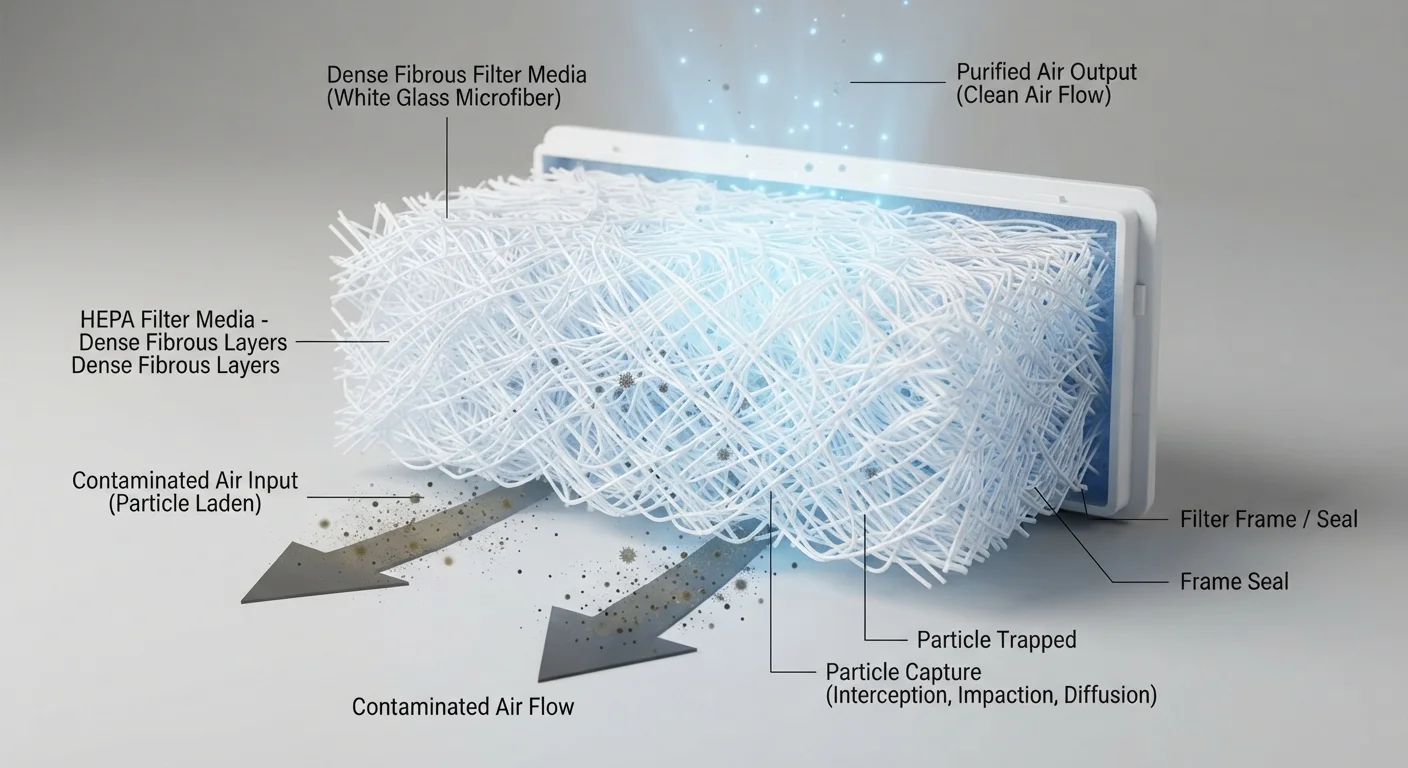
HEPA filters work by forcing air through a dense mat of fine fibers arranged in random orientations. Particles are captured through three mechanisms: direct interception, inertial impaction (larger particles can't follow airflow around fibers), and diffusion (very small particles move erratically and collide with fibers). The combination makes HEPA highly effective across a wide particle size range.
In practical terms, a properly functioning HEPA filter captures dust mite debris, mold spores, pollen, pet dander, and many bacteria. These are common household triggers for allergies and respiratory irritation.
What HEPA does not remove: gases, odors, tobacco smoke compounds, and volatile organic compounds (VOCs) like those off-gassed by paints, cleaning products, or furniture. These require a different mechanism - typically activated carbon filtration. Many air purifiers combine both layers, but the HEPA component alone handles only particles, not chemical pollutants.
99.97%
Minimum particle capture rate for true HEPA
This efficiency threshold applies specifically to particles of 0.3 microns - the most penetrating particle size for fibrous filters, per the established HEPA standard.
0.3 µm
Critical particle size for HEPA testing
Particles both larger and smaller than 0.3 microns are actually captured at higher rates; this size represents the hardest challenge for HEPA filter media.
4-5×
ACH recommended for allergy-sensitive households
Air quality researchers generally suggest air purifiers achieve at least 4 to 5 air changes per hour in the target room for meaningful allergen reduction.
When Fit and Sealing Matter as Much as the Filter
A HEPA filter installed in a poorly sealed housing is significantly less effective than its rating suggests. If air can bypass the filter - traveling around rather than through it - unfiltered particles pass straight through the device. This is why "fully sealed" construction matters in HEPA vacuums, and why filter fit and housing integrity are worth evaluating in any air filtration product.
For air purifiers, room coverage area is another practical variable. A unit sized for 150 square feet will not adequately clean a 400-square-foot open-plan living room, regardless of its filter rating. Manufacturers typically specify a recommended room size based on air changes per hour (ACH) - the number of times a unit cycles the room's full air volume. Higher ACH rates generally mean more effective particle removal.
If you're evaluating vacuums alongside air purifiers, the same filter-sealing logic applies there too. See why suction numbers alone don't tell the whole performance story for how filtration fits into overall vacuum effectiveness.
Check for Sealed Construction, Not Just Filter Rating
When evaluating any air filtration device, look for confirmation that the unit uses fully sealed construction - meaning all air must pass through the filter before exiting. Some products use genuine HEPA filter media but allow air to bypass the filter through gaps in casing or poor gasket design. A sealed system with a verified HEPA filter consistently outperforms an unsealed one with a higher-rated filter.
Where HEPA Makes the Most Difference
HEPA filtration has the clearest practical value in specific household situations. Allergy and asthma sufferers benefit most, since the particles HEPA targets - pollen, pet dander, dust mite debris, and mold spores - are primary triggers for respiratory symptoms. Households with cats or dogs also see meaningful air quality improvement, given the volume of dander and fine hair particles shed daily.
For general households without specific sensitivities, the benefit is real but more moderate. Everyday dust and particulate matter are still reduced, which is relevant for anyone who wants to minimize how often surfaces accumulate visible dust or maintain cleaner air during wildfire smoke events.
Where HEPA matters less: filtering odors from cooking or pets, removing chemical fumes from renovations, or addressing gas-phase pollutants. In those cases, the activated carbon layer of a combination unit does the meaningful work, not the HEPA component. Just as label-reading matters in other consumer categories - for example, understanding what "non-comedogenic" actually means on a product label - knowing what HEPA does and doesn't cover helps you evaluate whether a product addresses your actual need.
The bottom line: HEPA is a meaningful, verifiable standard - but only when the filter genuinely meets it, the housing seals properly, and the unit is matched to the space it's meant to clean.