

Key Takeaways
- Honing realigns a blade's edge; sharpening removes metal to create a new one - they are not interchangeable.
- Incorrect cutting surfaces and washing habits degrade knife edges faster than actual use.
- Consistent angle control during sharpening matters more than how quickly you work.
- Most home cooks need to sharpen knives just two to four times per year with regular honing in between.
Honing vs. Sharpening: The Confusion That Costs You
The single most common knife-care mistake is using the words honing and sharpening interchangeably - and then treating the tools the same way. They accomplish fundamentally different things.
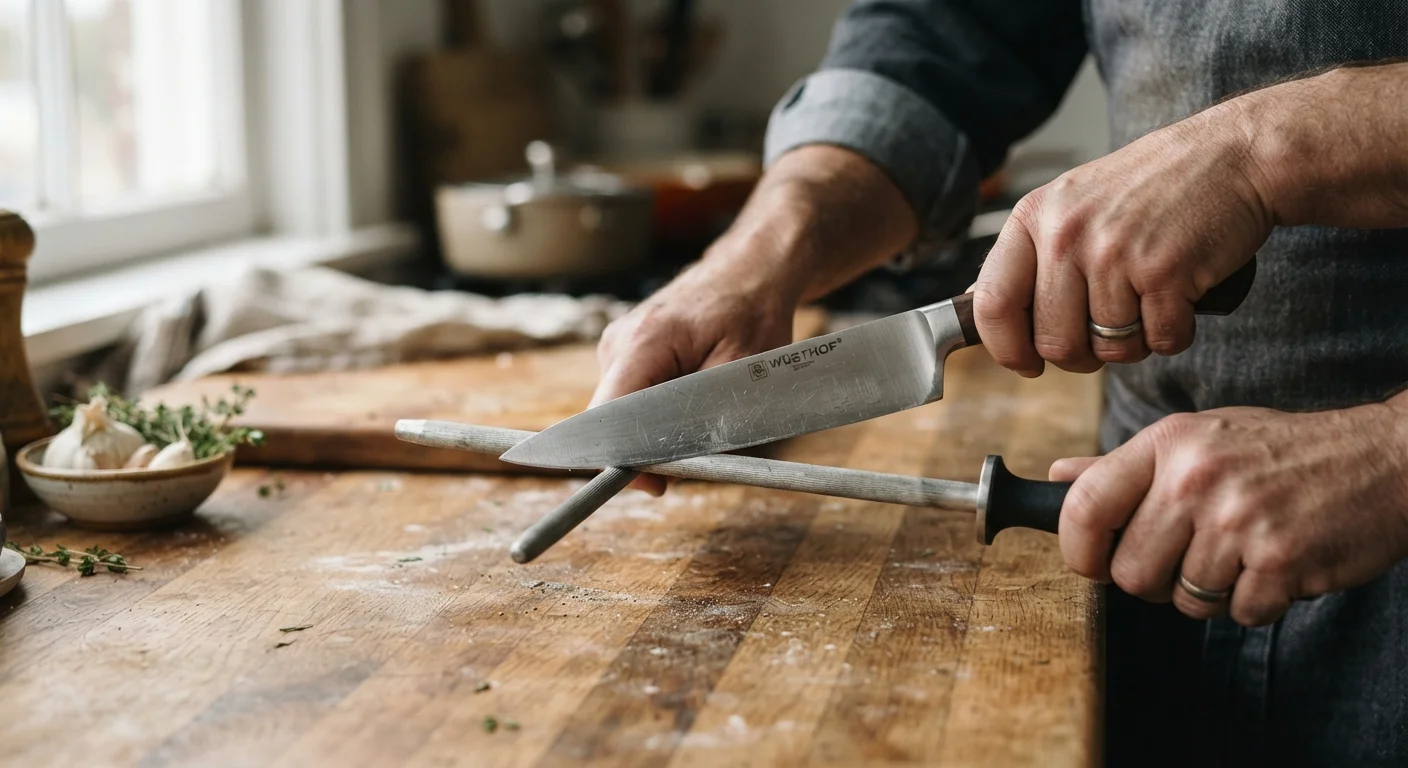
Honing uses a honing rod (sometimes called a sharpening steel) to push a blade's microscopic edge back into alignment. Over normal use, that edge folds and rolls slightly to one side. A few strokes on a honing rod corrects this without removing meaningful amounts of metal.
Sharpening - whether with a whetstone, pull-through sharpener, or electric unit - actually grinds away metal to form a fresh, acute edge. It's necessary when honing no longer restores cutting performance.
For most home cooks, honing before or after each use and sharpening two to four times per year is a reasonable rhythm. Doing them in the wrong order (sharpening a knife that just needed honing) wastes metal and shortens the knife's usable life.
A Simple Way to Test Your Edge
Hold a sheet of printer paper vertically by one end and draw the blade downward through it. A properly sharp knife will slice cleanly with little resistance. A dull or damaged edge will tear, skip, or crumple the paper. This test costs nothing and takes five seconds - use it before and after sharpening to gauge your results.
Angle Is Everything When Sharpening
Whether you use a whetstone or a guided sharpening system, the angle at which you hold the blade against the abrasive surface determines the quality and durability of the edge. Most Western-style knives are sharpened between 17 and 22 degrees per side; Japanese-style knives typically use a more acute 10 to 15 degrees per side, which produces a finer edge suited to precision cutting.
The problem most home cooks run into isn't choosing the wrong angle - it's failing to hold a consistent angle throughout the stroke. Even a few degrees of wobble produces a wavy, uneven edge that dulls quickly. Guided sharpeners and angle-setting clamps exist specifically to eliminate this variable for beginners.
Guided Systems vs. Freehand Whetstones
Guided angle sharpeners (pull-through or clamp-style) are easier for beginners and produce consistent results with less practice. Freehand whetstones offer more control and are gentler on metal over time, but require skill to use effectively. Neither approach is universally superior - the right choice depends on how much time you're willing to invest in technique.
If you sharpen freehand on a whetstone, practice the motion slowly before applying pressure. Consistency across 10 slow strokes beats speed across 30 inconsistent ones every time.
What's Actually Dulling Your Knives
Blade sharpness erodes from more than just cutting. These overlooked habits are often responsible:
Always cut on wood or plastic - never on glass, ceramic, or stone surfaces.
Glass and stone cutting boards look clean but are extremely hard, and each stroke rolls the knife's edge microscopically. After a few sessions, a sharp knife becomes noticeably dull. Wood and quality plastic are firm enough for stability but forgiving enough to preserve the edge.
Hand-wash knives and dry them immediately rather than using the dishwasher.
Dishwasher cycles expose blades to high heat, prolonged moisture, and harsh detergents that corrode the steel and weaken the handle. Blades also knock against other items during washing, creating small nicks along the edge.
Store knives on a magnetic strip or in a knife block - not loose in a drawer.
Loose storage means blades contact other metal utensils constantly, creating small chips and rolls along the cutting edge. It's also a safety concern for anyone reaching into the drawer.
Hone regularly and learn to recognize when honing is no longer enough.
Honing restores alignment but can't fix a truly dull edge. If a knife won't slice cleanly through a ripe tomato after honing, it needs sharpening - not more honing strokes, which won't help at that point.
Quick Habits to Start This Week
None of these changes require new equipment or significant time investment - they just require consistency.
Keeping a clean, well-maintained kitchen extends beyond knife care. Just as your cutting surface affects blade longevity, other kitchen tools need attention too - see our guide to kitchen sponge hygiene for another high-use item that's easy to overlook.