

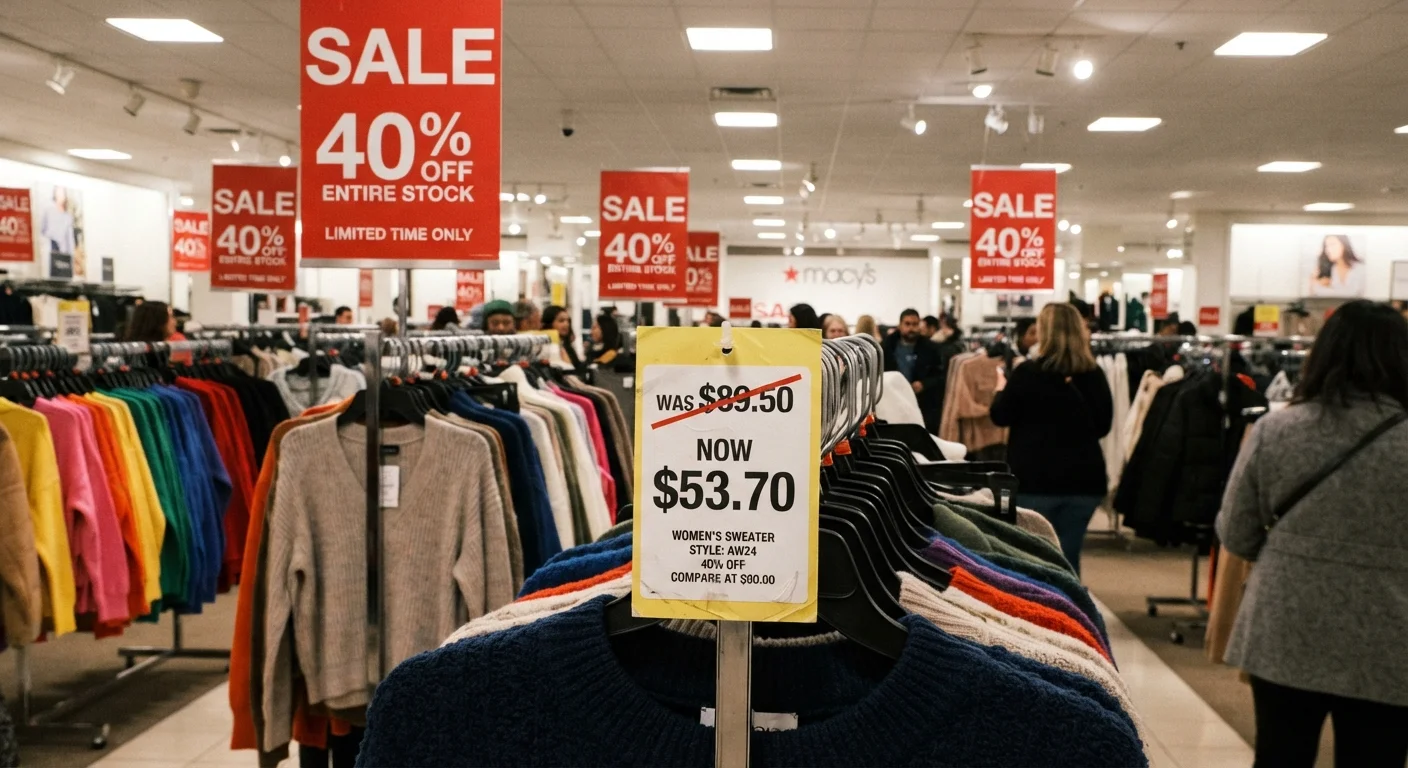
Key Takeaways
- The word 'sale' carries no legal guarantee that you're paying less than the item's true market value.
- Reference or 'was' prices are sometimes set artificially high to make a discount look bigger than it is.
- Comparing a current price to what an item actually sells for elsewhere is the most reliable check.
- Genuine savings are usually verifiable - a price history tool or quick search can confirm them.
- Urgency language like 'today only' is a persuasion tactic, not evidence of a real deal.
On Sale
A price labeled 'on sale' is supposed to mean the item is being offered at a lower price than it was previously sold for. In practice, retailers use the term loosely - sometimes the 'original' price was never widely charged, or the markdown is smaller than it appears. A genuine sale involves a meaningful, verifiable reduction from a price the item was actually sold at for a reasonable period.
The FTC has guidelines on price comparison advertising: a 'former price' used as a reference must be one at which the item was openly offered for a substantial time. Enforcement, however, is limited and practices vary widely by retailer.
How Retailers Define 'Sale' - and Why It Matters
Walk into almost any store or browse any retail website and you'll encounter sale tags in abundance. The word carries an implicit promise: this price is lower than it was. But that promise is far less solid than most shoppers realize.
Retailers have considerable latitude in how they use pricing language. A common approach is to set a high 'original' or 'regular' price - sometimes called a reference price - then display a lower number alongside it. The visual contrast does persuasive work. The more dramatic the gap between the two numbers, the better the deal appears, regardless of whether anyone ever actually paid the higher price.
This is sometimes called anchor pricing, and it's one of the most widely documented retail tactics. Understanding how anchor pricing and loss leaders work can help you recognize when a deal is designed to feel irresistible rather than actually be irresistible.
87%
Shoppers influenced by sale labels
Research consistently finds the large majority of consumers report that seeing a 'sale' or markdown label meaningfully increases their likelihood of purchase, regardless of the actual price reduction.
2-3 weeks
Typical 'reference price' inflation window
Consumer advocacy investigations have documented retailers inflating prices for short periods - often as little as two to three weeks - before advertising a 'sale' price at or near the original level.
The Mechanics of a Misleading Markdown
There are several specific scenarios where 'on sale' doesn't reflect a genuine reduction:
- Inflated reference prices: The item is listed at a high 'was' price that it rarely or never sold at. The sale price may actually be the normal everyday price.
- Brief price spikes: An item's price is raised for a short window - a week or two - then 'reduced' back to its previous level, now relabeled as a sale.
- Percentage-off from MSRP: The manufacturer's suggested retail price (MSRP) is used as the baseline, but most stores never charged that price. A discount from MSRP can look substantial while the real-world reduction is minimal.
- Bundle markdowns: A multi-item bundle is priced with a 'saving' compared to individual items - but the individual items were also inflated, or the bundle includes items you wouldn't otherwise buy.
Understanding these mechanics doesn't require cynicism about all sales - genuine markdowns exist. The goal is to develop a habit of verifying rather than assuming. Markdowns and promotional pricing explained in more depth covers additional scenarios worth knowing.
Use Price History Before You Buy
Several free browser extensions track price histories for products on major retail platforms, displaying a chart of past prices directly on the product page. Running this check before any significant purchase takes under a minute and quickly reveals whether the 'sale' price is actually lower than the item's normal price. It's one of the most straightforward tools available to verify a claimed discount.
How to Verify Whether a Deal Is Real
The most reliable check is a price history lookup. Several browser extensions and websites track historical prices for products on major retail platforms. If the current 'sale' price matches what the item sold for six months ago, the discount is cosmetic.
Beyond price history tools, these steps help:
- Search the item across multiple retailers. If the 'sale' price at one store matches the standard price everywhere else, you're not saving anything relative to the market.
- Ignore the percentage-off framing. Focus on the actual dollar amount you'd pay, and compare that number directly to alternatives.
- Check return and warranty terms. Sale items sometimes carry different conditions - final sale policies or shortened return windows - that affect total value. Hidden costs that erode apparent savings are worth reviewing before committing.
- Pause on urgency cues. 'Today only' and countdown timers are persuasion tools. Most promotions repeat or are replaced by equivalent ones.
For promotional deals with attached conditions - minimum spends, expiry dates, or exclusions - reading the fine print on promotional offers is a practical next step.
FTC Guidelines on Reference Prices
The Federal Trade Commission's Guides Against Deceptive Pricing state that a 'former price' used in advertising should be a price at which the product was openly sold for a reasonably substantial period of time. However, these are guides rather than hard statutory rules, and enforcement varies. State-level consumer protection laws in some states are more specific - check your state attorney general's consumer protection resources if you believe a pricing claim is deceptive.
When Sales Are Genuine - and Worth Acting On
Not every sale is a mirage. Clearance pricing on end-of-season inventory is typically real - retailers genuinely need to move stock to make room for new merchandise. Post-holiday markdowns on seasonal items, manufacturer closeouts, and overstock sales often reflect actual cost reductions passed along to buyers.
The difference usually comes down to inventory motivation. When a retailer has a business reason to reduce price - excess stock, shelf-life pressure, model changeover - the discount tends to be genuine. When the only visible reason is a calendar date or a promotional campaign, it warrants more scrutiny.
Combining promotions with coupons or loyalty rewards can compound savings, but it can also compound the risk of buying things you didn't need. Why coupon stacking isn't always a straightforward win is worth reading before layering promotions.
Approaching sale pricing with a verify-first habit - rather than assuming the label is honest - keeps your spending aligned with what you actually value, rather than what a tag implies you're saving.
This article is for general consumer education purposes only. Retail pricing practices and applicable regulations vary and may change over time; verify current rules and your rights with relevant consumer protection agencies in your state.