
Bodyweight Training vs. Free Weights: Which Builds Fitness More Effectively?

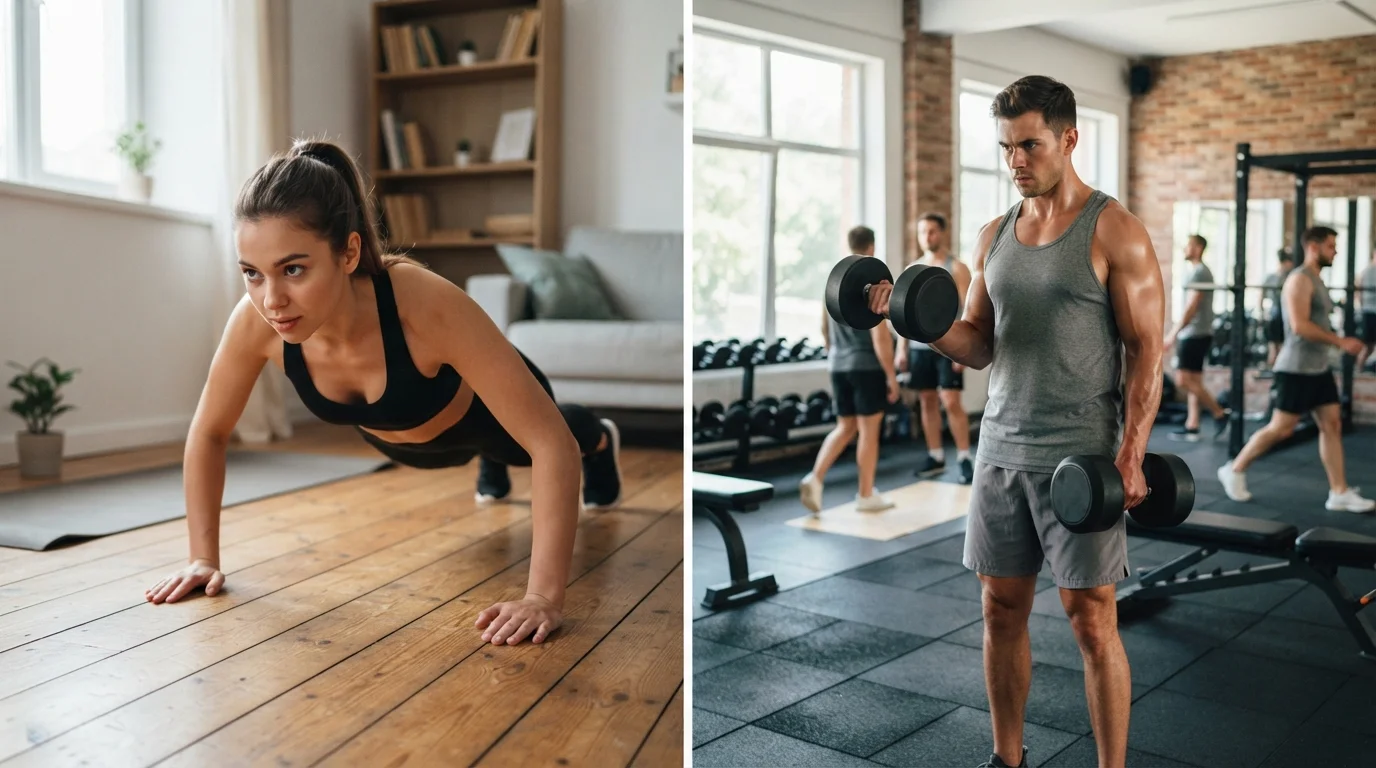
Key Takeaways
- Both bodyweight training and free weights can build strength, muscle, and endurance effectively.
- Bodyweight exercises require no equipment and offer high portability, making them easy to start.
- Free weights allow precise progressive overload, which is a key driver of muscle and strength gains.
- Your goals, access, and lifestyle matter more than which method is objectively 'superior.'
- Combining both approaches often produces the most balanced and sustainable fitness results.
Option A
Bodyweight Training
The accessible, anywhere-ready training method.
Best for: People seeking a low-barrier entry to fitness, home exercisers, and those focused on functional movement and mobility.
Option B
Free Weights
The precision-load approach for structured strength gains.
Best for: Those aiming for measurable muscle growth, progressive overload, and structured resistance training with adjustable intensity.
If you're a complete beginner with no gym access
Bodyweight Training
Bodyweight exercises have a low barrier to entry, require zero equipment, and teach fundamental movement patterns that reduce injury risk as you progress.
If your primary goal is measurable muscle growth
Free Weights
Free weights make it straightforward to apply and track progressive overload - consistently adding load over time - which research consistently links to hypertrophy.
If you travel frequently or work out at home
Bodyweight Training
No gear means no logistics. A well-designed bodyweight routine delivers a challenging, full-body workout from any room or outdoor space.
If you want to build strength for a specific sport or activity
Free Weights
Free weights let you isolate and load specific muscle groups with precision, making it easier to target the patterns most relevant to your sport or rehab goal.
If long-term joint health and mobility are your top priorities
Bodyweight Training
Many bodyweight movements naturally encourage full range-of-motion and joint stability, complementing mobility work for sustainable, injury-resistant fitness.
What Each Approach Actually Involves
Bodyweight training uses your own body mass as resistance - think push-ups, squats, lunges, pull-ups, and planks. No gym membership, no equipment budget, and no waiting for a rack to open up. The exercises are scalable; a push-up can be made easier by elevating your hands or harder by elevating your feet or adding a pause. This adaptability makes bodyweight training genuinely accessible at most fitness levels.
Free weights - typically dumbbells, barbells, and kettlebells - allow you to place a specific, measurable load on your muscles. The defining advantage is progressive overload: adding small amounts of weight over time to continually challenge your muscles. This mechanism is one of the most well-supported drivers of strength and muscle development in exercise science. Unlike fixed machines, free weights also engage stabilizing muscles because they move through space without a guided track.
Both methods stimulate muscle adaptation. The difference lies in how precisely and how far each can be pushed as you advance. If you're curious how these compare to other training modalities, see our breakdown of cardio vs. strength training for broader context.
Head-to-Head: Key Differences at a Glance
The table below compares the two approaches across the criteria that matter most to everyday exercisers.
| Criterion | Bodyweight Training | Free Weights |
|---|---|---|
| Equipment needed | None required | Dumbbells, barbells, or kettlebells |
| Cost to start | Free | Low to moderate investment |
| Location flexibility | Anywhere | Gym or equipped home space |
| Progressive overload | Possible but less precise | Precise and straightforward |
| Beginner friendliness | High | Moderate (technique required) |
| Strength ceiling | Limited without added load | Very high |
| Mobility & joint control | Naturally emphasized | Depends on exercise selection |
| Skill-based progression | Rich (handstands, levers, etc.) | Minimal |
One factor the table can't fully capture is progression ceiling. Bodyweight training can be made significantly harder through tempo manipulation, leverage changes (e.g., archer push-ups, single-leg squats), and skill-based movements like handstands or muscle-ups. However, adding resistance beyond your bodyweight typically requires equipment - a weighted vest, for instance. Free weights remove that ceiling almost entirely by allowing incremental load increases. This makes free weights the more straightforward tool once someone is pursuing serious strength goals.
Building Strength: Where the Evidence Points
Research consistently shows that resistance training - regardless of whether the resistance comes from your body or external weights - stimulates muscle protein synthesis and strength adaptation. A 2017 review published in the Journal of Human Kinetics found that bodyweight exercises performed with sufficient intensity produced comparable strength gains to machine-based resistance training in untrained individuals. The caveat: as training age increases, the difficulty of sufficiently loading muscles with bodyweight alone also increases.
~Equal
Strength gains in beginners, body weight vs. machines
A 2017 Journal of Human Kinetics review found comparable strength outcomes between bodyweight and machine resistance training in previously untrained participants.
2-3x
Bodyweight required for advanced lower-body loading
Researchers note that generating sufficient lower-body stimulus with bodyweight alone typically requires single-leg variations, as bilateral squats load each leg at roughly 60% of bodyweight.
For intermediate to advanced exercisers, free weights generally allow more targeted, measurable overload. That said, elite-level calisthenic athletes demonstrate that bodyweight training can produce impressive muscular development when taken to high levels of skill and difficulty. The honest answer is that neither method has a monopoly on results - execution, consistency, and appropriate progression matter more than the tool itself. This is one of the points our fitness myths article addresses directly: the idea that results require a specific environment or equipment is rarely supported by evidence.
Practical Considerations: Access, Cost, and Injury Risk
Bodyweight training's biggest practical advantage is accessibility. There are no upfront costs, no travel time, and no space requirements beyond a few square feet. If you're building a home routine from scratch, our guide to working out at home without equipment covers how to structure sessions and stay consistent over time.
Free weights require either a gym membership or a home investment in equipment. Entry-level dumbbell sets are widely available, but the cost scales with the weight range you need. Space and storage are also real considerations for home use.
On injury risk: both methods carry risk if form is poor or load is advanced too quickly. Free weights carry additional risk of acute injury if technique breaks down under heavy load - particularly with barbell exercises. Bodyweight training tends to have a gentler learning curve for beginners, though movements like handstands or full-range dips have their own injury considerations. Supporting your training with deliberate mobility work reduces risk with either approach.
Why Not Use Both?
Many fitness professionals recommend a hybrid approach: bodyweight movements for warm-up, mobility, and skill work, combined with free weights for the primary loading stimulus. This pairing captures the accessibility and joint-health benefits of calisthenics alongside the measurable progressive overload of weighted training. There is no rule requiring you to choose only one method.
This article is for general informational purposes only and does not constitute medical or personal fitness advice. Consult a qualified healthcare or fitness professional before beginning any new exercise program, particularly if you have an existing health condition or injury.