

Key Takeaways
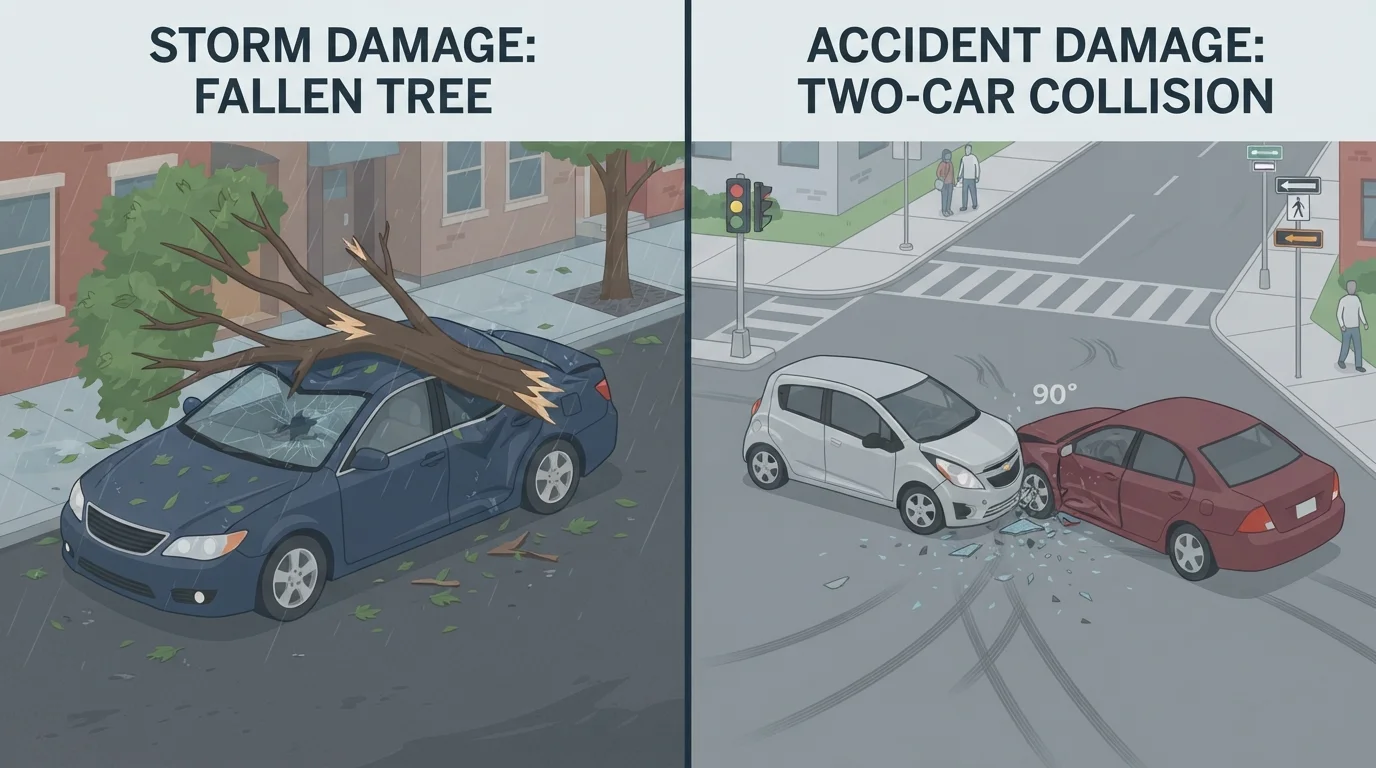
- Comprehensive covers non-collision losses such as theft, hail, floods, fire, and animal strikes.
- Collision covers damage to your vehicle resulting from crashes with other cars or objects.
- Neither coverage is legally required by state law, but lenders typically mandate both on financed vehicles.
- Both coverages are subject to your chosen deductible, which directly affects your premium.
- Dropping one or both coverages may make financial sense once a vehicle's value declines significantly.
- Understanding each coverage prevents costly surprises when you actually need to file a claim.
Option A
Comprehensive Coverage
Protection against the unexpected, non-collision events.
Best for: Drivers who want financial protection from theft, weather events, falling objects, and other hazards outside their control.
Option B
Collision Coverage
Protection when your vehicle strikes or is struck by something.
Best for: Drivers who want repair or replacement coverage when their vehicle is damaged in an accident, regardless of who is at fault.
If your vehicle is financed or leased
Both Comprehensive and Collision Coverage
Lenders and leasing companies almost universally require both coverages to protect their financial interest in the vehicle.
If you live in an area prone to severe weather, flooding, or high vehicle theft
Comprehensive Coverage
Comprehensive is the only coverage that responds to weather damage, theft, and environmental hazards - collision won't help in these scenarios.
If you frequently drive in high-traffic areas or have a longer daily commute
Collision Coverage
Higher driving exposure increases the statistical likelihood of an at-fault or multi-vehicle accident, making collision coverage especially valuable.
If your vehicle's market value is low relative to your combined deductibles and premiums
Neither - consider liability-only
When the maximum potential insurance payout barely exceeds what you'd pay in premiums and deductibles, dropping both may be the more financially sound choice.
What Each Coverage Actually Does
Despite appearing side by side on a declarations page, comprehensive and collision coverage respond to completely different types of events. Confusing the two is one of the most common misunderstandings drivers have about their own policies - a problem explored further in Everything Car Owners Get Wrong About Their Auto Insurance.
Comprehensive coverage pays to repair or replace your vehicle when it is damaged by something other than a collision. Covered events typically include theft, vandalism, fire, hail, flooding, falling objects (such as tree branches), earthquakes, and collisions with animals - for example, hitting a deer. Essentially, if something happens to your car that you couldn't prevent by simply driving more carefully, comprehensive is the coverage likely to apply.
Collision coverage pays to repair or replace your vehicle when it makes physical contact with another vehicle or a stationary object - a guardrail, a utility pole, or another car. It applies whether you are at fault or not, and it also covers single-car incidents such as rolling into a ditch or clipping a parking structure pillar. If an impact caused the damage, collision is the coverage to look at first.
| Criterion | Comprehensive Coverage | Collision Coverage |
|---|---|---|
| Primary trigger | Non-collision events | Vehicle impact or crash |
| Examples of covered losses | Theft, hail, flood, fire, animal strike | Accident with another car, hitting a pole |
| Fault requirement | Not applicable | Covers regardless of fault |
| Typical relative cost | Lower premium | Higher premium |
| Deductible applies? | Yes | Yes |
| Required by state law? | No | No |
| Often required by lenders? | Yes | Yes |
Costs, Deductibles, and How Insurers Calculate Premiums
Both comprehensive and collision are optional coverages in the sense that no state law mandates them - but optional does not mean inconsequential. Each is subject to a separate deductible: the amount you pay out of pocket before the insurer covers the remainder. Common deductible amounts range from $250 to $2,000. Choosing a higher deductible lowers your premium but increases your financial exposure after a loss.
Collision coverage is generally more expensive than comprehensive because traffic accidents are statistically more frequent and costlier to pay out than covered non-collision events. Your driving record, vehicle make and model, annual mileage, and ZIP code all influence the premium for each coverage type independently.
~6%
Average share of insured vehicles with theft claims annually
Vehicle theft and weather events consistently rank among the most frequent comprehensive claims, according to industry loss data from the Insurance Information Institute.
~72%
U.S. drivers carrying collision coverage
According to the Insurance Research Council, roughly seven in ten insured drivers carry collision coverage, making it the more widely held optional coverage type.
For a fuller breakdown of how these coverages fit into a complete auto policy, see Car Insurance Decoded.
When Lenders and Lessors Require Both
If you financed your vehicle through a bank, credit union, or dealership - or if you are leasing - you almost certainly have a contractual obligation to carry both comprehensive and collision coverage for the life of the loan or lease. The lender retains a financial interest in the vehicle until you own it outright, and these coverages protect that interest.
Dropping either coverage while a loan is active typically constitutes a breach of your financing contract. The lender may respond by placing force-placed insurance on the vehicle - a policy chosen by the lender, not you, which is frequently more expensive and narrower in scope than coverage you would select yourself.
What Is Force-Placed Insurance?
Force-placed insurance (also called lender-placed or collateral protection insurance) is a policy the lender purchases on your behalf if you allow required coverage to lapse. The cost is added to your loan balance or monthly payment. These policies generally protect only the lender's interest - not yours - and do not provide the same breadth of coverage as a standard auto policy you choose yourself.
Deciding Whether to Keep, Adjust, or Drop Coverage
Once a vehicle is paid off, the choice of whether to continue carrying comprehensive and collision coverage becomes purely a personal financial calculation. A commonly cited rule of thumb is to weigh the annual combined premium against the vehicle's actual cash value (ACV) - what the insurer would pay if the car were totaled. If the ACV minus your deductible yields a payout that barely exceeds your annual premium cost, the math starts to work against keeping the coverage.
Other factors worth weighing: how easily you could absorb the cost of replacing the vehicle without insurance, whether you drive in high-theft or severe-weather areas, and your overall risk tolerance. There is no universal answer - but there is a clear framework, covered in detail in Situations Where Dropping Full Coverage Makes Sense.
Drivers should also be aware of common gaps that arise when coverage decisions are made without a complete picture of the policy. Gaps in Auto Coverage That Leave Drivers Exposed outlines scenarios where even well-intentioned coverage choices leave drivers financially vulnerable.
This article provides general information about auto insurance coverages and is not a substitute for personalized advice from a licensed insurance professional. Coverage terms, exclusions, and requirements vary by insurer, state, and individual policy. Always review your policy documents and consult your insurer or a licensed agent before making coverage decisions.