

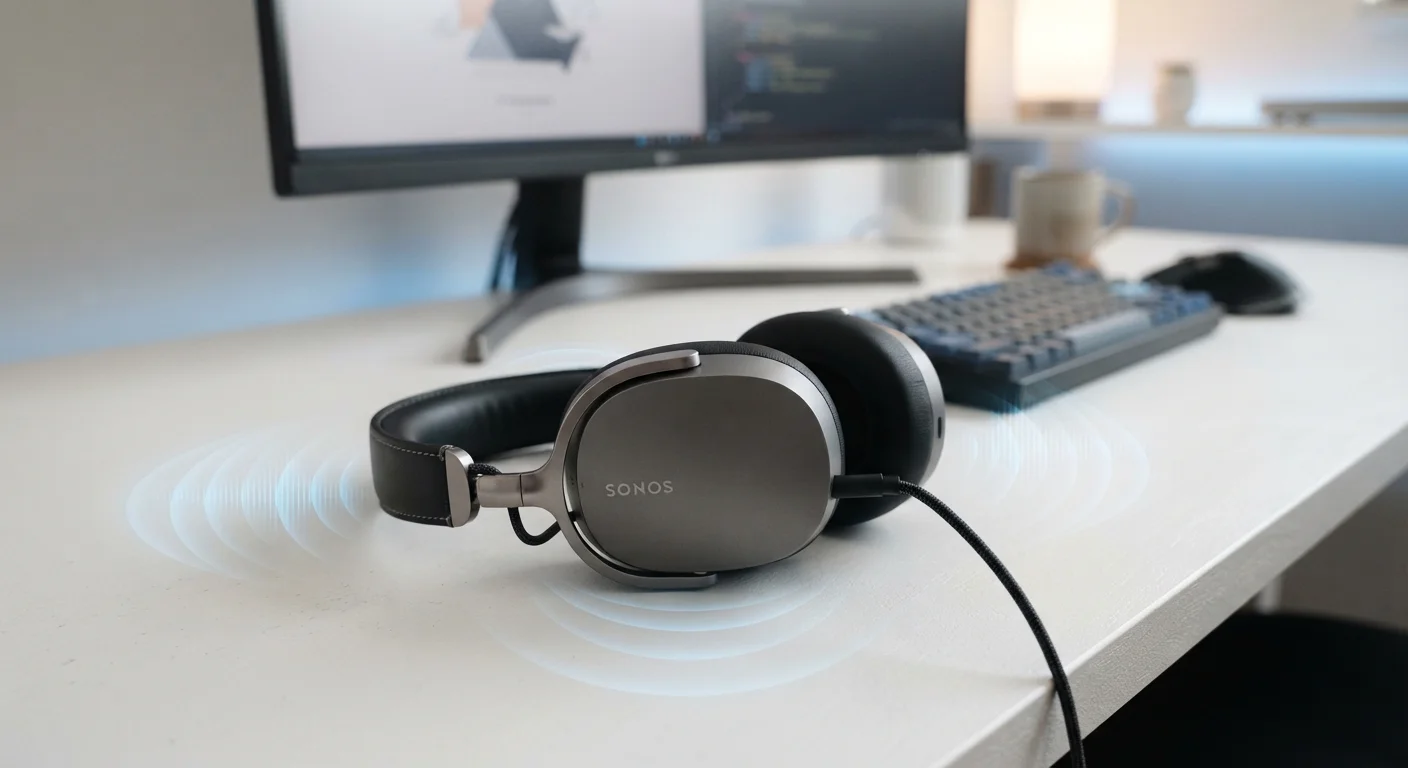
Key Takeaways
- ANC uses microphones to detect ambient sound and a processor to generate a canceling signal.
- The canceling signal is a mirror-image sound wave - called an anti-phase signal - that neutralizes incoming noise.
- ANC works best on steady, low-frequency sounds like airplane engines or air conditioning.
- Passive noise isolation (physical blocking from ear cups) works alongside ANC for better results.
- Battery power is required to run ANC; disabling it can extend listening time.
Active Noise Cancellation (ANC)
Active noise cancellation is a technology built into certain headphones that uses tiny microphones and a processor to detect surrounding sounds and generate an opposing audio signal that cancels them out. The result is a significant reduction in the ambient noise you hear - like engine hum, HVAC systems, or crowd chatter. It works in real time, making your listening environment noticeably quieter without you doing anything.
ANC targets low-frequency, continuous noise most effectively. Sudden, high-frequency sounds like speech or a snapping finger are harder to cancel because their waveforms change too quickly for the processor to counteract in time.
The Physics Behind the Quiet
Sound travels as waves - compressions and expansions of air moving outward from a source. Every sound you hear, from a jet engine to a coffee shop buzz, has a specific waveform shape. Active noise cancellation exploits a simple but powerful principle of wave physics: when two identical sound waves meet perfectly out of phase - meaning one's peak lines up with the other's trough - they cancel each other out. This is called destructive interference.
ANC headphones manufacture that canceling wave on the fly. The process happens so fast it feels instantaneous to your ears, effectively making unwanted noise disappear before it registers in your perception.
“Noise cancellation is fundamentally an acoustic engineering problem - you're trying to produce the right sound at the right place at exactly the right time. Get any one of those wrong and the cancellation falls apart.”
— Audio Engineering Society Technical Council, Professional body for audio science and engineering standards
The Three-Step Process Inside Your Headphones
Understanding ANC becomes easier when you break it into three stages:
- Detect: One or more tiny microphones - usually mounted on the outside of the ear cup - continuously sample the ambient sound around you. These are called feedforward microphones.
- Analyze: A dedicated onboard processor receives that audio signal and computes its exact inverse - a mirror-image waveform flipped 180 degrees. This happens in milliseconds.
- Cancel: The processor sends this anti-phase signal to the headphone's driver (the speaker), which plays it simultaneously with your music or simply on its own. When the anti-phase signal meets the incoming noise wave inside the ear cup, the two largely cancel out.
Some headphones also add a feedback microphone positioned inside the ear cup. This second mic listens to what you're actually hearing and feeds that data back to the processor for fine-tuned corrections - a loop that keeps the cancellation accurate even as conditions change.
Get the Most from Your ANC Headphones
Make sure the ear cups form a snug seal around your ears before turning on ANC. Even the most sophisticated active cancellation system is undermined by gaps in the physical seal that let noise leak in. If your headphones feel loose, check the headband adjustment - a better fit often makes more difference than any electronic setting.
Why ANC Handles Some Sounds Better Than Others
ANC isn't equally effective across all types of noise. The technology performs best on low-frequency, repetitive sounds - airplane cabin rumble, train vibration, HVAC drone - because these waveforms are predictable. The processor has enough time to model the wave and generate an accurate inverse before the sound reaches your eardrum.
Higher-frequency sounds - like consonant-heavy speech or a squealing brake - change shape too rapidly for the processor to keep up. By the time an anti-phase signal is calculated, the original waveform has already moved on. That's why voices in a noisy café still bleed through ANC headphones, even good ones.
20-30 dB
Typical ANC noise reduction range
Consumer ANC headphones commonly reduce ambient noise by 20 to 30 decibels, according to widely published audio engineering benchmarks - roughly equivalent to moving from a loud street to a quiet library.
~1 ms
Processor reaction time target
ANC processors aim to generate an anti-phase signal within approximately one millisecond to counteract incoming sound before it reaches the eardrum, as described in standard audio engineering literature.
This is also why passive isolation still matters. The physical design of over-ear headphones - dense padding, a sealed cup - attenuates higher frequencies that ANC misses. The two mechanisms complement each other: ANC handles the low-end rumble, physical materials dampen the highs.
What This Means When You're Choosing Headphones
Knowing how ANC works helps you set realistic expectations. If you're a frequent flyer or a regular commuter on trains or buses, ANC will make a meaningful, noticeable difference - those environments are dominated by exactly the kind of steady low-frequency noise ANC handles best. If your main concern is blocking nearby conversations in an open office, the improvement will be more modest.
ANC performance also varies with fit. A poor seal between the ear cup and your head lets in external sound that neither ANC nor passive isolation can fully compensate for. Adjusting the headband and ensuring the cups sit flush against your ears is the simplest step you can take to improve performance regardless of the technology inside.
This article is for informational purposes only. Specifications and features vary widely across products; always review manufacturer documentation for your specific device.