
End-to-End Encryption vs. Standard Encryption: What the Difference Means for Your Messages

Key Takeaways
- End-to-end encryption ensures only the sender and recipient can read a message - not even the service provider.
- Standard encryption protects data in transit or storage but lets the platform decrypt it on their servers.
- The difference determines who else, besides you, can theoretically access your private conversations.
- E2EE is not universally on by default in every app, even those that advertise encryption.
- Knowing which type your app uses helps you make smarter choices about what you share digitally.
Option A
End-to-End Encryption (E2EE)
The gold standard for private, uninterceptable messaging.
Best for: Anyone who wants their messages readable only by the sender and recipient - no exceptions.
Option B
Standard Encryption (In-Transit or At-Rest)
Broad protection that still leaves a middleman in the picture.
Best for: General data security across services where the provider needs some access to content to function.
If you share sensitive personal, financial, or medical information via messaging
End-to-End Encryption (E2EE)
Only E2EE ensures that even the platform hosting the conversation cannot access your content, significantly limiting exposure.
If you use a business email or collaborative platform that needs admin access to content
Standard Encryption
Standard encryption protects data adequately for many business tools where IT admins legitimately need visibility into communications.
If you're concerned about government data requests or data breaches affecting a platform's servers
End-to-End Encryption (E2EE)
With E2EE, even if a service's servers are breached or subpoenaed, the message content remains unreadable without the recipient's private key.
If you need broad protection for stored files, cloud backups, or website logins
Standard Encryption
Standard encryption methods like TLS and AES-256 are well-established and effective for protecting data at rest and in transit across most everyday contexts.
The Core Distinction: Who Holds the Keys?
Both types of encryption scramble your data so it can't be read without the right key - think of it as a digital lock on your information. The critical difference is who controls that lock.
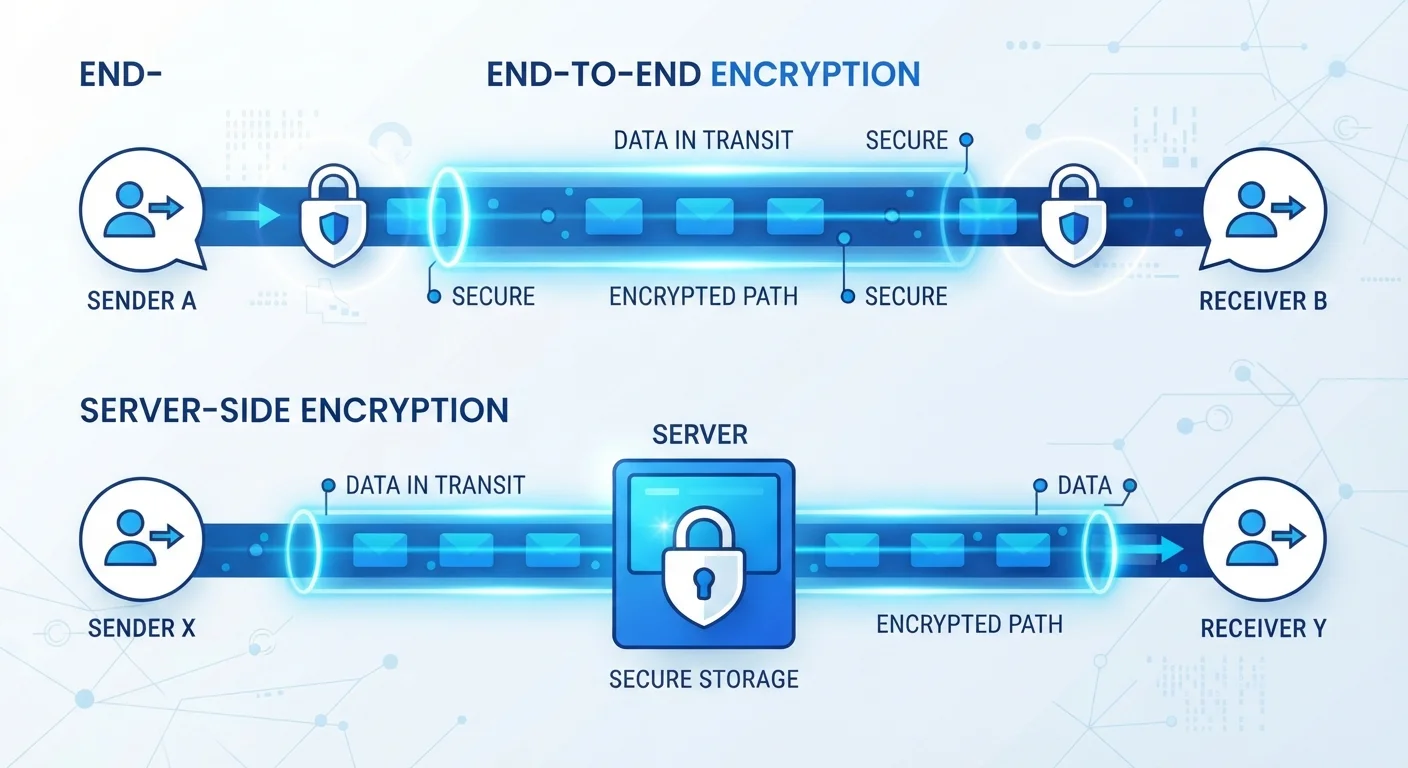
With standard encryption (sometimes called transport-layer or server-side encryption), your message is encrypted while it travels between your device and the provider's servers, and again when stored. But the service provider holds a master key. That means the company - and potentially anyone who accesses their systems - can decrypt and read your messages if needed. This is how most email services and many popular chat platforms operate.
With end-to-end encryption (E2EE), the message is encrypted on your device and only decrypted on the recipient's device. The keys never live on the provider's servers. Even the company running the messaging app cannot read what you sent. No third party in the middle - including the platform itself - can access the plaintext of your conversation.
A useful analogy: standard encryption is like sending a sealed envelope through a courier company that has a master key to all mailboxes. E2EE is like sending a locked briefcase where only you and the recipient have copies of the key.
Encryption ≠ Anonymity
Encryption protects the content of your messages, but not necessarily your identity or metadata. Even with E2EE, a platform may still log who you messaged, when, and how often - this is called metadata. If anonymity is also a concern, encryption alone is not sufficient; additional privacy tools and practices are needed.
Side-by-Side: How They Compare in Practice
These aren't abstract technical differences - they have real implications for your daily digital life. Here's how the two approaches stack up across the factors that matter most to everyday users.
| Criterion | End-to-End Encryption | Standard Encryption |
|---|---|---|
| Who can decrypt messages | Sender and recipient only | Sender, recipient, and the platform |
| Where keys are stored | On users' devices only | On the provider's servers |
| Vulnerability to server breaches | Low - content stays encrypted | Higher - platform holds decryption keys |
| Response to legal data requests | Provider cannot supply readable content | Provider may be compelled to hand over content |
| Common use cases | Private messaging apps, secure calls | Email, cloud storage, most business tools |
| Typical default status | Sometimes opt-in or app-specific | On by default across most platforms |
One nuance worth noting: some apps offer optional E2EE (requiring you to enable a "secret chat" mode, for example) while defaulting to standard encryption for convenience. Always check your app's settings and documentation to know which mode is actually active for your conversations. For a broader foundation on protecting your digital life, see our complete digital safety overview.
Why This Matters When Something Goes Wrong
The encryption model your app uses becomes especially important in two scenarios: data breaches and legal data requests.
If a company using standard encryption suffers a server breach, attackers could potentially access decrypted messages - either because the keys were stored alongside the data, or because they gained admin-level access. With E2EE, message content stolen from a server remains encrypted gibberish without the private keys stored on individual devices.
Similarly, when law enforcement or government agencies request user data, a standard-encryption platform may be required to hand over readable message content. An E2EE provider, by contrast, can truthfully say they don't have the ability to decrypt your messages - because they genuinely don't hold the keys.
82%
Of major data breaches involve data stored on servers
According to Verizon's Data Breach Investigations Report, the vast majority of breaches target centralized server-side data - exactly what standard encryption leaves more exposed.
0
Readable messages a true E2EE provider can hand over
When end-to-end encryption is correctly implemented, the service provider mathematically cannot decrypt message content, making meaningful compliance with content requests impossible.
None of this means E2EE is flawless. If someone physically accesses your unlocked phone, or if malware is installed on your device, your messages can still be compromised before encryption occurs. Device-level security remains essential - our cell phone security habits guide walks through the practical steps worth taking.
Practical Steps for Everyday Users
You don't need to be a security engineer to make smarter choices about messaging. Here's where to start:
- Verify your app's encryption model. Look for explicit language about end-to-end encryption in the app's privacy documentation - not just the word "encrypted," which can mean many things.
- Check default settings. Some apps only enable E2EE in specific chat modes. Make sure E2EE is active for conversations where privacy matters most.
- Consider your content. Casual group chats may not need the same protection as messages containing financial details, medical information, or sensitive personal matters.
- Keep devices secure. E2EE protects messages in transit and on servers - but not on an unlocked, unprotected device sitting on a table.
If you're just getting started thinking about your online privacy more broadly, our plain-English privacy starting point covers the essential groundwork without requiring any technical background.