

Key Takeaways
- Buying builds equity over time but carries significant upfront costs and ongoing maintenance responsibilities.
- Renting offers flexibility and predictable short-term expenses but provides no return on monthly payments.
- Local market conditions, your timeline, and financial stability all heavily influence which option makes more sense.
- Neither renting nor buying is universally superior - the right choice depends on your specific situation.
- The true cost of homeownership extends well beyond the mortgage payment itself.
Our Verdict
Buying a home can build long-term wealth and provide stability, but it demands financial readiness, a longer time horizon, and tolerance for ongoing costs. Renting keeps your options open and your expenses more predictable in the short term, though it offers no equity accumulation. The stronger choice is whichever aligns with your financial position, how long you plan to stay, and what you value most in daily life.
| Best for | Recommended |
|---|---|
| Those planning to stay in one place for five or more years with stable income | Buying |
| Those who prioritise flexibility or are early in their careers | Renting |
| Those with limited savings or high existing debt | Renting |
| Those seeking long-term wealth building and are financially prepared | Buying |
The Core Trade-Off: Control vs. Flexibility
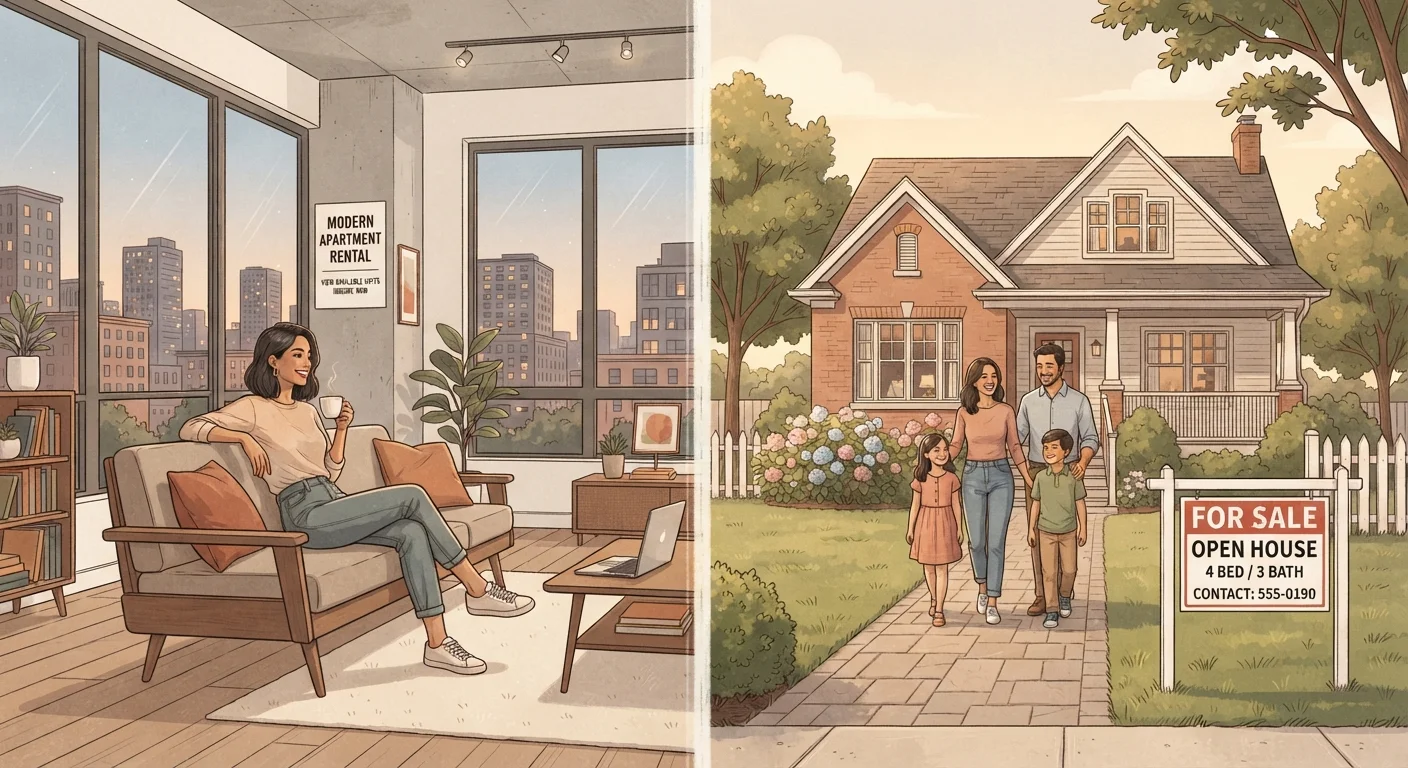
The renting vs. buying debate is fundamentally about what you value more right now - the stability and control of ownership, or the mobility and simplicity of renting. Neither path is wrong; they reflect different life stages, financial realities, and priorities.
Renters gain flexibility: you can relocate for a job, downsize after a life change, or simply avoid the complexity of property maintenance. Buyers gain control: you can renovate, build equity, and establish roots. The challenge is that most people are comparing these options at a moment when their finances, career, and personal goals are all in motion.
One useful framework is the breakeven horizon - the number of years it takes for buying to become financially equivalent to renting in a given market. In many US cities, this ranges from four to seven years. If you expect to move sooner, renting is often the more financially sound choice, even if home prices are rising.
The Real Costs of Buying a Home
The mortgage payment is just the beginning. First-time buyers are often surprised by the full financial picture. Understanding upfront costs like earnest money, down payments, and closing costs is essential before committing. Closing costs alone typically range from 2% to 5% of the purchase price.
Ongoing homeownership expenses include:
- Property taxes: Vary widely by state and municipality, often adding thousands per year.
- Homeowners insurance: Required by lenders and subject to rate increases.
- Maintenance and repairs: Industry estimates commonly suggest budgeting 1%-2% of the home's value annually, though actual costs vary significantly.
- HOA fees: Applicable in many communities, ranging from modest to substantial monthly charges.
- Mortgage interest: In the early years of a fixed-rate loan, the bulk of each payment covers interest, not principal.
Choosing between a fixed-rate or adjustable-rate mortgage adds another layer of complexity, with each structure carrying distinct risks. For a detailed walkthrough of what happens after you've found a home, see the home buying process from offer to closing.
| Renting | Buying | |
|---|---|---|
| Upfront costs | Security deposit, first/last month | Down payment, closing costs (2-5%) |
| Monthly cost predictability | Fixed for lease term | Variable (taxes, maintenance, insurance) |
| Equity accumulation | None | Builds over time with payments and appreciation |
| Flexibility to relocate | High - move at lease end | Low - selling takes time and money |
| Maintenance responsibility | Landlord handles most repairs | Owner bears full cost |
| Customisation freedom | Limited by landlord rules | Full control within local codes |
| Exposure to market risk | Rent increases at renewal | Property value can decline |
| Ideal time horizon | Short to medium term (under 5 years) | Long term (5+ years typically) |
The Real Costs of Renting
Renting is sometimes framed as "throwing money away," but this misrepresents the actual financial picture. Renters pay for a place to live - just as buyers pay mortgage interest and maintenance costs that also don't build equity. The key difference is that rent payments are predictable and finite for the lease term, with no surprise repair bills.
What renters typically spend on includes monthly rent, renter's insurance (generally low-cost but important), and utility costs not bundled into the lease. What renters avoid includes property taxes, major repairs, and the opportunity cost of tying up a large down payment in a single illiquid asset.
Renter's Insurance Is Often Overlooked
Many renters skip renter's insurance, not realising it typically costs only a modest amount per month. It covers personal belongings against theft, fire, and certain other losses - and may also include liability coverage. It's one of the more cost-effective protections available to renters and is worth factoring into your true monthly housing cost.
That said, renters are exposed to rent increases at lease renewal, limited control over their living space, and potential displacement if a landlord sells or redevelops the property. In high-demand markets, rent appreciation can outpace income growth, eroding the affordability advantage over time.
Sound budgeting fundamentals apply equally whether you rent or own - tracking housing costs as a share of take-home pay is a discipline both groups benefit from.
Equity, Wealth Building, and the Investment Question
Homeownership is often cited as a primary wealth-building vehicle for American households. Over long time horizons, this has historically held true for many owners - but it comes with caveats. Home values can stagnate or decline, particularly in markets experiencing population loss, economic downturns, or oversupply.
Equity - the portion of the home's value you actually own - grows as you pay down your mortgage and, in appreciating markets, as the property's value increases. This equity can be accessed through refinancing or a sale, or leveraged for other financial goals. For those interested in how property investment works beyond primary residence, the landlord side of property investment explores the responsibilities and risks involved.
65.6%
US homeownership rate
According to the US Census Bureau, roughly two-thirds of American households own their home, a share that has remained relatively stable over the past decade.
2%-5%
Typical closing cost range
The Consumer Financial Protection Bureau notes that closing costs for home purchases generally fall between 2% and 5% of the loan amount, a substantial upfront expense for buyers.
30%
Recommended housing cost ceiling
A widely cited guideline in personal finance holds that housing costs - rent or mortgage - should generally not exceed 30% of gross monthly income.
Renters who invest the difference between renting and ownership costs - including the down payment - into diversified financial instruments may build comparable or greater wealth depending on market conditions and personal discipline. No single strategy is guaranteed. As with all financial decisions, consulting a licensed financial adviser about your specific circumstances is advisable.
This article is for general informational and educational purposes only. It does not constitute financial, legal, or investment advice. Readers should consult qualified professionals before making housing or financial decisions.