

Key Takeaways
- Whole-home humidifiers treat every room simultaneously, unlike portable units that cover one space at a time.
- Incorrect humidity levels - too high or too low - can damage your home and affect respiratory comfort.
- These systems require periodic professional maintenance, including filter and water panel replacement.
- Installation costs are significant upfront but per-year operating costs are often lower than running multiple portable units.
- A hygrometer is essential for calibrating output and verifying the system is working within healthy ranges.
Treats the entire home with one system
Because the humidifier ties into your central ductwork, every room receiving conditioned air benefits simultaneously - no repositioning portable units or leaving bedrooms unaddressed.
No manual tank refilling required
A direct connection to the home's water supply eliminates the daily or twice-daily refills required by portable units, reducing hands-on effort significantly.
Can protect wood surfaces and finishes
Maintaining adequate humidity levels helps prevent hardwood floors, wood furniture, and trim from drying out, cracking, or separating - issues that can be expensive to repair.
Quieter and less obtrusive than portable units
Integrated systems operate within the ductwork rather than sitting on a floor or countertop, eliminating the noise and visual clutter of multiple portable humidifiers running in different rooms.
Automated humidity control via humidistat
The built-in humidistat cycles the unit on and off to maintain a target humidity level without constant manual adjustment, similar to how a thermostat manages temperature.
Significant upfront installation cost
Professional installation involves integrating the unit into ductwork, a water supply line, and a drain - a job that requires a licensed HVAC technician and carries costs that vary considerably by region and system type.
Requires regular maintenance to function safely
Water panels (also called evaporator pads) need replacement at least annually, and more often in areas with hard water. Neglecting this allows mineral scale buildup that reduces efficiency and can harbor bacteria.
Over-humidification risk is serious
A miscalibrated humidistat or malfunctioning unit can push indoor humidity above 50%, promoting mold growth in wall cavities, around windows, and in attic spaces - damage that is both costly and health-relevant.
Only works with forced-air HVAC systems
Homes heated by radiators, mini-splits, or radiant floor systems cannot use a duct-mounted whole-home humidifier without a separate air handler - limiting who can practically benefit.
Steam models increase electricity consumption
Steam humidifiers generate moisture by electrically heating water, which can meaningfully increase utility bills in climates where the system runs frequently through a long heating season.
Our Verdict
Whole-home humidifiers deliver real, measurable benefits for households in dry climates or those with hardwood floors, wood furniture, or residents sensitive to dry air. However, they aren't a set-it-and-forget-it solution - improper calibration or skipped maintenance can introduce moisture problems that are costly to fix. Weigh upfront installation costs and ongoing maintenance demands honestly before committing.
Best for homeowners in consistently dry climates who already have forced-air heating and are willing to schedule annual maintenance and monitor indoor humidity levels.
What Whole-Home Humidifiers Actually Do
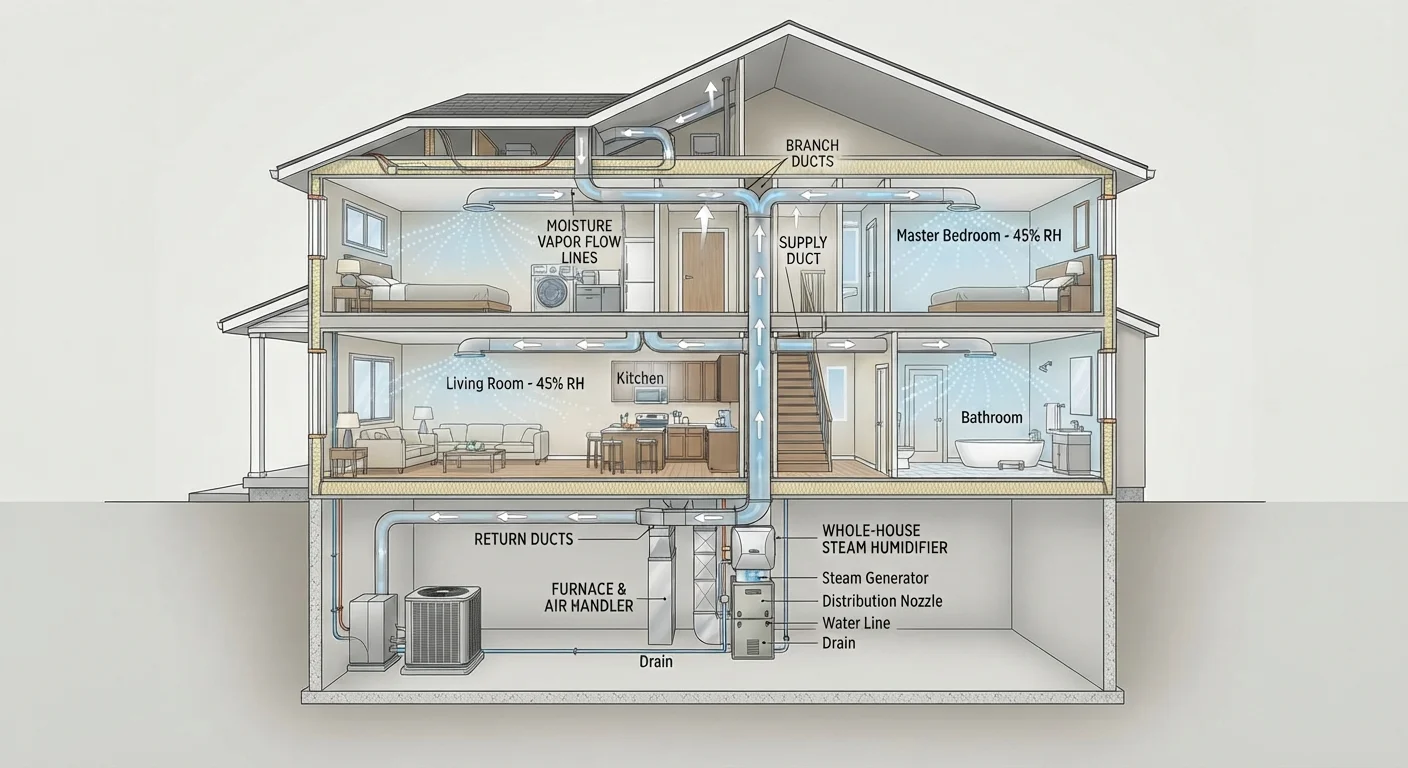
A whole-home humidifier - sometimes called a central or furnace-mounted humidifier - integrates directly into your home's existing forced-air HVAC system. Rather than treating a single room, it adds moisture to the air as it circulates through the ductwork, distributing humidity throughout every connected space in the house.
There are three common types: bypass humidifiers (which route air through a water panel and back into the furnace), fan-powered humidifiers (which use a dedicated motor to push air across the water panel independently), and steam humidifiers (which generate moisture by heating water electrically). Each differs in how much humidity it can produce and what kind of maintenance it demands.
Unlike portable units, these systems connect to your home's water supply, eliminating the need to manually refill a tank. They're controlled by a humidistat - a sensor that monitors indoor humidity and cycles the unit on and off to maintain a target level, similar to how a thermostat controls temperature.
Understanding this basic setup matters because most of the tradeoffs discussed below flow directly from how the system is installed, calibrated, and maintained - not from the concept of humidification itself. For a useful parallel on evaluating whole-home systems before purchase, see our guide to whole-home water filter types.
The Case For: Real Benefits Worth Considering
The advantages of a whole-home humidifier are most apparent during winter months when forced-air heating strips indoor air of moisture.
Treats the entire home with one system
Because the humidifier ties into your central ductwork, every room receiving conditioned air benefits simultaneously - no repositioning portable units or leaving bedrooms unaddressed.
No manual tank refilling required
A direct connection to the home's water supply eliminates the daily or twice-daily refills required by portable units, reducing hands-on effort significantly.
Can protect wood surfaces and finishes
Maintaining adequate humidity levels helps prevent hardwood floors, wood furniture, and trim from drying out, cracking, or separating - issues that can be expensive to repair.
Quieter and less obtrusive than portable units
Integrated systems operate within the ductwork rather than sitting on a floor or countertop, eliminating the noise and visual clutter of multiple portable humidifiers running in different rooms.
Automated humidity control via humidistat
The built-in humidistat cycles the unit on and off to maintain a target humidity level without constant manual adjustment, similar to how a thermostat manages temperature.
30-50%
Recommended indoor relative humidity range
The U.S. Environmental Protection Agency advises keeping indoor humidity between 30% and 50% to balance comfort and minimize conditions that support mold or dust mites.
~10-20%
Typical indoor humidity drop during winter heating
Forced-air heating systems can reduce indoor relative humidity significantly during cold months, especially in northern climates with long heating seasons and tight building envelopes.
Beyond comfort, correctly humidified air can help protect wood floors, furniture, musical instruments, and even painted drywall from cracking or warping caused by excessively dry conditions. Many homeowners in northern states with long heating seasons report less static electricity and reduced symptoms of dry skin, chapped lips, and irritated sinuses - though individual responses vary and this is general information, not medical guidance.
From a practical standpoint, a single integrated unit is also quieter and less intrusive than running two or three portable humidifiers in different rooms, each needing separate monitoring and tank refills.
The Case Against: Tradeoffs That Matter
The disadvantages of whole-home humidifiers are real and often underestimated at the point of purchase.
Significant upfront installation cost
Professional installation involves integrating the unit into ductwork, a water supply line, and a drain - a job that requires a licensed HVAC technician and carries costs that vary considerably by region and system type.
Requires regular maintenance to function safely
Water panels (also called evaporator pads) need replacement at least annually, and more often in areas with hard water. Neglecting this allows mineral scale buildup that reduces efficiency and can harbor bacteria.
Over-humidification risk is serious
A miscalibrated humidistat or malfunctioning unit can push indoor humidity above 50%, promoting mold growth in wall cavities, around windows, and in attic spaces - damage that is both costly and health-relevant.
Only works with forced-air HVAC systems
Homes heated by radiators, mini-splits, or radiant floor systems cannot use a duct-mounted whole-home humidifier without a separate air handler - limiting who can practically benefit.
Steam models increase electricity consumption
Steam humidifiers generate moisture by electrically heating water, which can meaningfully increase utility bills in climates where the system runs frequently through a long heating season.
Installation typically requires a licensed HVAC technician and involves tapping into the ductwork, water supply line, and drain - costs that vary by region and system type but are rarely trivial. Steam humidifiers, while capable of the highest output, also draw significant electricity.
The more serious risk is over-humidification. If the humidistat is miscalibrated or the system malfunctions, excess moisture can accumulate in wall cavities, attic spaces, and around windows - conditions that promote mold and structural damage. This risk is especially pronounced in well-sealed, energy-efficient homes where moisture has fewer natural escape routes. Homeowners should also be aware that hard water accelerates mineral buildup on the water panel, requiring more frequent cleaning in affected areas.
Hard Water Accelerates Maintenance Needs
In areas with hard water - water with high concentrations of dissolved minerals like calcium and magnesium - water panels and internal components accumulate scale much faster than in soft-water areas. If your home uses hard water, check the manufacturer's maintenance schedule and plan to replace the water panel more frequently than the standard annual recommendation. A water softener installed upstream of the humidifier can reduce this issue but adds its own maintenance and cost considerations.
How to Approach the Decision Practically
Before committing, audit your current indoor humidity. A basic digital hygrometer (a humidity gauge) costs under $20 at most hardware stores and gives you a factual baseline. The Environmental Protection Agency generally recommends keeping indoor relative humidity between 30% and 50%. If your home routinely drops below 30% during winter despite reasonable weatherizing, a whole-home system deserves serious consideration.
If your home doesn't have existing forced-air ductwork, a central humidifier isn't an option - portable units or other solutions would need to be evaluated separately. Similarly, if your HVAC system is aging and due for replacement, it may make sense to plan the humidifier installation alongside that larger project rather than retrofitting now.
Budget not just for installation but for annual maintenance: water panels typically need replacing once or twice a year depending on water hardness and usage. Factor in the cost of a service visit if you're not comfortable performing that yourself.
For households considering multiple smart or connected home upgrades in parallel, the smart home device planning checklist offers a useful framework for prioritizing investments by compatibility and practical value.
This article provides general home improvement information for educational purposes only. Consult a licensed HVAC professional for advice specific to your home's system and local building requirements.