

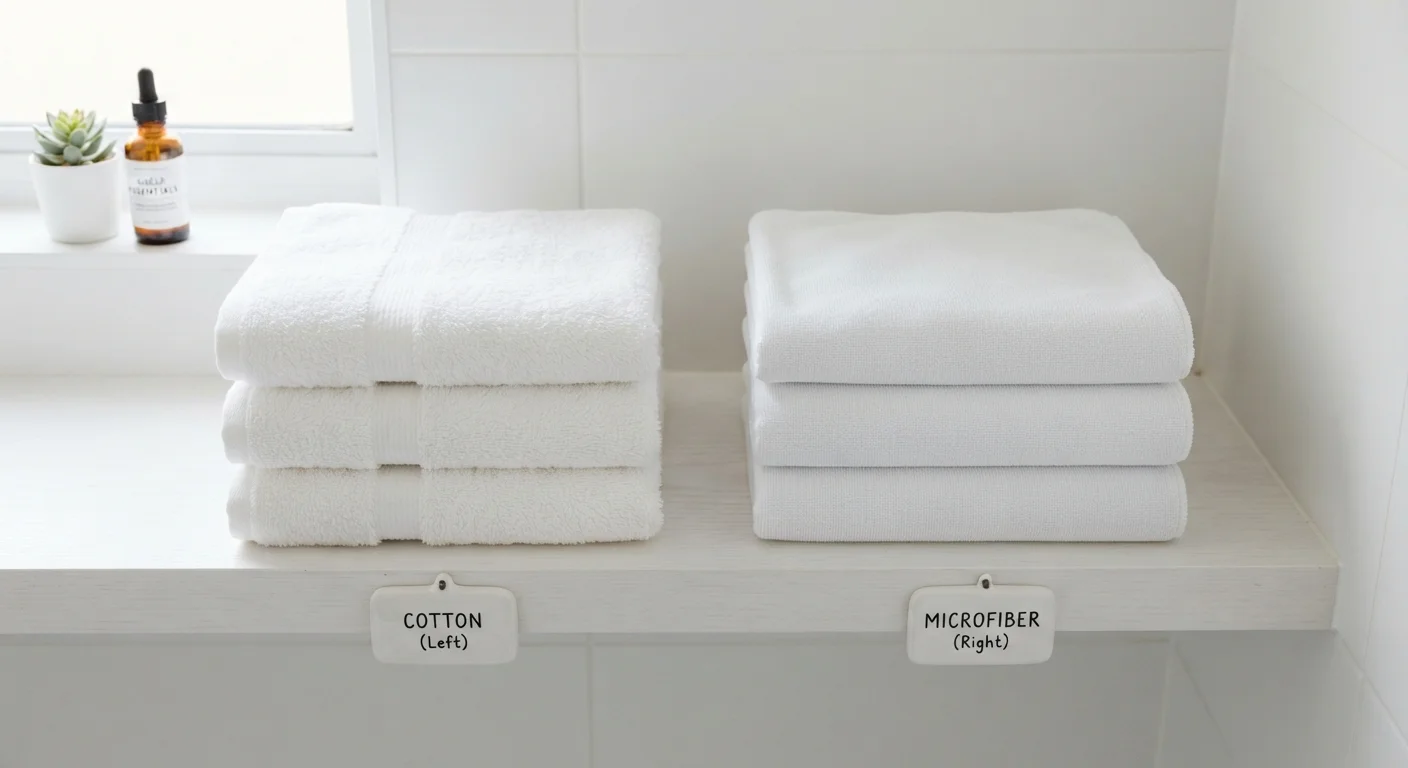
Key Takeaways
- Microfiber towels dry significantly faster than cotton and resist mildew better in humid bathrooms.
- Cotton towels often become softer with repeated washing but take longer to fully dry between uses.
- Microfiber's synthetic fibers can degrade when washed with fabric softener or at high heat.
- Cotton holds up well to hot-water washing, making it easier to sanitize thoroughly.
- Longevity depends heavily on care habits - both materials can last years with proper washing routines.
- Cotton is a natural fiber; microfiber is typically made from polyester-polyamide blends, a synthetic plastic-derived material.
Option A
Microfiber Towels
The fast-drying, lightweight modern option.
Best for: Households that prioritize quick drying times, travel, or gym use where compact storage matters.
Option B
Cotton Towels
The familiar, plush everyday standard.
Best for: Households that value softness, breathability, and a traditional feel after showering.
If you want faster drying and fewer odor issues between washes
Microfiber Towels
Microfiber dries in roughly half the time of cotton, reducing the moisture window where mildew and odor develop.
If you prefer a soft, plush feel and simpler care instructions
Cotton Towels
Cotton is forgiving in the wash, tolerates higher temperatures, and typically feels more familiar for everyday bathing use.
If you're concerned about environmental impact and synthetic materials
Cotton Towels
Cotton is biodegradable and does not shed microplastic particles during laundering, which is an ongoing concern with synthetic microfiber.
If you travel frequently or need compact, lightweight towels
Microfiber Towels
Microfiber packs down smaller and lighter than cotton equivalents, making it a practical choice for travel bags and gym kits.
How Each Material Actually Works
Understanding what each towel is made of clarifies why they perform so differently. Cotton towels are woven from natural cellulose fibers - the same plant-based material found in most everyday clothing. Their loop structure (called terry weave) traps water through absorption. The more loops per square inch, generally the more water the towel can hold.
Microfiber is a synthetic material, typically a blend of polyester and polyamide (nylon), woven into extremely fine filaments - often finer than a strand of silk. Rather than absorbing water the way cotton does, microfiber primarily pulls moisture away through capillary action, drawing water into tiny spaces between fibers. This is why microfiber feels almost squeegee-like compared to cotton's soaking sensation.
For a broader look at how fiber types affect fabric behavior, see our fabric basics guide covering common materials and their practical trade-offs.
| Criterion | Microfiber | Cotton |
|---|---|---|
| Drying speed | Dries in roughly half the time | Takes longer; stays damp longer |
| Absorbency feel | Wicks moisture via capillary action | Soaks up water through absorption |
| Softness after washing | Can stiffen if care rules ignored | Often softens with repeated washing |
| Washing temperature tolerance | Cold to warm only; no high heat | Tolerates hot water washing well |
| Fabric softener compatibility | Avoid - degrades performance | Compatible; adds softness |
| Microplastic shedding | Sheds microplastics when washed | None; natural fiber |
| Weight and packability | Lightweight, compact | Heavier, bulkier |
| Material origin | Synthetic (polyester/polyamide) | Natural (plant-based cellulose) |
Durability and Longevity: What Holds Up Over Years of Use
Both towel types can last several years - but they age differently, and their vulnerabilities differ too.
Cotton generally becomes softer with repeated washing in the early stages of its life. Over time, repeated high-heat drying can break down fibers and reduce absorbency, but hot-water washing is actually safe and effective for sanitizing. Cotton towels typically show wear as thinning, pilling, or fraying at the edges rather than sudden failure.
Microfiber has a specific weakness: fabric softener. The conditioning agents coat the synthetic fibers and reduce their moisture-wicking capability - sometimes permanently. High dryer heat can also melt or fuse fine fibers together, degrading the towel's texture and performance. With proper care (cold or warm wash, no softener, low heat dry), microfiber can maintain its performance for hundreds of wash cycles.
~50%
Faster drying time vs. cotton
Microfiber towels are generally reported to dry in roughly half the time of comparable cotton towels under typical household conditions.
200+
Wash cycles microfiber can sustain
With correct care - no fabric softener, low heat - quality microfiber towels are commonly rated to maintain performance for 200 or more wash cycles.
The practical takeaway: microfiber rewards careful laundering habits, while cotton is more forgiving of everyday washing variation. If you already follow careful care routines for your household textiles - as outlined in these fabric care habits - microfiber fits naturally into that approach.
Environmental and Everyday Use Considerations
Microfiber's environmental profile is more complicated than its performance suggests. Because it is made from plastics, microfiber sheds tiny synthetic particles (microplastics) during washing. These particles pass through most wastewater treatment systems and enter waterways. This is a documented, ongoing environmental concern - not a settled issue, but one worth factoring into a long-term household decision.
Cotton is biodegradable and does not shed microplastics. However, conventional cotton farming is water- and pesticide-intensive. Organic cotton options reduce chemical use but are typically more expensive upfront.
A Note on Microplastics and Laundry
Research into microplastic shedding from synthetic textiles is ongoing, and the long-term ecological impacts are still being studied. Some laundry bags and filters are designed to capture microfibers before they reach wastewater. If microplastic reduction is a priority for your household, these tools may be worth researching - though they do not eliminate shedding entirely.
For daily bathroom use, cotton remains the default choice for most households - it's familiar, widely available, and tolerant of varied wash conditions. Microfiber earns its place in travel bags, gym kits, and households that actively maintain proper care habits and value its drying speed. Neither towel type is universally superior - the right choice depends on how you use and care for your linens.